
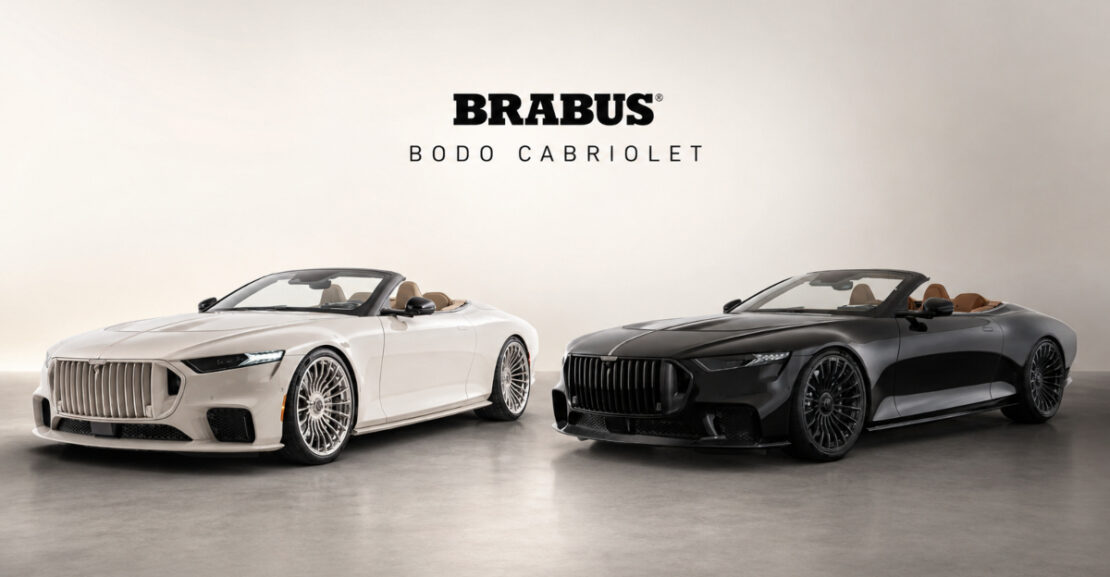
There are convertibles designed around elegance.
Others around performance.
The BRABUS BODO Cabriolet attempts to combine both at a scale few modern automobiles dare to explore.
Long.
Wide.
Low.
Powered by a 1,000-horsepower twin-turbocharged V12.
Wrapped in a completely bespoke carbon-fibre body.
And limited to just 77 examples worldwide.
Yet the story behind the BODO Cabriolet extends far beyond performance figures.
This is the open-top counterpart to the BRABUS BODO Gran Turismo Coupé and one of the most personal automobiles ever created by the Bottrop-based company. Its name honours Bodo Buschmann, founder of BRABUS, while the project itself fulfils an idea shared by Bodo and his son Constantin almost two decades ago: to create a grand tourer developed entirely around the BRABUS philosophy rather than simply modifying an existing production car.
The result is something considerably more ambitious than another tuned luxury convertible.
It is BRABUS moving into modern coachbuilding.
The BODO Story
For almost five decades, BRABUS has built its reputation by transforming already powerful automobiles into something faster, more individual and considerably more dramatic.
Mercedes-Benz provided the foundation for much of that history.
Later came smart, Porsche, Rolls-Royce and other manufacturers.
But the BODO programme represents something different.
Rather than beginning with a production car and visually preserving most of its original identity, BRABUS has used the mechanical architecture as the foundation for an automobile with its own proportions, bodywork and design language.
The name makes the intention deeply personal.
Bodo Buschmann founded BRABUS in 1977, and his passion for powerful open-top grand tourers strongly influenced the Cabriolet project. The new model therefore becomes both a continuation of the company’s engineering philosophy and a tribute from Constantin Buschmann to his father.
That explains another number appearing repeatedly throughout the car.
77.
Only 77 Cabriolets
Production of the BODO Cabriolet is limited to 77 cars worldwide, built as a separate series from the BODO Coupé.
That number directly references BRABUS’s foundation in 1977.
The motif appears throughout the vehicle rather than simply on a numbered plaque.
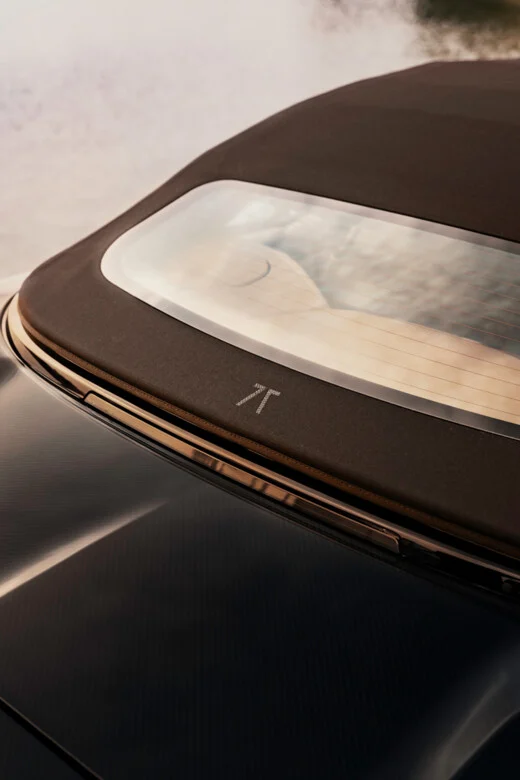
It is integrated into the roof.
Placed beneath the rear window.
And incorporated into the broader visual identity of the car.
For a project named after the company’s founder, the symbolism feels entirely appropriate.
Aston Martin Foundations, BRABUS Identity
Beneath the transformation lies the architecture of the Aston Martin Vanquish Volante.
That provides the BODO Cabriolet with an exceptional starting point.
Front-mounted V12 power.
Rear-wheel drive.
A long-wheelbase grand touring layout.
And a 2+2 cabin capable of combining serious performance with genuine long-distance usability.
But visually, very little remains recognisable.
BRABUS BODO — A V12 Tribute to Legacy, Power and Presence
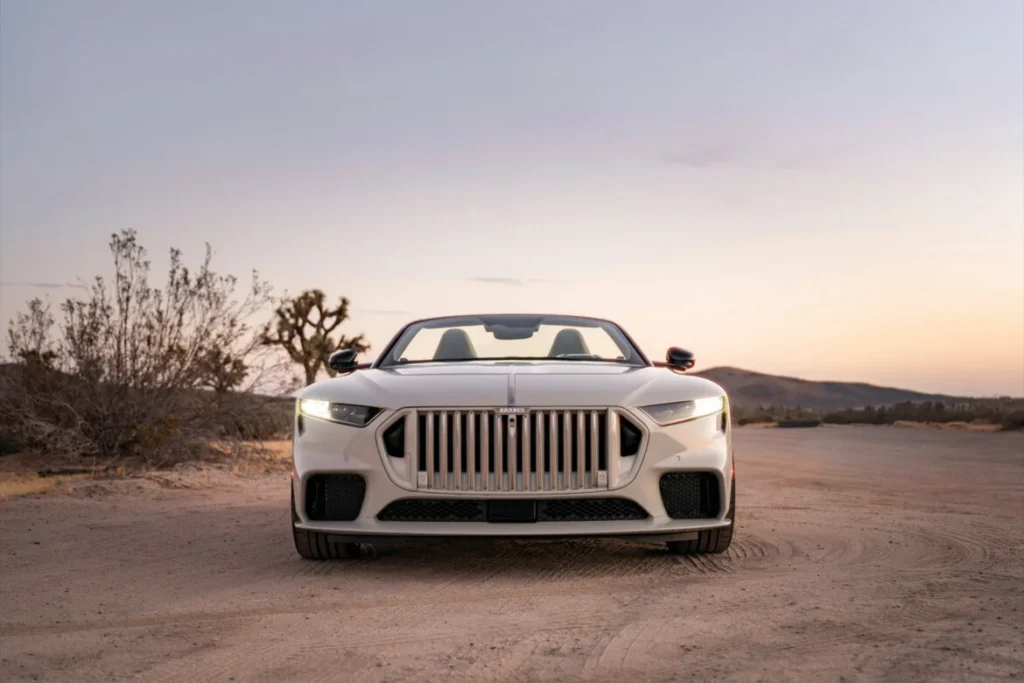
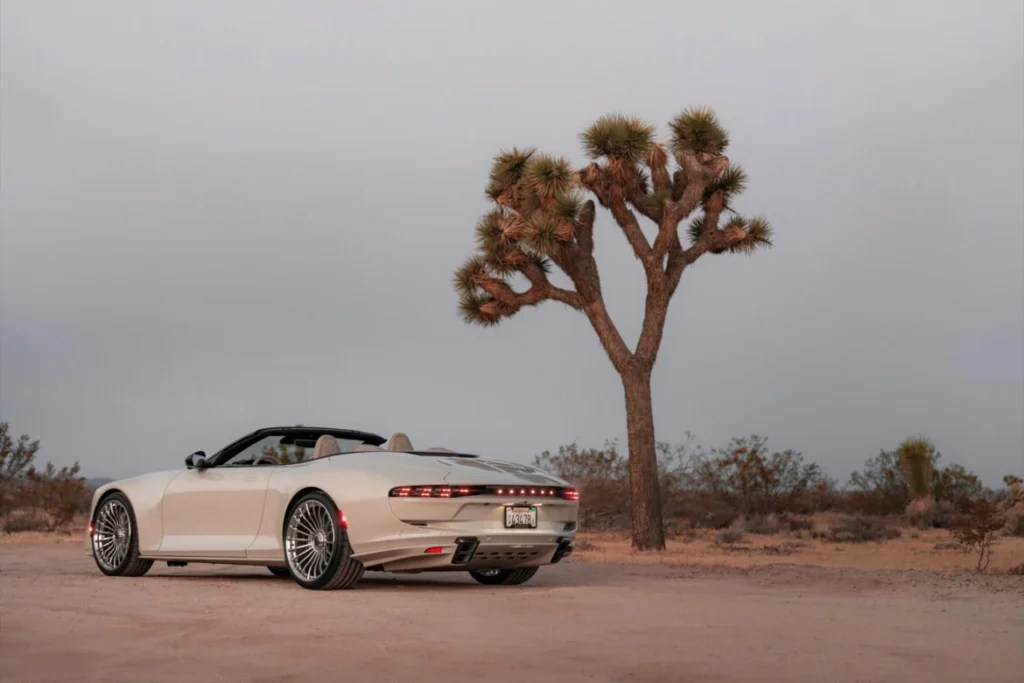
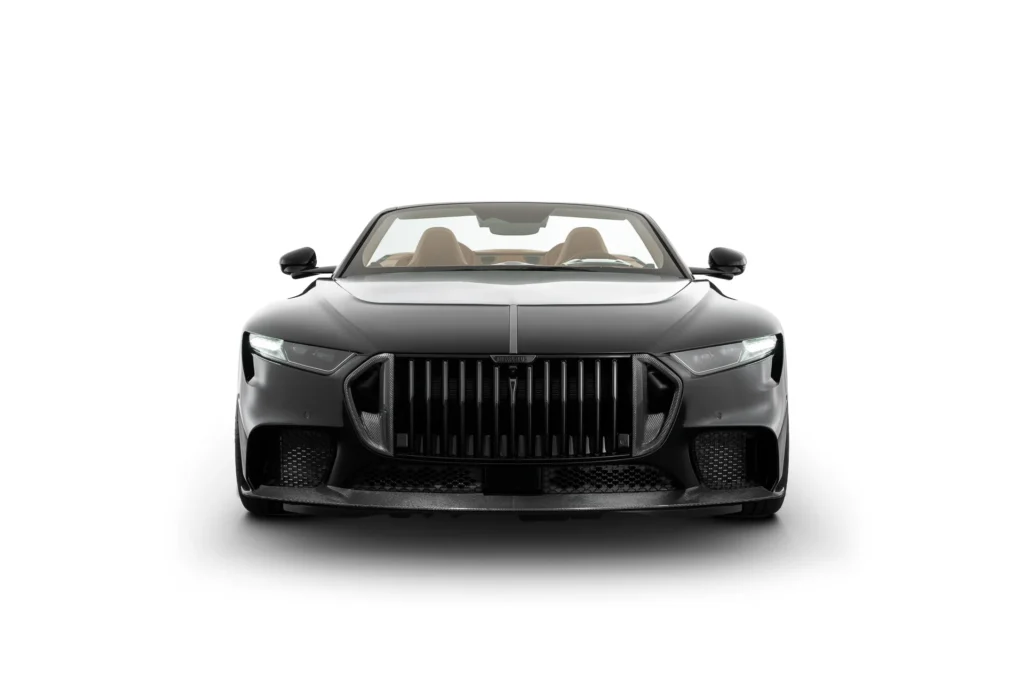
BRABUS replaces the exterior with a bespoke coachbuilt carbon-fibre body developed specifically around its own design language.
The proportions become more exaggerated.
The surfaces cleaner.
The stance more imposing.
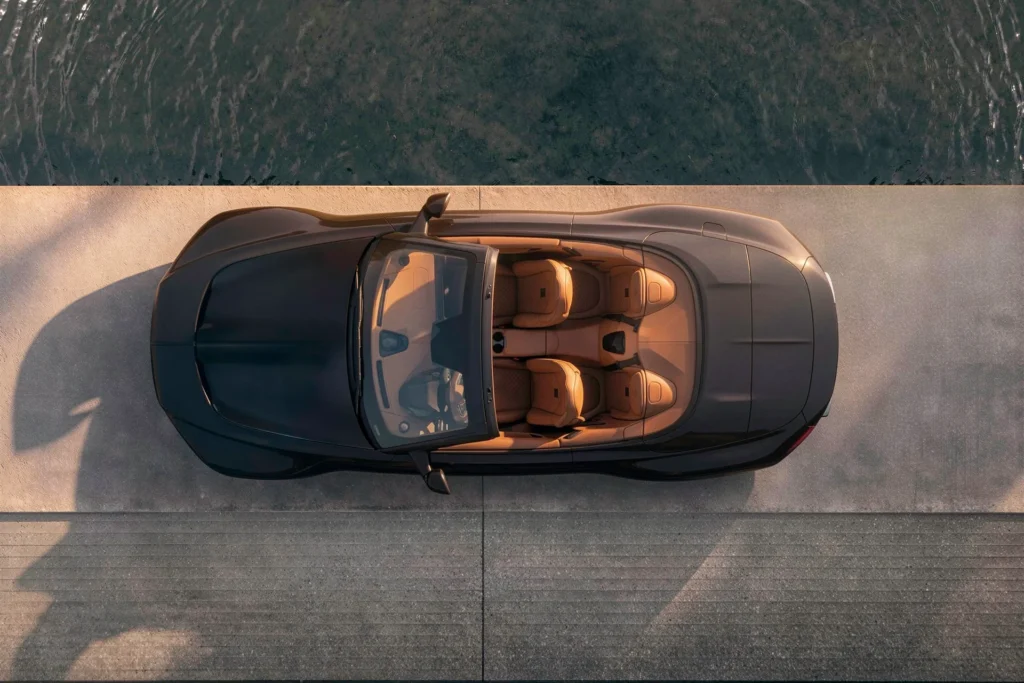
At 5,062 mm long, 2,027 mm wide and only 1,305 mm high, the BODO Cabriolet possesses the kind of dimensions once associated with enormous luxury convertibles rather than contemporary supercars.
It is not compact.
It does not want to be.
The Bodo Line
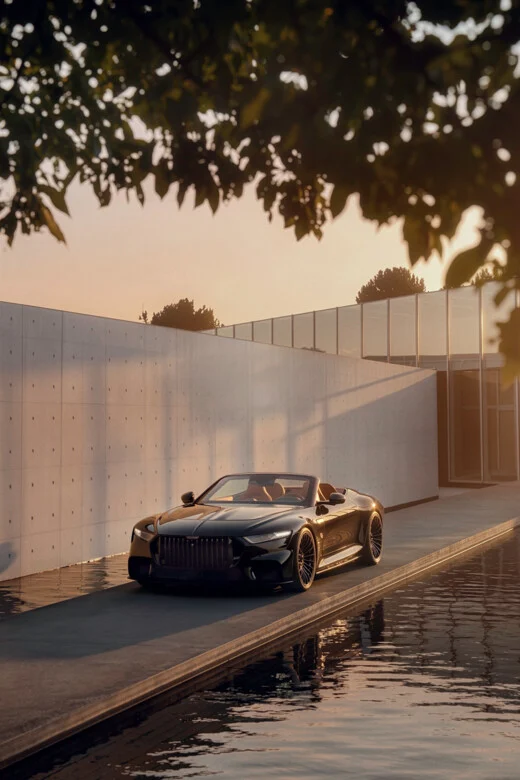
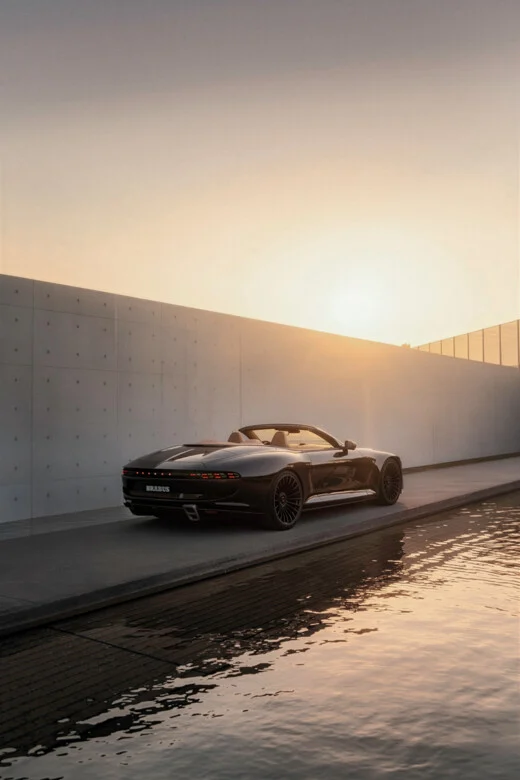
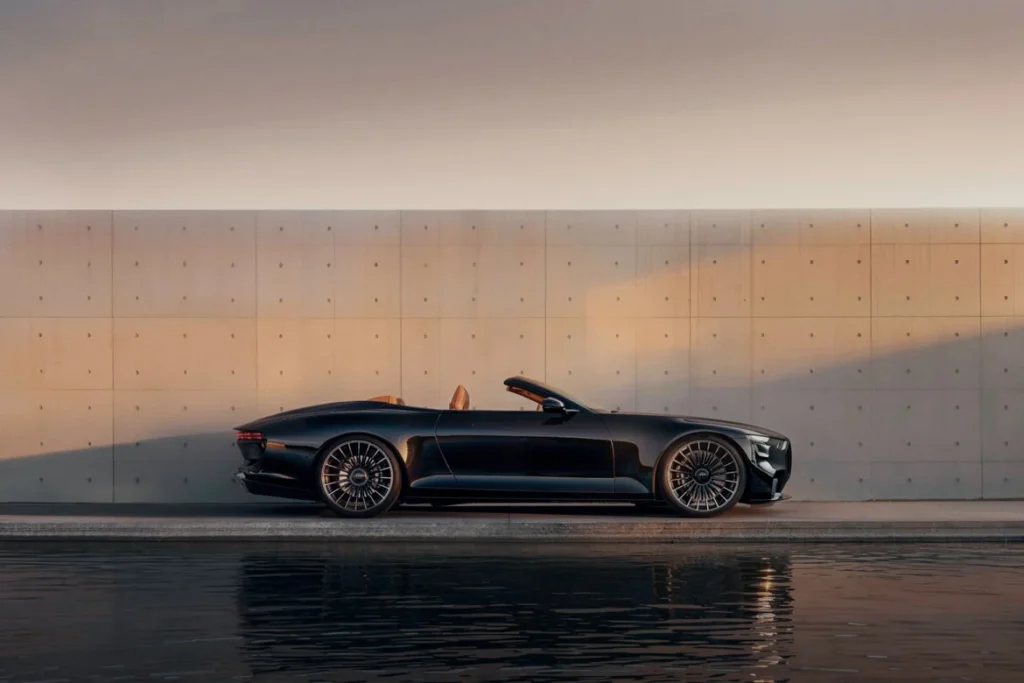
One of the defining exterior elements is what BRABUS calls the Bodo Line.
A continuous contour runs from the nose towards the rear on both sides of the body, visually connecting the car’s enormous length into a single flowing gesture.
It gives the Cabriolet a remarkably clean profile despite its size.
Rather than relying on countless vents and aggressive body cuts, the design places greater emphasis on proportion.
Long bonnet.
Low windscreen.
Compact fabric roof.
Broad rear shoulders.
It feels more like a contemporary interpretation of the classic European Gran Turismo than a conventional tuned supercar.
A Complete Pre-Preg Carbon-Fibre Body
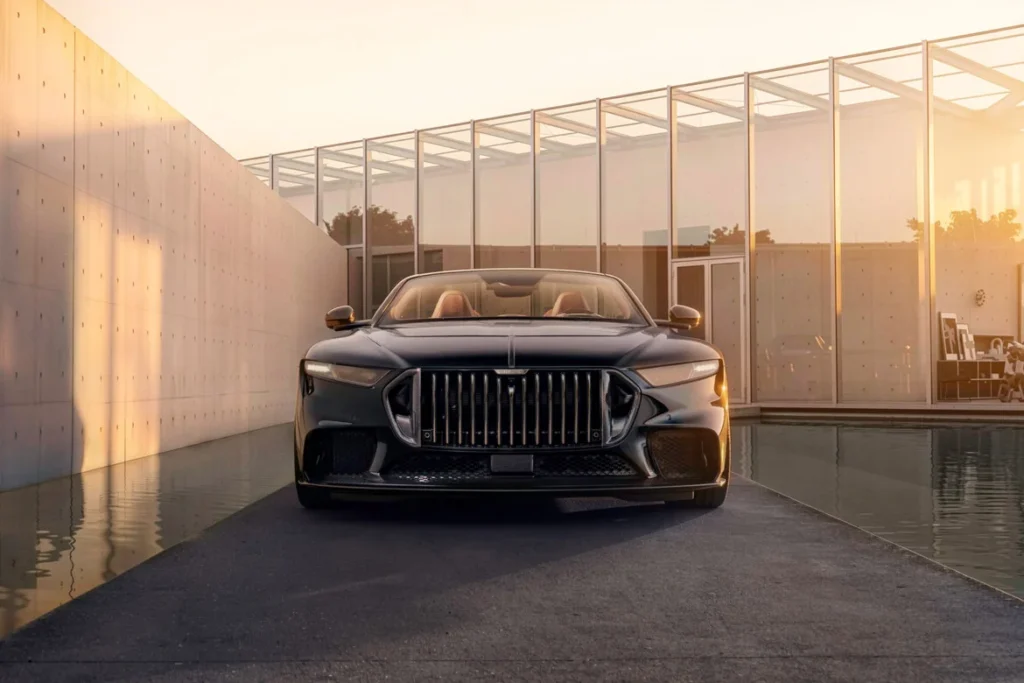
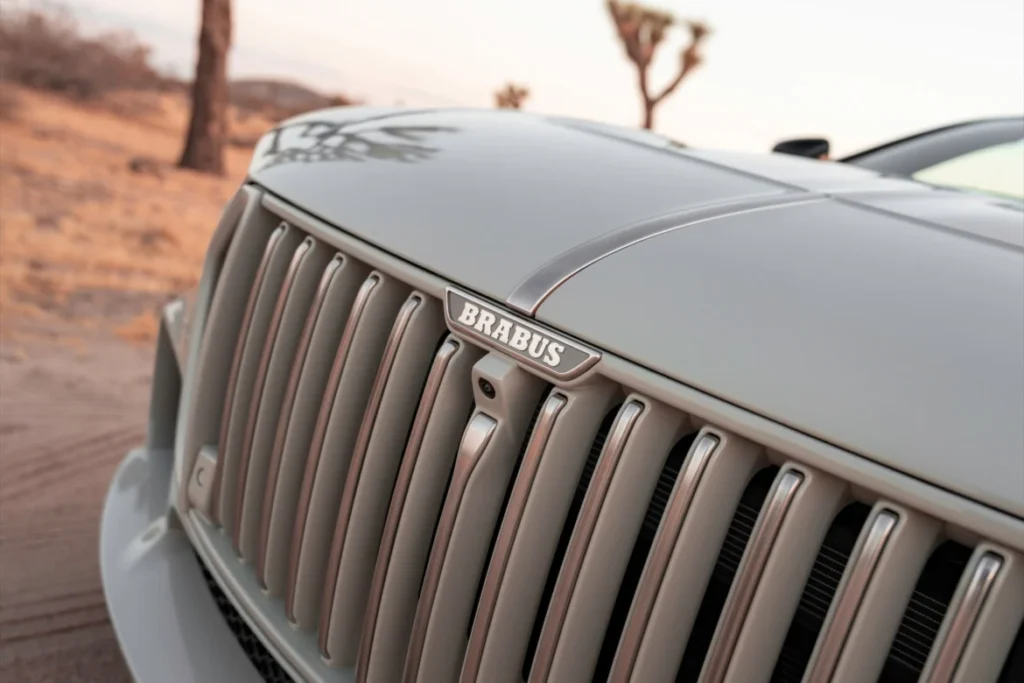
The entire coachbuilt body is produced from pre-preg carbon fibre.
For BRABUS, this serves several purposes simultaneously.
Weight reduction.
Structural quality.
Manufacturing precision.
And design freedom.
Large body sections can be produced with complex forms while retaining exceptionally high rigidity.
More importantly, BRABUS controls its own composite production, allowing the company to approach carbon-fibre manufacturing as part of the complete vehicle-development process rather than simply purchasing decorative components from external suppliers.
The result is a body that belongs visually to BRABUS rather than Aston Martin.
Silk Stone
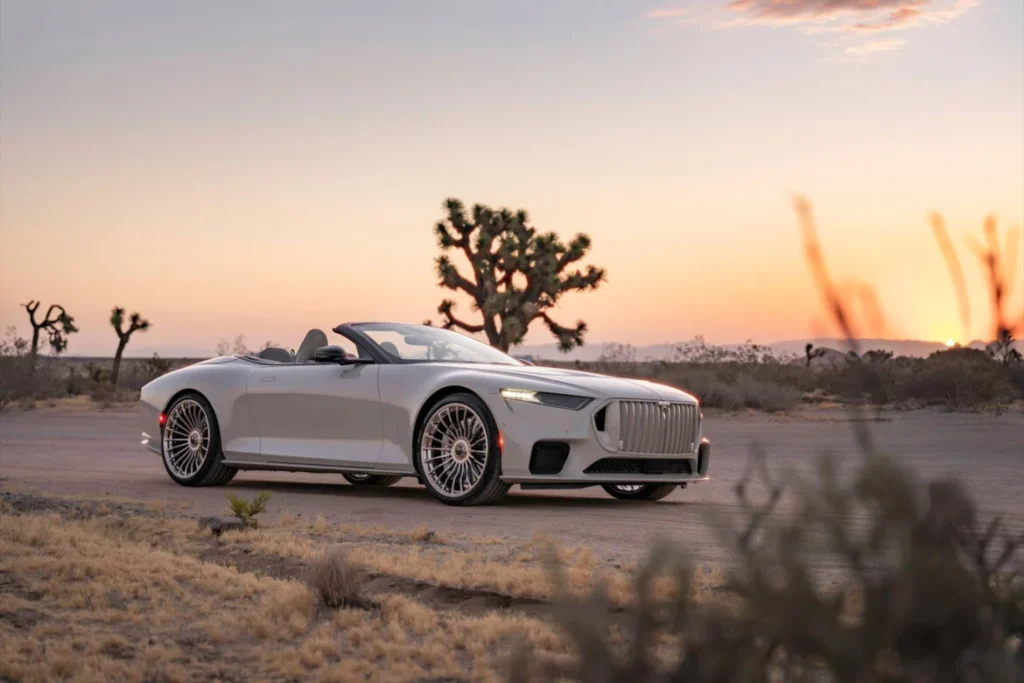
The launch configuration introduces one of the most elegant finishes BRABUS has used in recent years.
Silk Stone.
The subtle neutral tone covers the carbon body and continues almost uninterrupted into the wheels, interior and trim.
It is an interesting contrast with the aggressive specifications traditionally associated with BRABUS.
Where black exposed carbon and high-contrast accents might have made the car visually overwhelming, Silk Stone allows the proportions to dominate instead.
The Cabriolet appears enormous.
But surprisingly restrained.
That makes the launch car feel closer to a luxury yacht or bespoke grand tourer than a conventional modified supercar.
Novitec Ferrari 12Cilindri Spider: Refining Ferrari’s Open-Air V12 Masterpiece
A Jacquard Roof Created Specifically for BODO
The fabric roof is far more interesting than it initially appears.
BRABUS developed a bespoke two-tone black-and-grey Jacquard soft top specifically for the Cabriolet.
Look closely and the fabric reveals an inverted 77 motif woven directly into its structure.
It is not printed.
Not embroidered afterwards.
The pattern forms part of the fabric itself.
That brings several advantages.
Greater durability.
Resistance to UV exposure.
Better resistance to abrasion.
And the ability to withstand repeated folding without gradually losing its design.
It is exactly the kind of detail that separates genuine low-volume vehicle development from conventional aftermarket modification.
Open or Closed in Under 15 Seconds
The electrically operated soft top can be opened or closed in less than 15 seconds.
That may sound like a conventional luxury-car feature.
But integrating a folding roof into an entirely new carbon-fibre body is far from simple.
Structural rigidity.
Roof storage.
Aerodynamic sealing.
Noise suppression.
Water management.
All need to coexist with a car capable of travelling at more than 350 km/h.
The fact that the Cabriolet preserves the dramatic proportions of the Coupé without appearing compromised by the folding roof is one of the project’s quieter engineering achievements.
Active Aerodynamics
At the rear sits an electrically operated active carbon-fibre spoiler.
It deploys progressively according to speed, increasing rear-axle downforce as velocity rises.
But the system has another function.
Under heavy braking above 140 km/h, the spoiler can rotate into a near-vertical position and function as an air brake.
This increases aerodynamic drag and supports the conventional braking system during extreme deceleration.
It is a technology more commonly associated with modern hypercars than four-seat grand touring convertibles.
On the BODO Cabriolet, it becomes another example of BRABUS refusing to treat design and engineering as separate disciplines.
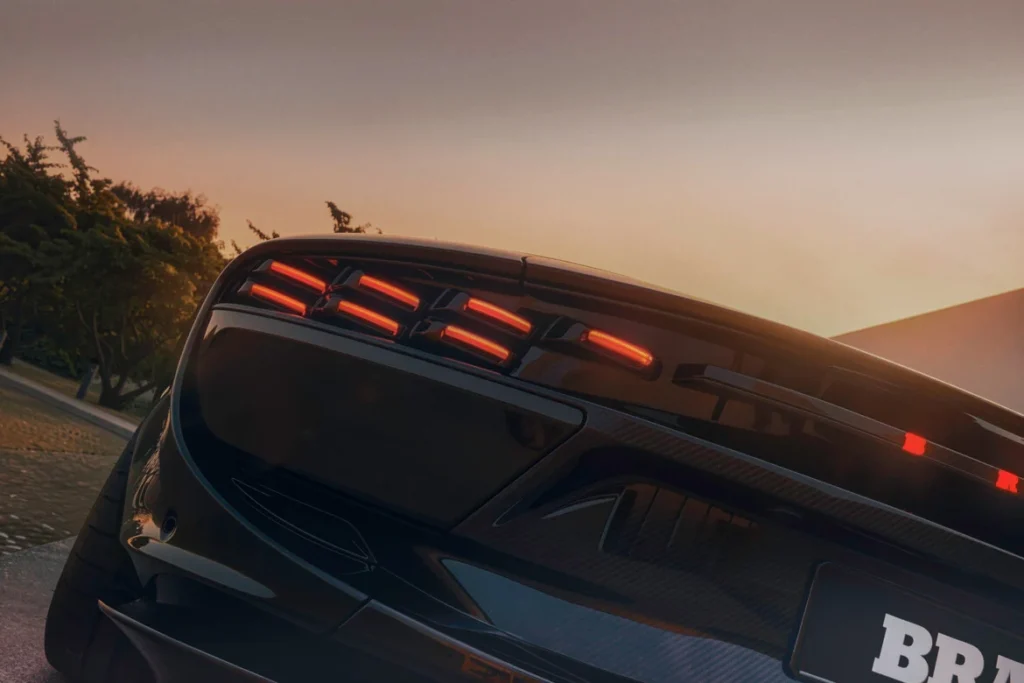
Seven Rear Lights on Each Side
The rear lighting also contains another reference to the company’s history.
Each side features seven individual LED elements.
Between them sits an illuminated BRABUS logo using the same lighting technology.
The arrangement gives the rear an unmistakable nighttime signature while once again quietly referencing the number that defines the project.
Seven lights.
Seventy-seven cars.
The historical references are everywhere without becoming decorative nostalgia.
A 5.2-Litre Twin-Turbocharged V12
Then comes the engine.
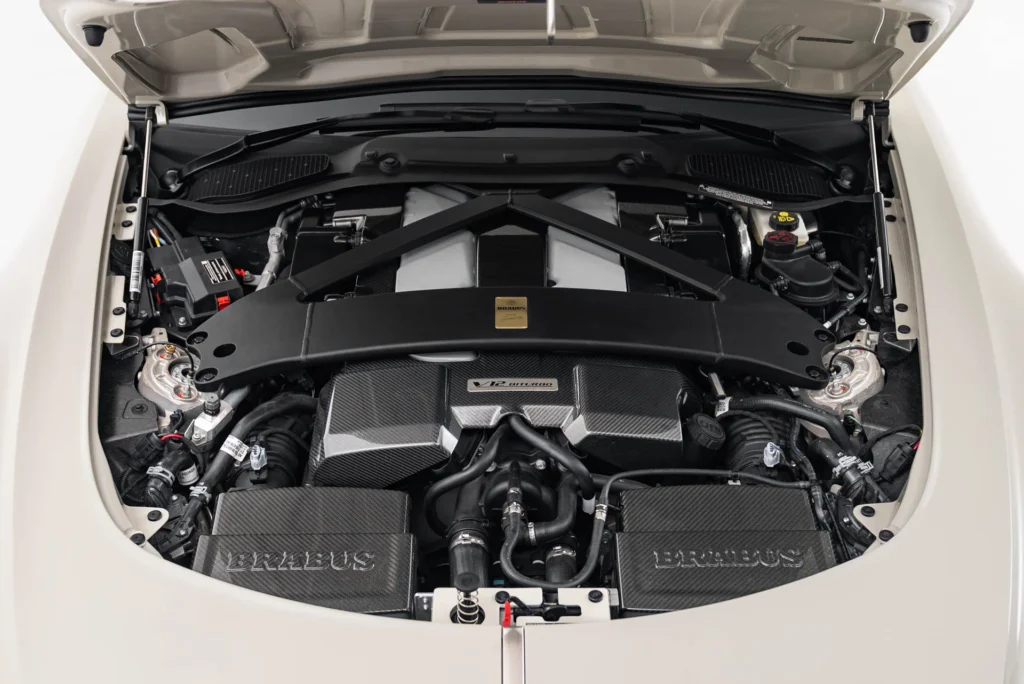
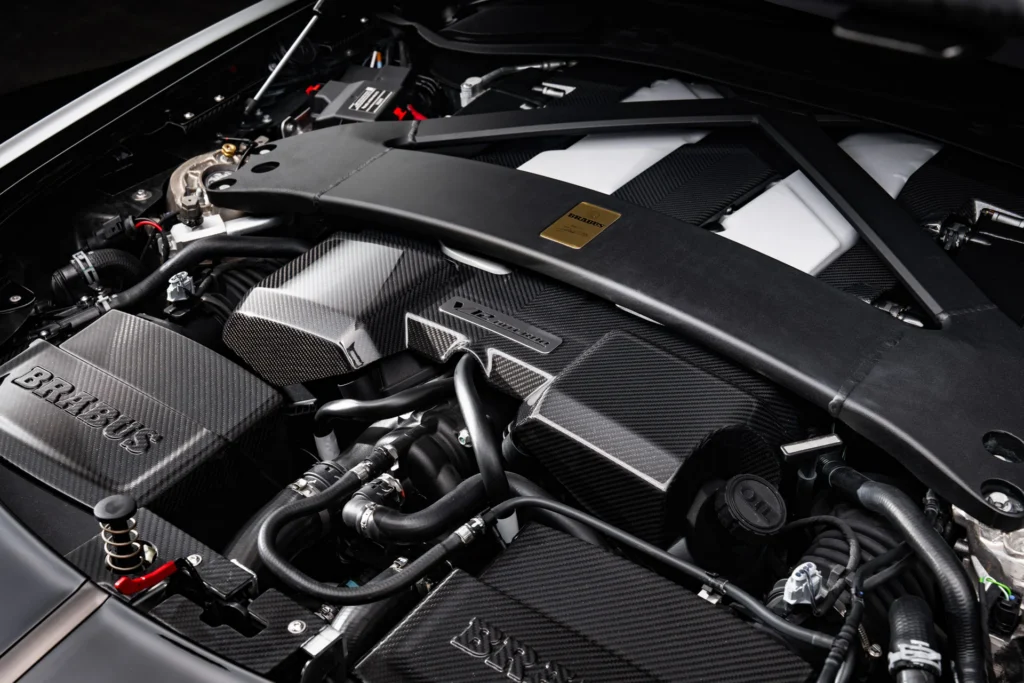
At the heart of the BODO Cabriolet sits a heavily reworked 5.2-litre twin-turbocharged V12 producing 735 kW — 1,000 hp — at 6,400 rpm.
Maximum torque reaches an electronically limited 1,200 Nm, available between 2,900 and 5,000 rpm.
That represents a substantial increase over the already formidable output of the underlying Vanquish architecture.
But BRABUS did considerably more than simply alter the engine software.
The powertrain receives extensive hardware development to support the additional output and maintain reliability under sustained load.
New Turbochargers and Improved Cooling
The BODO powertrain incorporates specially developed turbochargers, an improved intake system and upgraded charge-air cooling.
These changes matter because additional boost inevitably generates additional heat.
Without sufficient thermal management, headline power figures can become temporary.
BRABUS therefore approaches the engine as a complete system.
Air enters more efficiently.
Compression increases.
Cooling capacity rises.
Exhaust gases leave with lower restriction.
The objective is not simply to produce 1,000 hp on a dyno.
It is to make that output usable.
3D-Printed Titanium Exhaust Finishers
At the rear, the carbon diffuser frames four striking exhaust outlets.
The finishers are manufactured using 3D metal printing and titanium.
The technology allows BRABUS to create forms that would be difficult or inefficient to manufacture conventionally.
It also reinforces the relationship between contemporary high-performance engineering and modern low-volume manufacturing.
The exhaust system itself is manufactured from stainless steel and incorporates electronically controlled valves.
The driver can therefore alter the acoustic character from comparatively discreet to significantly more aggressive.
With a thousand-horsepower V12 beneath the bonnet and no fixed roof above the occupants, the louder setting is unlikely to lack theatre.
Rear-Wheel Drive Only
Perhaps the most remarkable part of the drivetrain is what BRABUS has not added.
All-wheel drive.
The full 1,000 hp and 1,200 Nm are transmitted exclusively to the rear wheels.
An eight-speed torque-converter automatic manages the power, while an electronically controlled rear differential can provide up to 100 percent locking capability.
This is not the easiest possible route to enormous acceleration figures.
It is, however, consistent with the character of a traditional grand tourer.
Front engine.
Rear drive.
Huge torque.
And enough electronic intelligence to make the combination usable.
0–100 km/h in 3.0 Seconds
Despite its substantial dimensions and luxurious 2+2 configuration, performance is extraordinary.
0–100 km/h: 3.0 seconds. 0–200 km/h: 8.5 seconds. 0–300 km/h: 23.9 seconds.
Top speed: 360 km/h.
That final figure translates to approximately 224 mph.
For an open-top four-seat Gran Turismo, it is a remarkable level of performance.
And perhaps more impressive than the initial acceleration is the 0–300 km/h figure.
It demonstrates just how relentlessly the V12 continues pulling once conventional performance cars have already begun running out of breath.
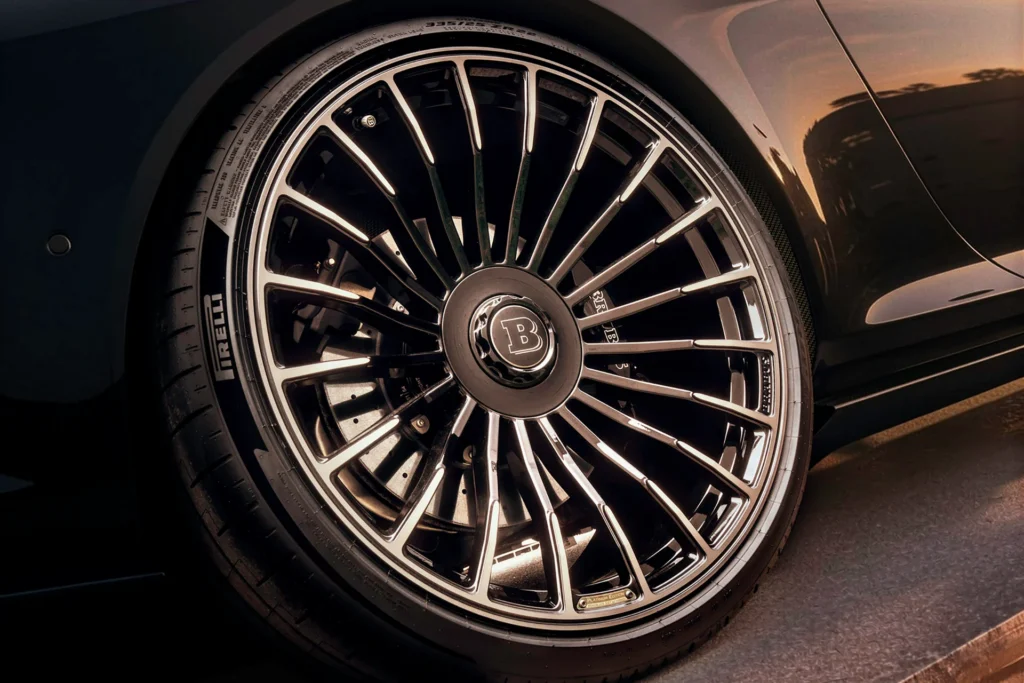
22-Inch Monoblock Z-GT Forged Wheels
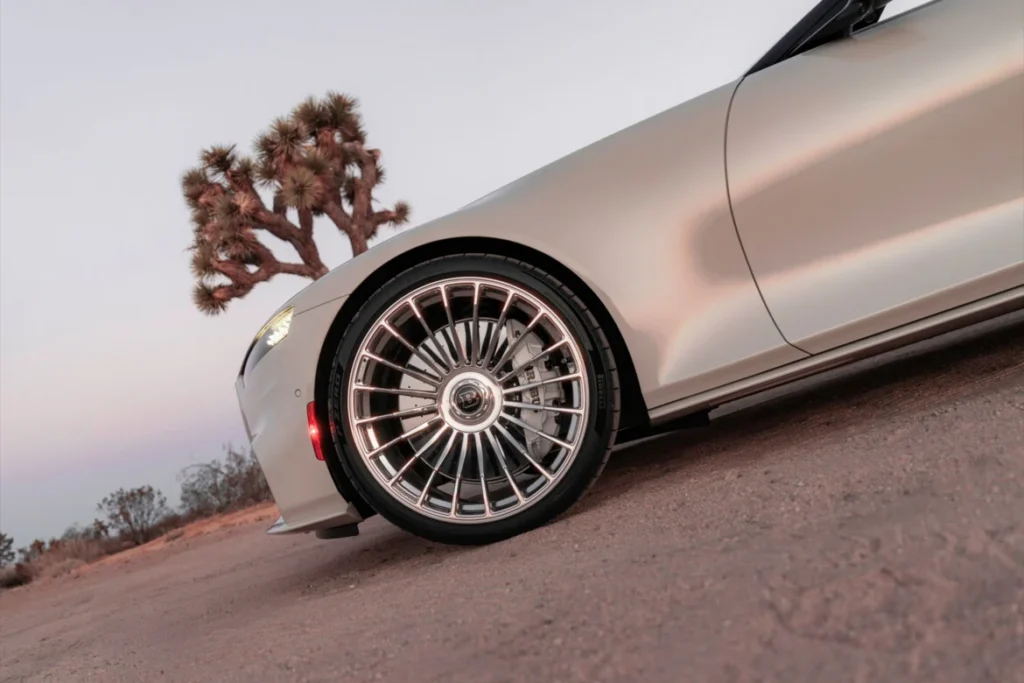
The Silk Stone specification sits on enormous 22-inch BRABUS Monoblock Z-GT “Platinum Edition” forged wheels.
Their twenty concave spokes are produced using modern forging and CNC machining techniques.
The polished surfaces are then finished to complement the Silk Stone bodywork.
Front wheels measure 9.5J x 22.
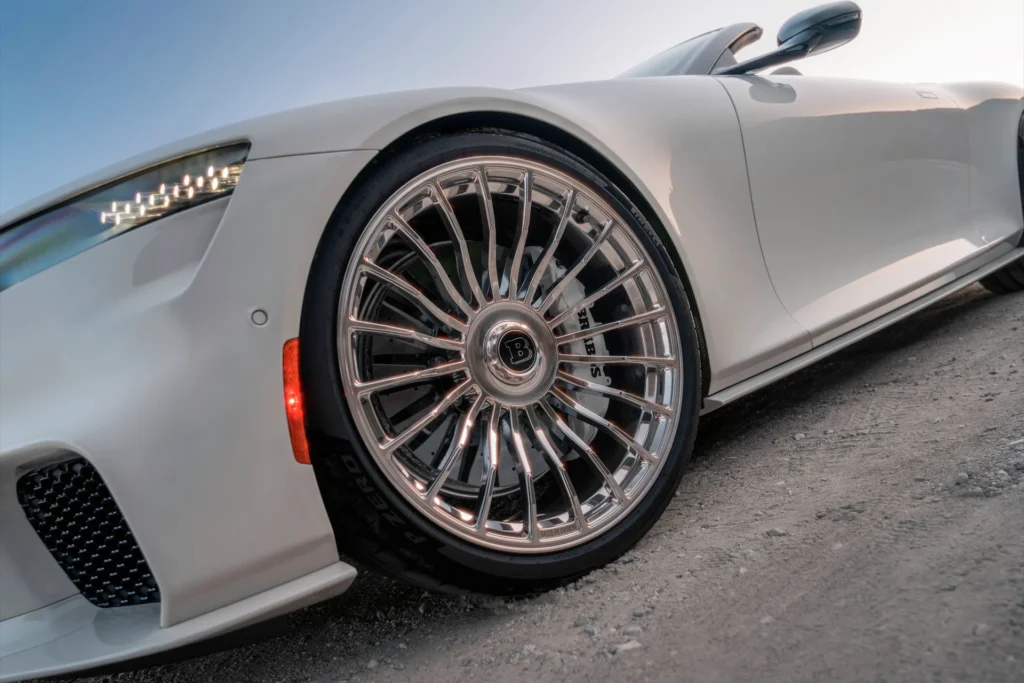
The rears grow to 11.5J x 22.
For a car of this scale, smaller wheels would almost disappear beneath the body.
The Z-GTs instead reinforce the enormous proportions without becoming visually disconnected from them.
Aston Martin Valen: The 850 PS V12 Supercar Redefining the Front-Engine Formula
Bespoke Pirelli P Zero Tyres
Pirelli developed a dedicated P Zero specification specifically for the BODO programme.
The tyres measure:
285/30 ZR 22 front
335/25 ZR 22 rear.
Their construction and compound have been optimised around the particular demands of the BODO Cabriolet: extreme speed, enormous rear-wheel-drive torque, steering precision and the ride comfort expected from a luxury Gran Turismo.
Each carries a dedicated “BB” marking, identifying it as a tyre developed specifically for BRABUS BODO.
It is another small detail revealing how far beyond ordinary wheel-and-tyre modification the programme has gone.
Carbon-Ceramic Brakes
Stopping a 360 km/h convertible requires serious braking hardware.
The Cabriolet therefore uses internally ventilated and perforated carbon-ceramic composite discs.
Six-piston fixed calipers operate at the front.
Four-piston fixed calipers sit behind.
On the Silk Stone car, even the brake finish is colour coordinated with the exterior.
Again, performance engineering becomes part of the visual specification.
Five Driving Modes
The suspension combines a double-wishbone front architecture with a sophisticated multi-link rear arrangement.
Electronically adaptive aluminium dampers provide five selectable driving modes:
GT
Sport
Sport+
Wet
Individual.
This breadth matters.
The BODO Cabriolet is not intended to become a rigid track special simply because it produces 1,000 horsepower.
Its core mission remains grand touring.
The driver should be able to cross countries in comfort before selecting a more aggressive chassis setting when the road becomes interesting.
A Lift System on Both Axles
BRABUS also equips the Cabriolet with an unusual dual-axle lift system.
Both front and rear can rise by approximately 25 mm to help clear steep ramps, parking structures and speed bumps.
Above 45 km/h, the vehicle automatically returns to its normal ride height.
It is a small but useful acknowledgement of reality.
A car more than five metres long and capable of 360 km/h still needs to enter hotel garages.
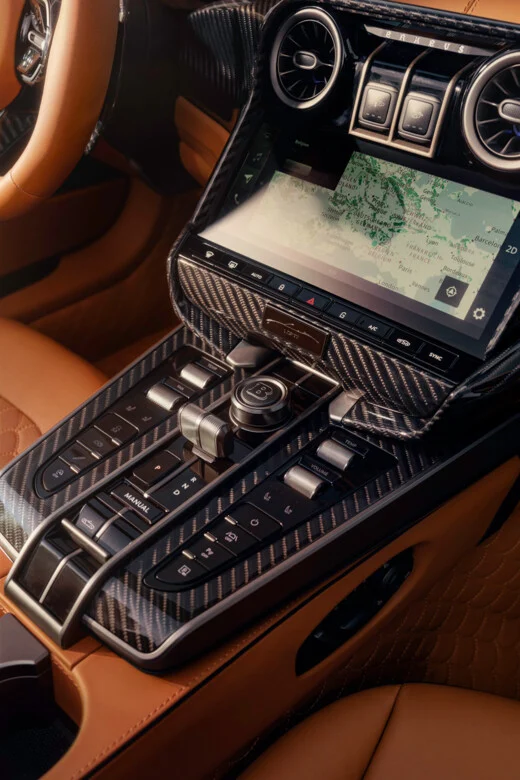
The Masterpiece Interior
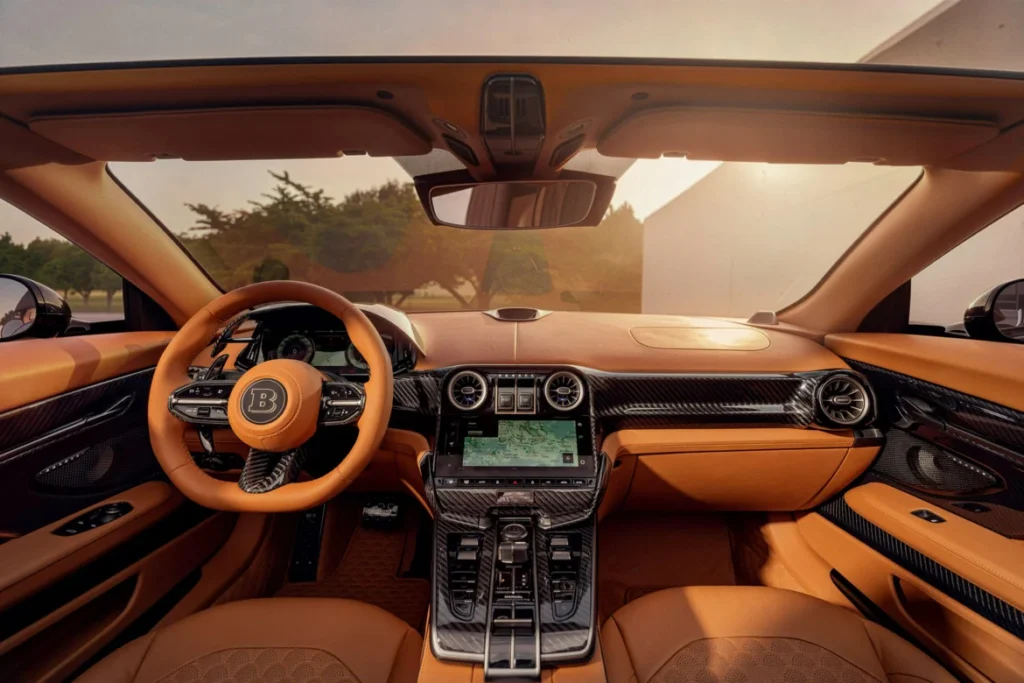
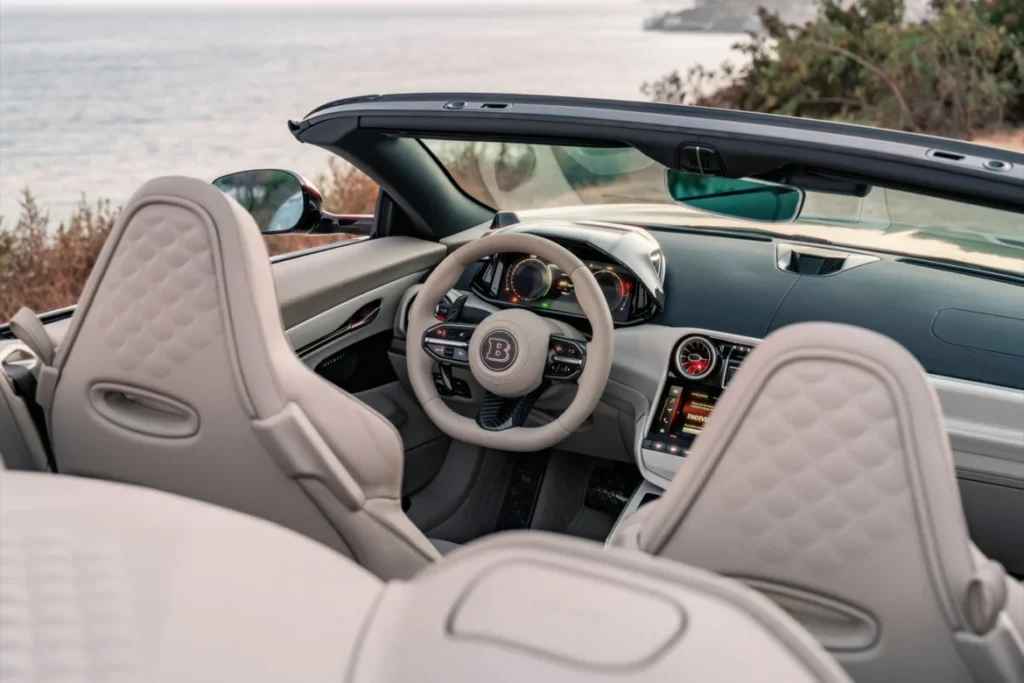
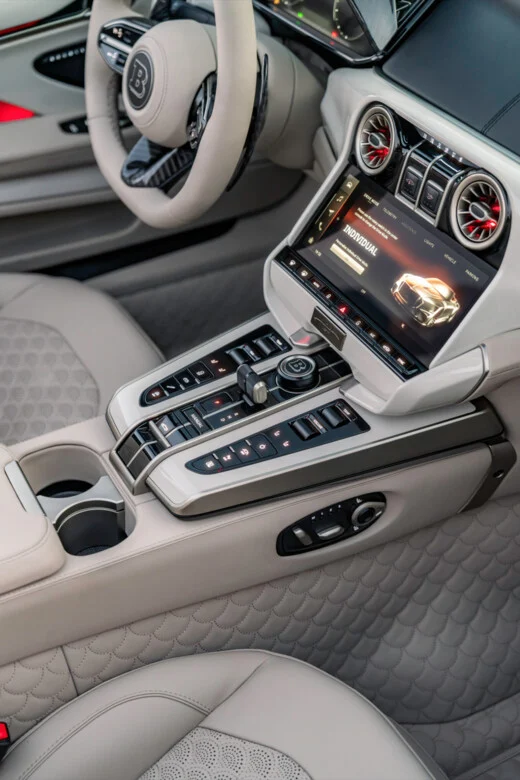
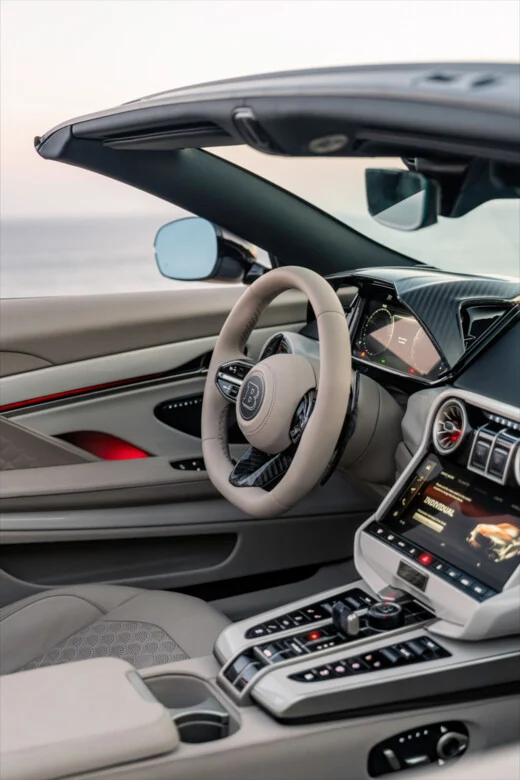
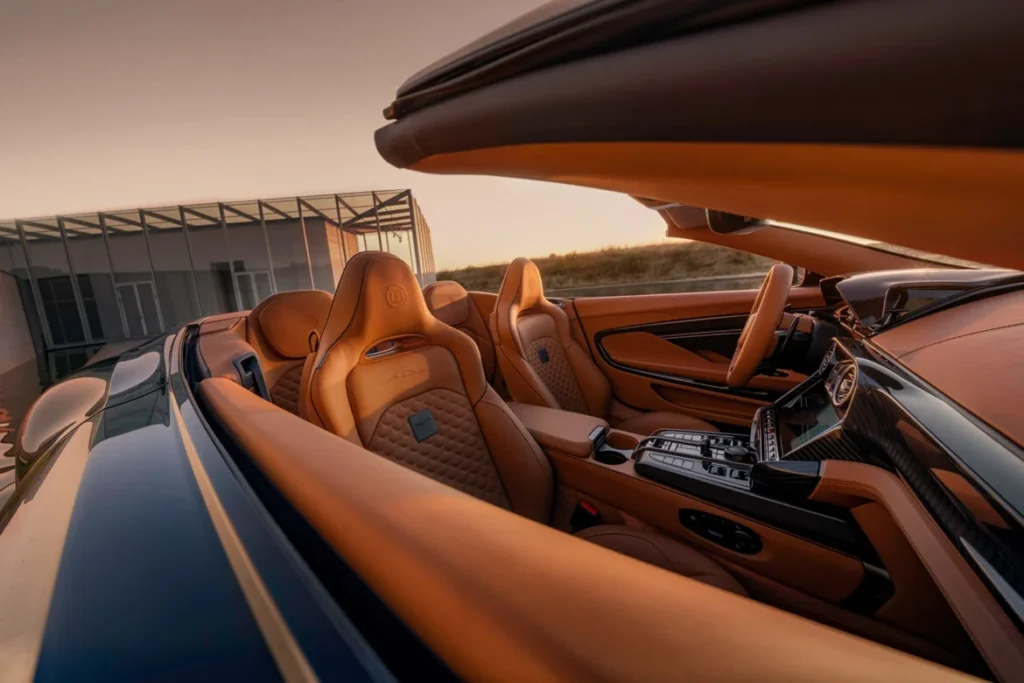
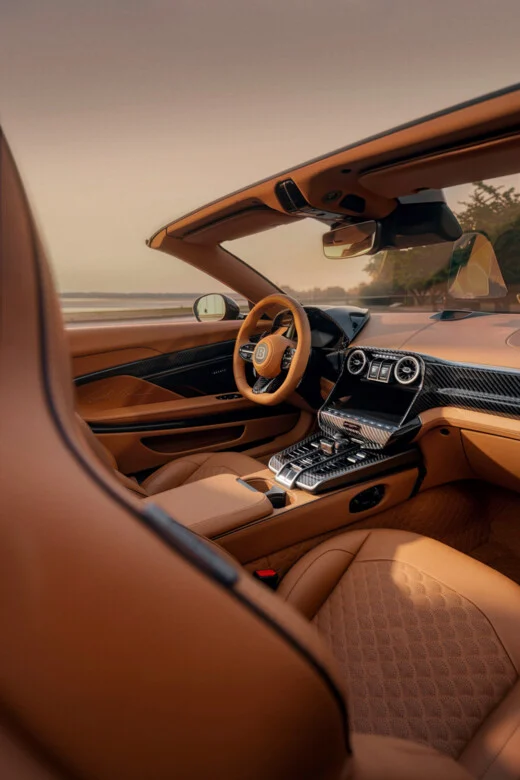
If the exterior demonstrates BRABUS coachbuilding, the cabin demonstrates the company’s Masterpiece craftsmanship.
In the Silk Stone specification, the interior becomes almost monochromatic.
Fine leather is matched to the exterior finish.
Carbon-fibre elements receive complementary treatments.
Alcantara appears throughout the centre console.
And virtually every visible surface is either upholstered or individually finished.
The effect is very different from the traditionally dark, performance-focused BRABUS cabin.
It feels lighter.
More architectural.
And considerably more aligned with contemporary luxury design.
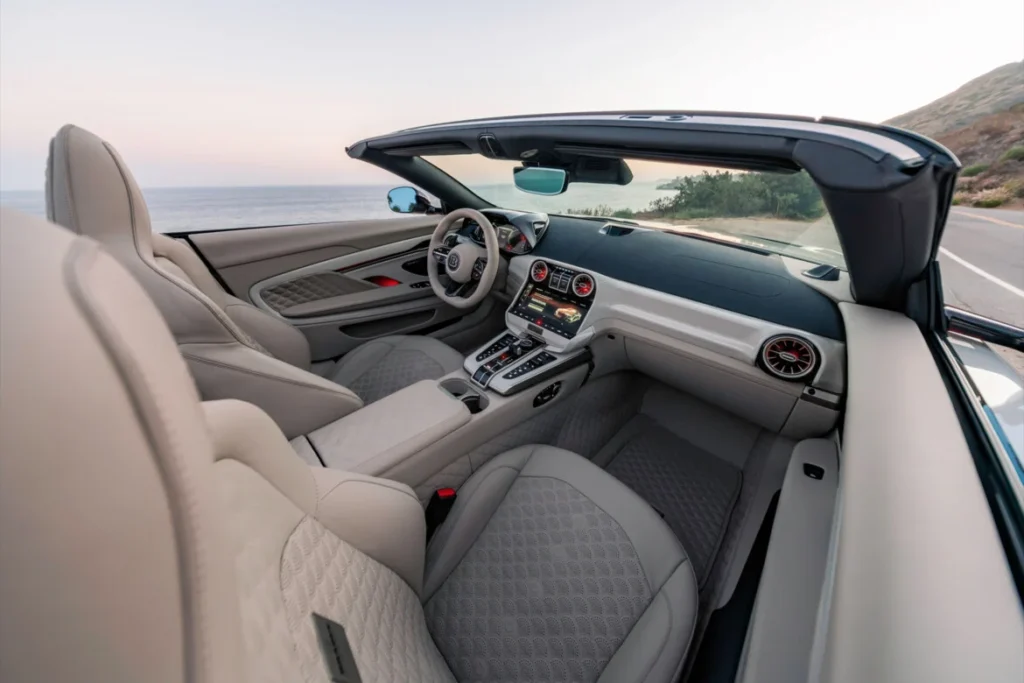
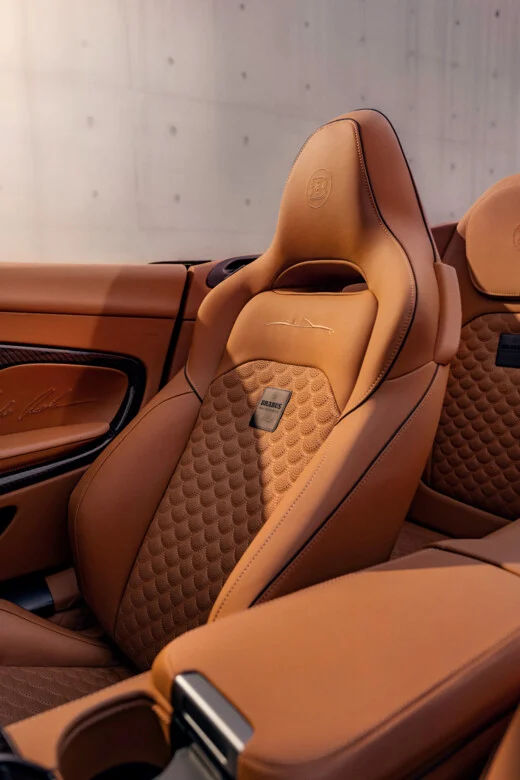
Shell Quilting Everywhere
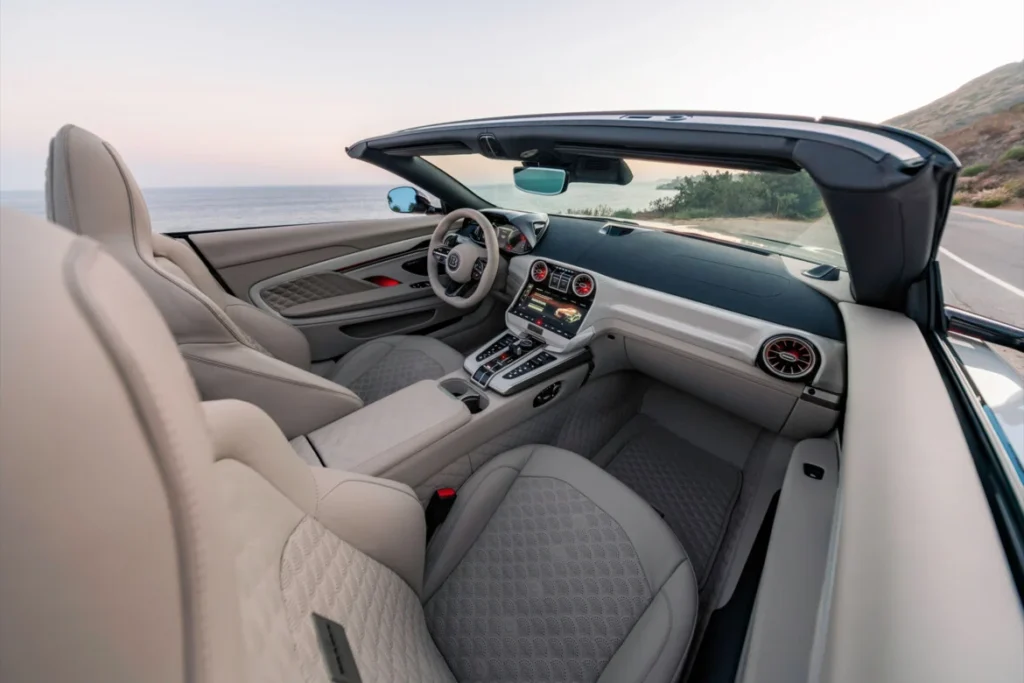
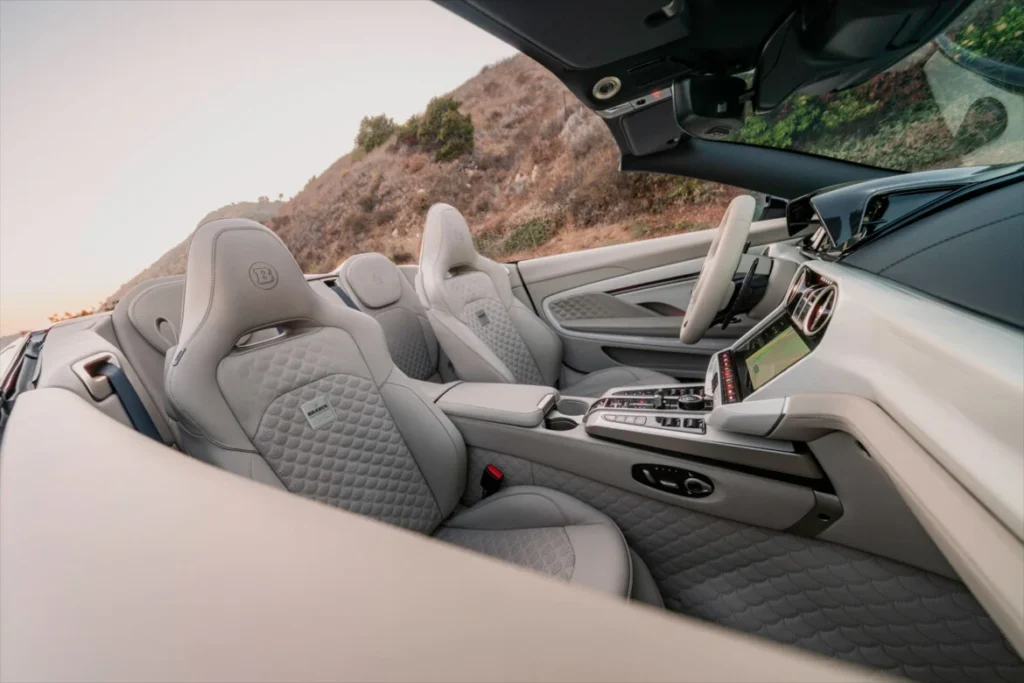
A newly developed three-dimensional interpretation of BRABUS’s characteristic Shell quilting appears throughout the cabin.
Not simply on the seats.
The pattern continues across the leather-covered cabin floor.
Rear deck.
Floor mats.
Luggage compartment.
And even the trunk liner.
This level of repetition creates an unusually cohesive interior.
Rather than individual luxury components existing independently, the cabin feels designed around one continuous visual theme.
Four Real Seats
The BODO Cabriolet retains a genuine 2+2 configuration.
That distinction separates it from many contemporary open-top supercars.
This is not a two-seat roadster with token luggage space.
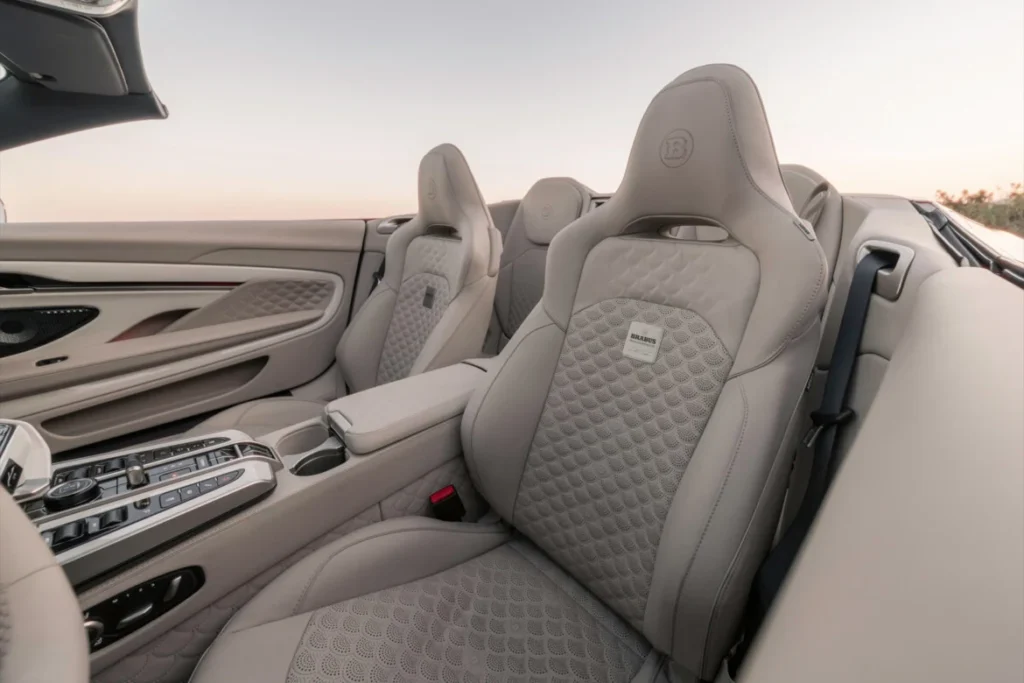
Its character is closer to the great luxury convertibles of previous decades, where enormous performance coexisted with the ability to carry additional passengers.
The rear seats may not transform it into a family saloon.
But they reinforce the car’s central identity.
Gran Turismo first.
Supercar performance second.
BRABUS ROCKET GTS — 1,000 HP Hyper GT Madness
Silk Stone Is Only One Interpretation
The launch car demonstrates one end of the BODO Cabriolet’s personality.
BRABUS also shows dramatically different configurations.
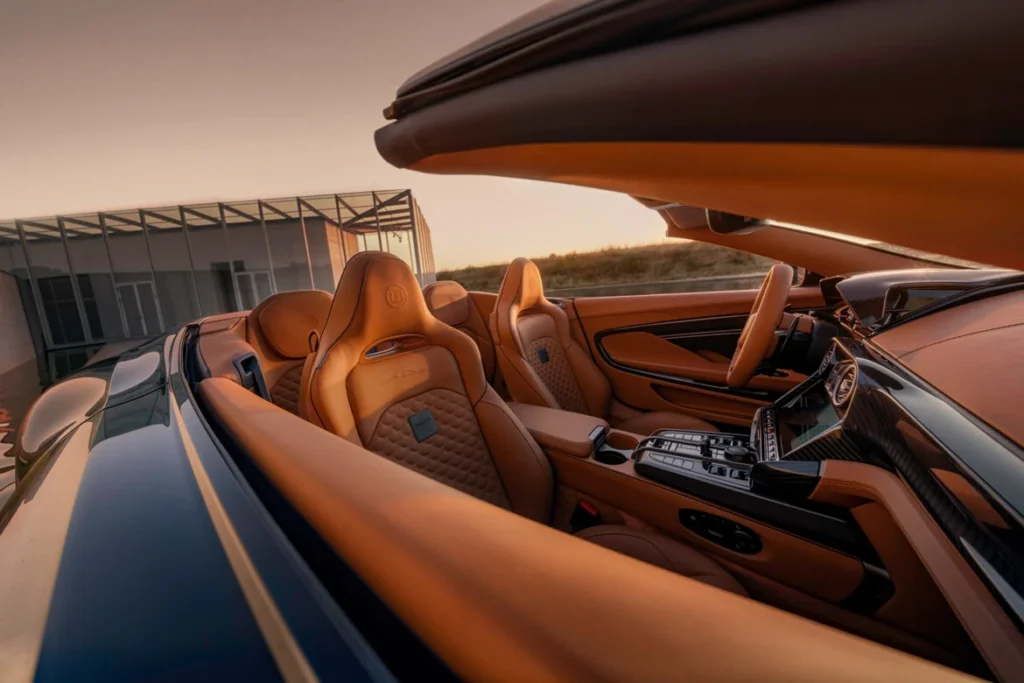
A Piano Black example, for instance, combines dark exterior carbon detailing with Shadow Chrome trim and a rich Cuoio leather interior.
That car feels almost entirely different.
More traditional.
More aggressive.
Less minimal.
The contrast demonstrates an important part of the BODO programme.
The design is fixed.
The personality does not need to be.
Bodo Buschmann’s Signature
On some specifications, the interior even incorporates Bodo Buschmann’s signature into the door trim.
For a car carrying his first name, that detail gives the project a level of personal significance unusual within BRABUS history.
This is not simply another product line named by a marketing department.
The company is deliberately turning the memory of its founder into a new chapter of its design identity.
Bespoke Luggage Included
Each Cabriolet is delivered with bespoke accessories including a colour-matched Masterpiece Weekender bag, additional luggage, matching key covers and leather accessories.
These may appear secondary beside a 1,000-horsepower V12.
But they suit the car’s purpose perfectly.
A Gran Turismo should be designed around travel.
The luggage becomes part of the complete commission rather than an afterthought.
A Digital Product Passport
Interestingly, one of the most modern details is almost invisible.
Each BODO Cabriolet receives a blockchain-based Digital Product Passport integrated into a dedicated BRABUS specification plate within the luggage compartment.
Developed with the Aura Blockchain Consortium, the system records authenticity, ownership and individual vehicle specification.
For limited-production collector cars, this may become increasingly valuable.
Documentation becomes permanent.
Specification history becomes easier to verify.
And future owners gain a clearer record of exactly how the car left Bottrop.
It is a particularly modern solution attached to an automobile whose emotional appeal remains decidedly traditional.
More Coachbuilder Than Tuner
The BODO Cabriolet also illustrates how dramatically BRABUS itself has evolved.
For decades, the company was primarily understood as a tuner.
Take a Mercedes.
Add power.
Change the suspension.
Develop aerodynamics.
Create wheels and interior upgrades.
That definition increasingly feels inadequate.
The BODO programme replaces essentially the entire visible body.
Develops its own proportions.
Creates unique lighting.
Integrates active aerodynamics.
Uses bespoke textiles.
Introduces dedicated tyre specifications.
And builds a complete visual identity unrelated to the donor car.
At some point, tuning becomes coachbuilding.
The BODO Cabriolet has clearly crossed that line.
A Different Kind of Modern Coachbuilding
Traditional coachbuilding flourished when automobile manufacturers sold rolling chassis that independent carrozzerie could clothe however a client desired.
Modern cars make that process vastly more complicated.
Crash structures.
ADAS sensors.
Aerodynamic requirements.
Thermal management.
Electronic architectures.
Lighting regulations.
Roof mechanisms.
Everything is deeply interconnected.
That makes creating a coachbuilt modern convertible particularly difficult.
The BODO Cabriolet therefore represents not merely a styling exercise, but an example of how the old coachbuilding philosophy can survive within contemporary engineering.
The Aston Martin architecture supplies the fundamentals.
BRABUS builds its own automobile around them.
Mansory Vincerò and Vivere: Two One-Off Bugattis Reimagined for Pebble Beach
Why the Vanquish Volante Makes Sense
The choice of foundation is also particularly appropriate.
BRABUS could have built its coachbuilt flagship around a conventional supercar.
Instead, the company selected a front-engined V12 Aston Martin.
That gives the BODO a different character from the mid-engined exotica dominating the seven-figure market.
Long bonnet.
Cabin positioned rearward.
Rear-wheel drive.
Four seats.
Soft top.
It is fundamentally a classic grand-tourer formula.
BRABUS simply pushes every element towards the extreme.
The proportions become larger.
The engine reaches four figures.
The body becomes carbon.
And the exclusivity drops to 77 units.
A Million-Euro Cabriolet
BRABUS currently lists the Silk Stone specification at around €1.077 million in European configuration, while U.S. reporting places the starting price at approximately $1.24 million.
At that level, the BODO Cabriolet exists in a very different marketplace from the production Vanquish.
Its competition is no longer another luxury convertible.
It sits alongside limited-production hypercars, coachbuilt commissions and one-off collector automobiles.
That means the buyer is not simply paying for additional power.
They are paying for transformation.
The Luxury of Excessive Scale
There is something almost old-fashioned about the BODO Cabriolet.
Not in its technology.
In its attitude.
Modern performance cars increasingly pursue compact dimensions, low drag, electrification and extreme efficiency.
The BODO is enormous.
Its performance is excessive.
Its interior is covered almost entirely in leather.
And it makes no attempt to apologise for any of it.
In that sense, it recalls an era when luxury convertibles were not simply roofless sports cars.
They were statements.
The Bentley Azure.
Large coachbuilt Mercedes cabriolets.
Grand tourers designed to cross Europe rather than attack a lap time.
The BODO revives that spirit with 1,000 horsepower.
BODO Is Becoming a Brand Within BRABUS
Perhaps the most interesting question is what comes next.
The Coupé established the BODO design language.
The Cabriolet expands it.
Both are limited to 77 examples.
Both carry complete carbon-fibre bodies and positioned dramatically above BRABUS’s conventional conversion programmes.
That begins to look less like an isolated project and more like a new ultra-luxury layer within BRABUS itself.
A place where the company stops modifying cars and begins creating them.
Whether additional BODO derivatives eventually follow remains to be seen.
But the direction is clear.
BRABUS wants to be understood as more than the company that makes powerful Mercedes-Benz models.
One Dream, Finally Open to the Sky
The BRABUS BODO Cabriolet succeeds because its most impressive number may not actually be 1,000 horsepower.
Nor 360 km/h.
Nor 1,200 Nm.
It is 77.
That number connects the car to the year BRABUS began and to the man whose name now appears on its most ambitious coachbuilding programme.
Bodo Buschmann spent his career turning an enthusiasm for fast automobiles into one of the world’s most recognisable performance companies.
His son has taken that philosophy somewhere new.
A completely bespoke carbon-fibre body.
A thousand-horsepower V12.
Four seats.
Rear-wheel drive.
Active aerodynamics.
A roof woven with the company’s history.
And enough performance to reach 360 km/h with the sky above.
The BODO Coupé established the idea.
The Cabriolet makes it emotional.
BRABUS may have started as a tuner in 1977.
The BODO Cabriolet suggests that, almost fifty years later, it has become something much more ambitious.