
There are many ways to celebrate a racetrack.
Set a lap record.
Win a race.
Recreate a famous livery.
Porsche has chosen something more personal.
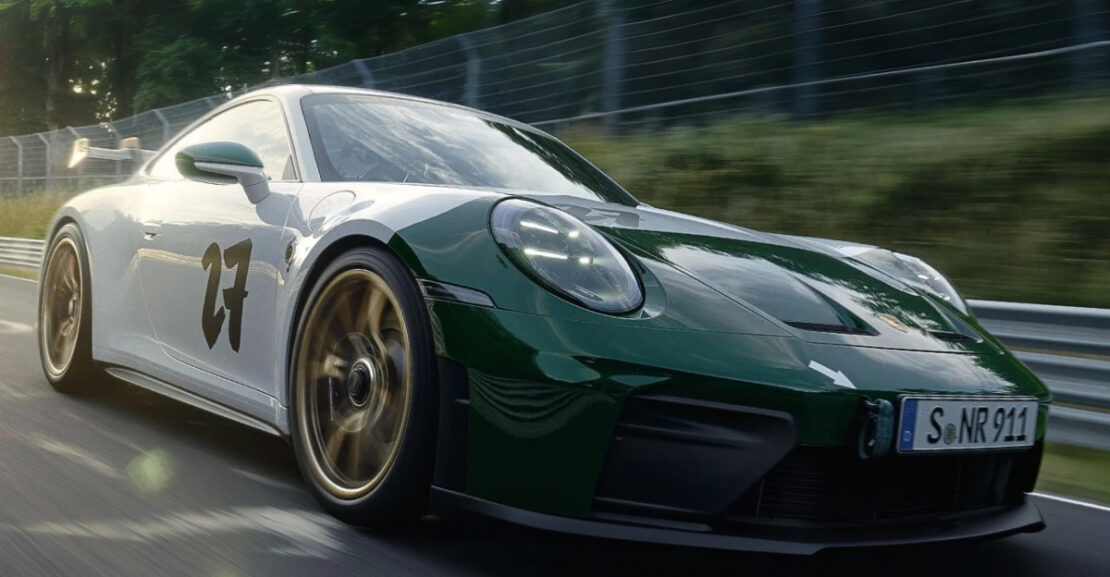
The 911 GT3 100 Jahre Nürburgring has been created to celebrate the centenary of one of the most demanding and influential circuits in automotive history.
Not with more horsepower..
Not with another headline-grabbing performance claim.
Instead, Porsche has taken the 911 GT3 and filled it with references to the place that has shaped generations of its road and racing cars.
The Nürburgring turns 100 in 2027.
And this GT3 exists to say thank you.
The Nürburgring and Porsche: More Than a Racetrack
Few circuits are as deeply connected to Porsche as the Nürburgring.
The relationship stretches back decades.
Long before the Nordschleife became the global benchmark for production-car lap times, Porsche was already using the circuit for racing, testing and development.
Today, the track remains one of the most demanding environments in the world for validating a performance car.
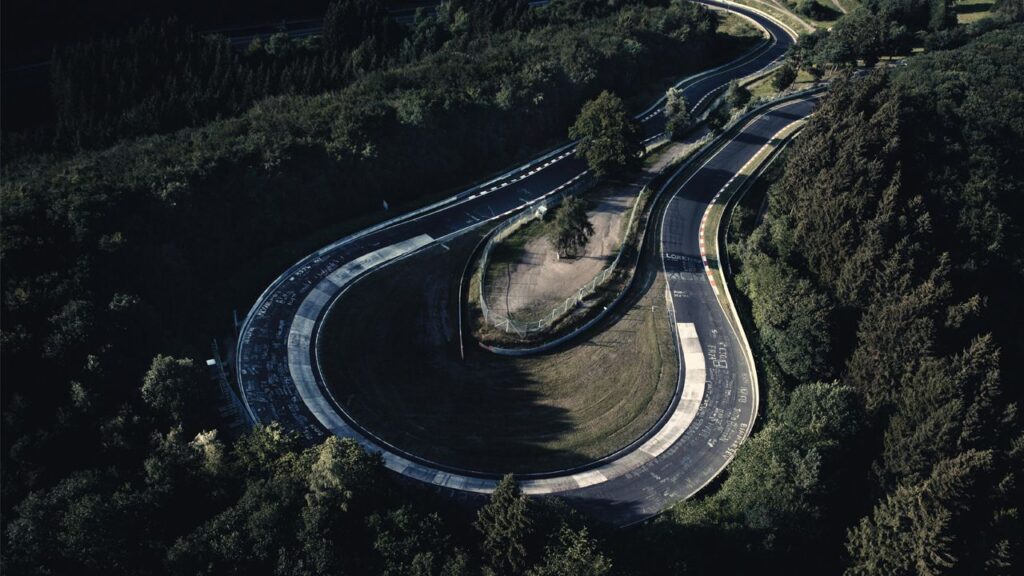
Its 20.8-kilometre Nordschleife combines 73 corners, dramatic elevation changes, compressions, crests, blind entries and continuously changing surfaces.
Cars are subjected to enormous stress.
So are drivers.
That intensity is precisely why Porsche returns again and again.
The circuit has effectively become part of the development process.
And for Porsche GT cars in particular, it is something even more significant.
Home.
One Hundred Years of the Green Hell
The Nürburgring officially opened on 18 June 1927.
Its original purpose was ambitious.
Create a circuit that would serve motorsport, automotive development and the regional economy simultaneously.
A century later, its reputation is unmatched.
Sir Jackie Stewart famously called the Nordschleife the Green Hell, a nickname that perfectly captures the strange duality of the place.
Beautiful.
Dangerous.
Addictive.
Unforgiving.
Porsche embraces that identity throughout the anniversary GT3.
Green appears almost everywhere.
But never randomly.
Only 100 Cars
Production is limited to 100 examples.
Exactly one for every year of Nürburgring history.
There is another restriction.
The car is available only to customers in Germany.
Orders open in September 2026, with deliveries scheduled for 2027, the circuit’s centenary year.
For collectors outside Germany, that naturally creates frustration.
But conceptually it also makes sense.
This is one of Porsche’s most geographically specific special editions.
A German car.
Celebrating a German circuit.
Sold only in Germany.
The exclusivity reinforces the connection.
Porsche Flachbau RS: The 911 GT2 RS Reimagined in the Spirit of Moby Dick
A GT3 Without More Power
Mechanically, Porsche has resisted the temptation to create another performance hierarchy.
The anniversary model retains the familiar 4.0-litre naturally aspirated flat-six.
Output remains approximately:
510 PS
450 Nm
Drive goes exclusively to the rear wheels.
There are faster Porsche 911s.
More powerful ones.
More extreme ones.
That is not the point.
The GT3 already provides one of the most complete road-and-track experiences in the current Porsche range.
The anniversary edition changes the story around the car rather than the mechanical foundation beneath it.
Manual or PDK
Customers can choose between two transmissions.
A seven-speed PDK dual-clutch gearbox.
Or a six-speed sports manual.
That second option feels especially appropriate.
The Nürburgring anniversary car is built around involvement rather than pure lap time.
A manual gearbox inevitably sacrifices a little outright speed.
But it gives the driver something more valuable in return.
Participation.
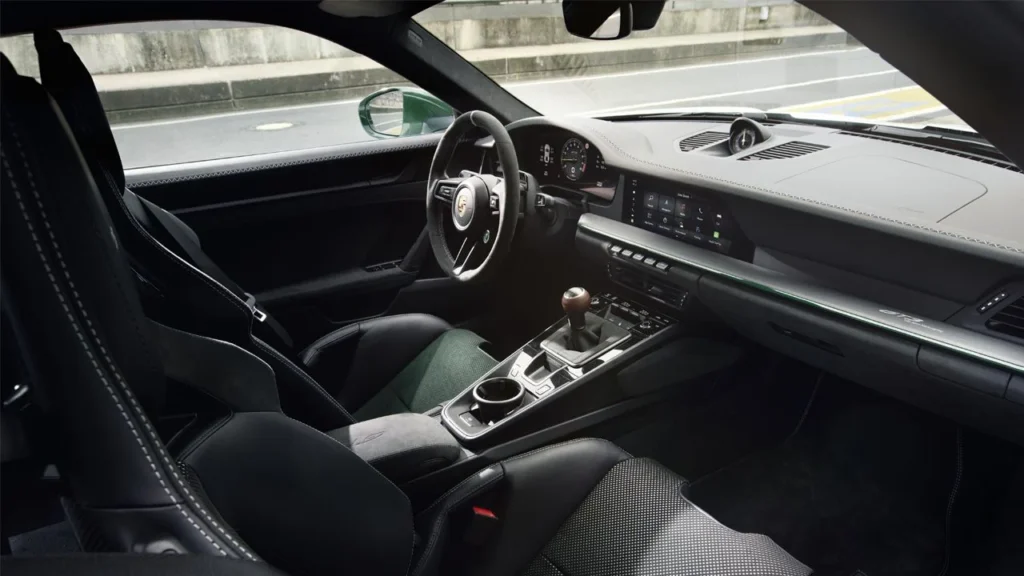
The manual version also receives a distinctive walnut gear knob, similar to the one fitted to the 911 Carrera T.
Wood inside a modern GT3 might sound unusual.
Here, it adds exactly the right amount of warmth to an otherwise technical cabin.
White or GT Silver Metallic
There are only two exterior colour choices.
White.
Or GT Silver Metallic.
Each has its own historical meaning.
White recalls the traditional neutral colour in which racing cars were often delivered before sponsor graphics and team identities were applied.
GT Silver Metallic references Porsche’s modern Cup-car world.
Both serve as relatively restrained foundations for the anniversary graphics.
Because the real colour story is green.
Green for the Green Hell
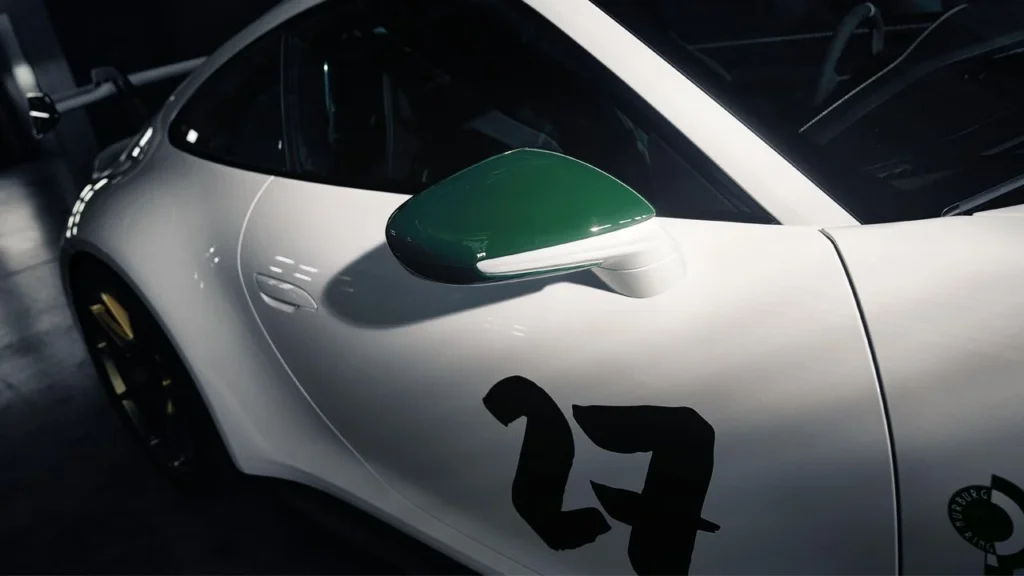
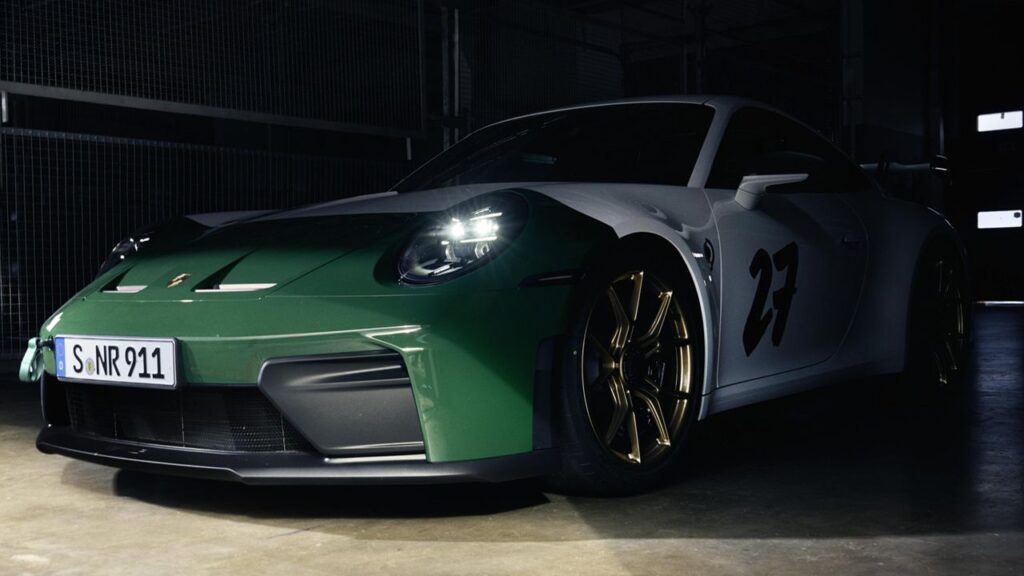
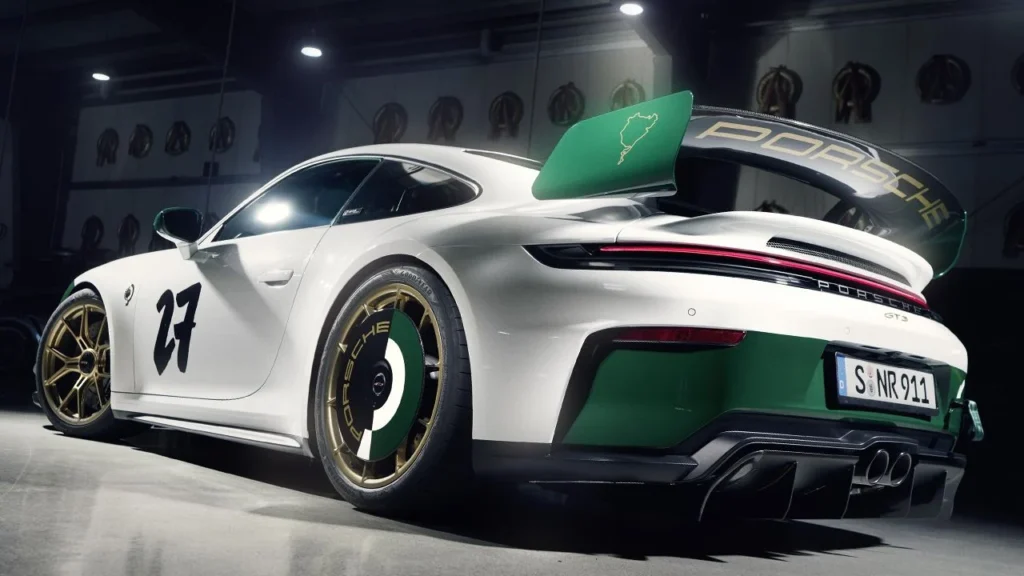
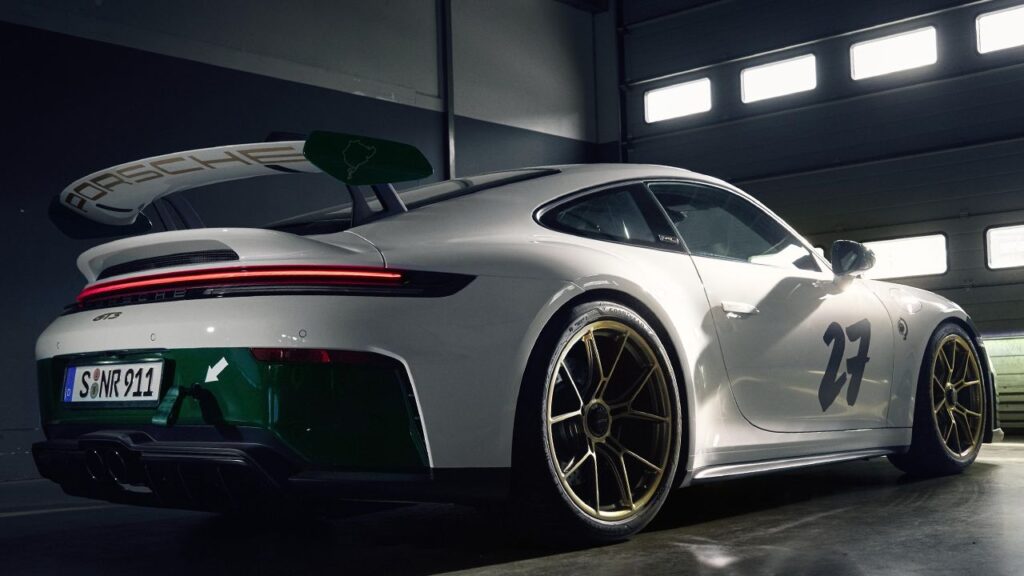
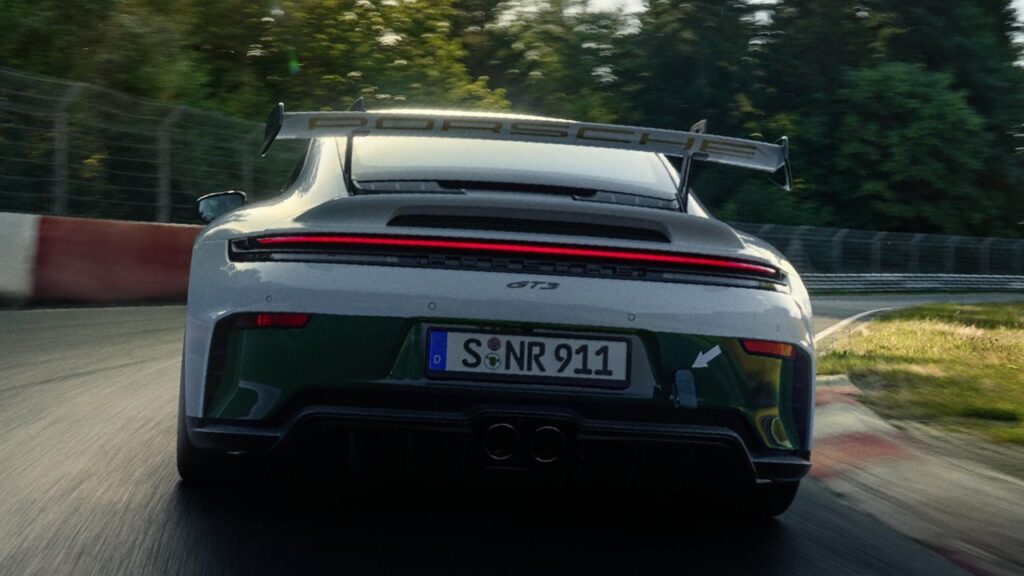
The front section and rear trim receive a green protective wrap.
That treatment does more than simply reference the Nürburgring’s nickname.
Historically, factory race teams often used coloured markings to help distinguish visually similar cars from one another during competition.
Porsche takes that practical racing tradition and turns it into a design feature.
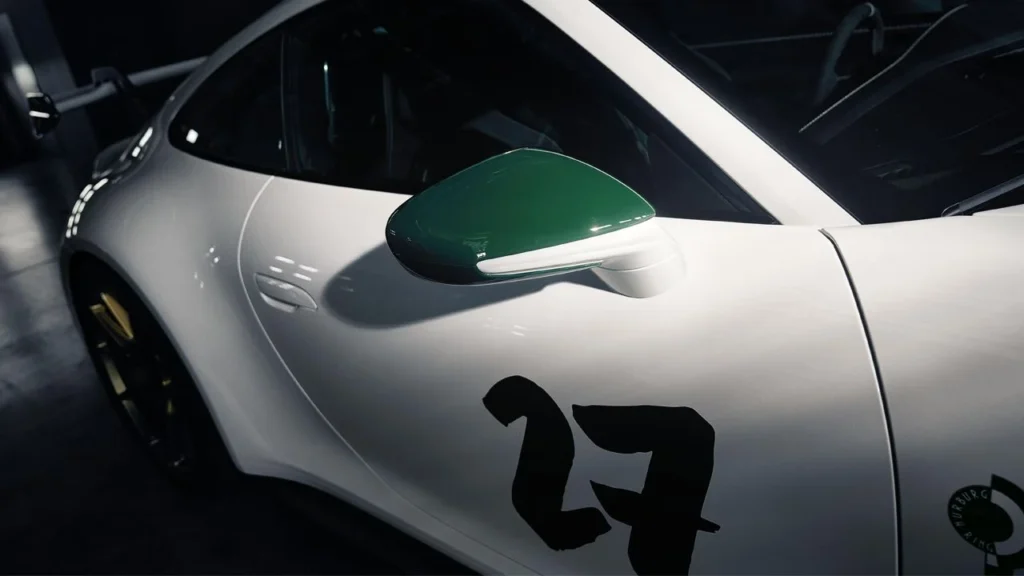
The mirror housings receive green accents.
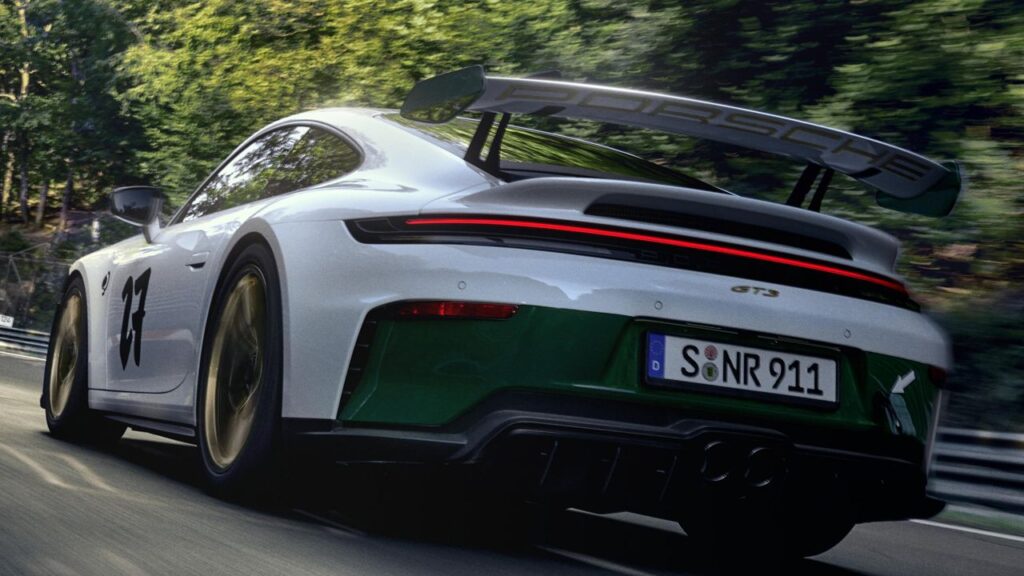
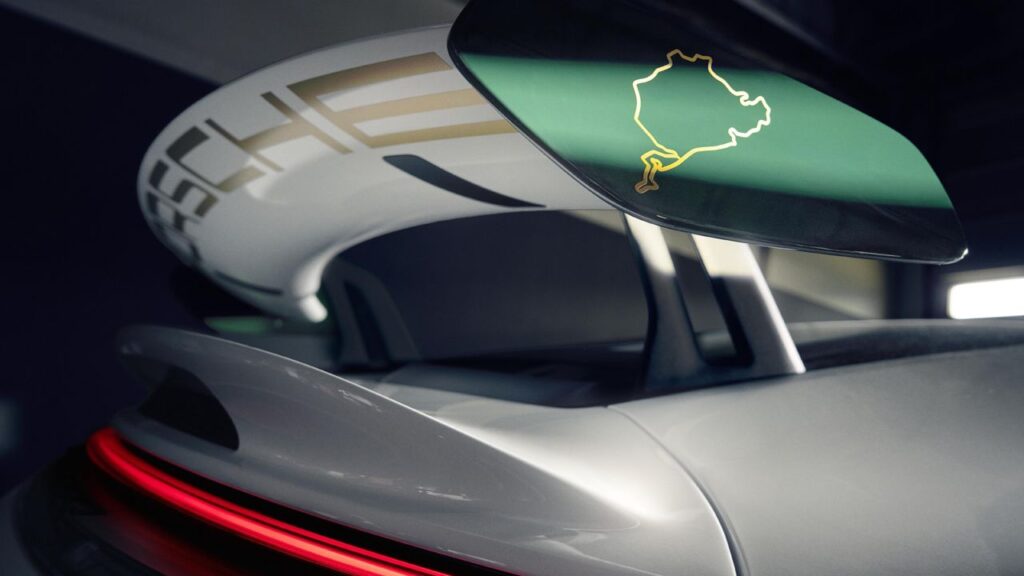
The rear-wing sideplates are green.
The tow lugs are green.
Inside, the roll cage becomes green.
The entire car feels connected by one visual language.
California Gold Wheels
Then comes the contrast.
The 20-inch front and 21-inch rear forged aluminium GT3 wheels are finished in high-gloss California Gold.
The centre-lock mechanisms remain satin black.
The combination of white or silver bodywork, green detailing and gold wheels could easily become theatrical.
Instead, it works.
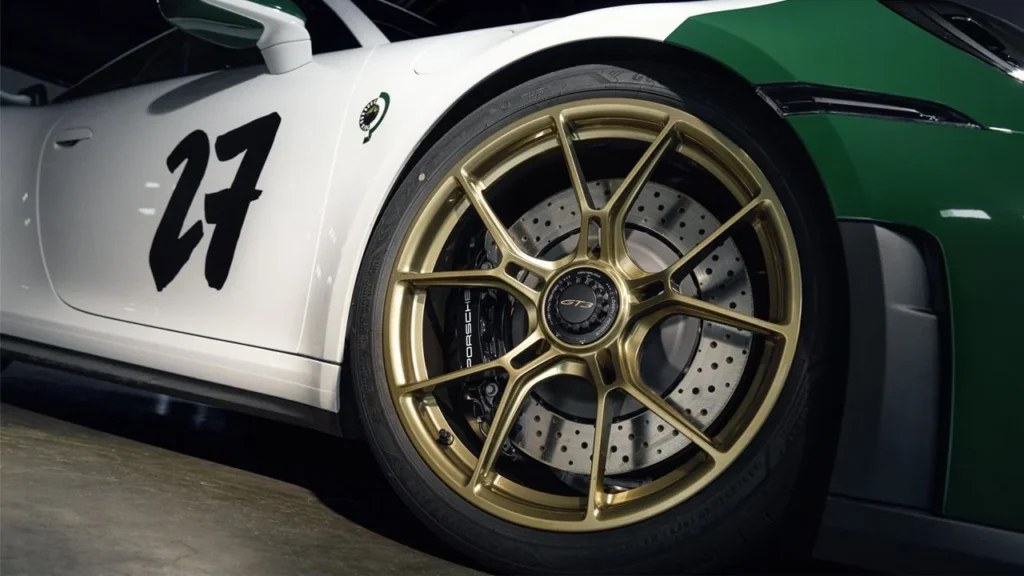
The gold provides warmth.
The green provides identity.
The underlying GT3 proportions keep everything disciplined.
It is a surprisingly elegant specification for a car celebrating one of the world’s most brutal circuits.
Gunther Werks GXR-Evo: The Ultimate Air-Cooled 993 Track Machine
Historic Nürburgring Logos
The body receives historic Nürburgring logos across the front wings.
These are not contemporary track graphics.
They reference older visual identities associated with the circuit.
The B-pillars also carry exclusive anniversary badges incorporating the Nürburgring track layout, finished in California Gold.
Every element reinforces the same story.
This is not simply a GT3 wearing green accents.
It is a GT3 built around one place.
Choose Your Own Race Number
Customers can specify a race number between 0 and 999.
The number appears on the bonnet, doors and rear window.
More interestingly, Porsche has developed a specific typeface inspired by the handwritten graffiti that covers sections of the Nordschleife.
That is a brilliant detail.
The circuit’s graffiti has become part of its identity.
Names.
Messages.
Tributes.
Personal statements.
The asphalt and surrounding surfaces have effectively become an ever-changing visual archive of people who have visited the track.
Porsche turns that culture into typography.
A Golden Porsche Sun Strip
The windscreen receives another motorsport-inspired element.
A sun strip runs across the upper section of the glass.
Functionally, it helps reduce glare when the sun sits low.
Visually, it carries gold Porsche lettering.
Again, Porsche uses a genuine motorsport element rather than simply attaching decorative graphics.
That distinction matters.
Almost every detail has some relationship with how racing cars actually function.
“Welcome to the Green Hell”
Open the door and five words appear across the illuminated sill:
Welcome to the Green Hell.
It immediately establishes the atmosphere.
There is nothing subtle about the message.
This is a car designed around one of the world’s most intimidating circuits.
The LED door projectors continue the theme by casting an illuminated outline of the Nürburgring onto the ground beside the car.
Before the engine even starts, the track is already part of the experience.
A Green Roll Cage
The interior combines black leather and Race-Tex with a striking green rear roll cage.
It visually connects the cabin with the exterior details while reinforcing the GT3’s motorsport character.
The driver’s lightweight bucket seat receives another distinctive treatment.
Green backing material is visible through graduated perforations across the centre and bolsters.
The effect is subtle from a distance.
Closer inspection reveals the colour beneath the surface.
Even the seats become part of the Nürburgring theme.
Driver and Passenger Are Different
Porsche deliberately differentiates the two seats.
The driver’s headrest receives an embroidered Nürburgring logo.
The passenger seat receives GT3 lettering.
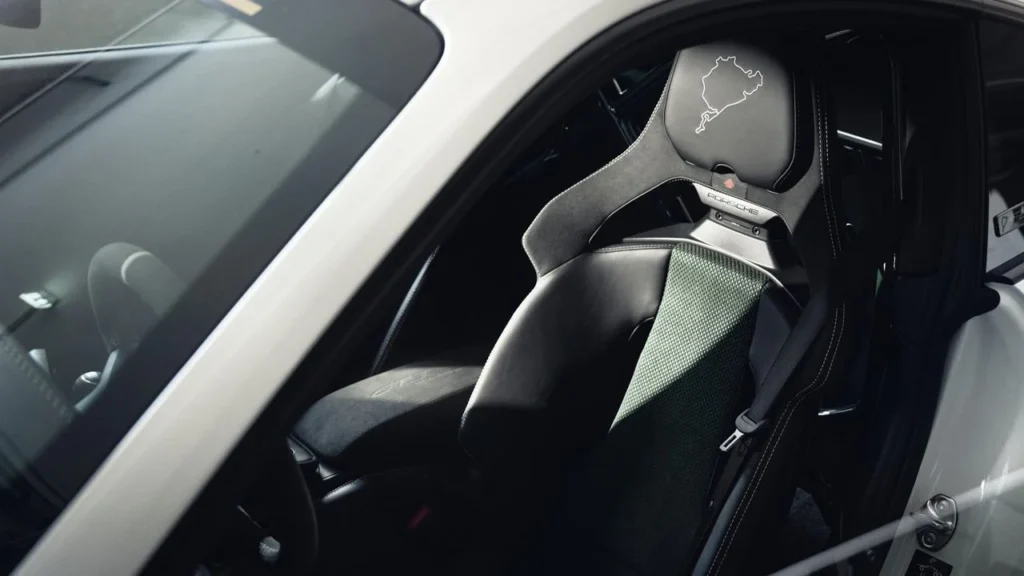
The headrest pads can also be removed when wearing a helmet on circuit.
This is the type of detail that makes sense only in a car genuinely expected to be driven hard.
Not simply displayed.
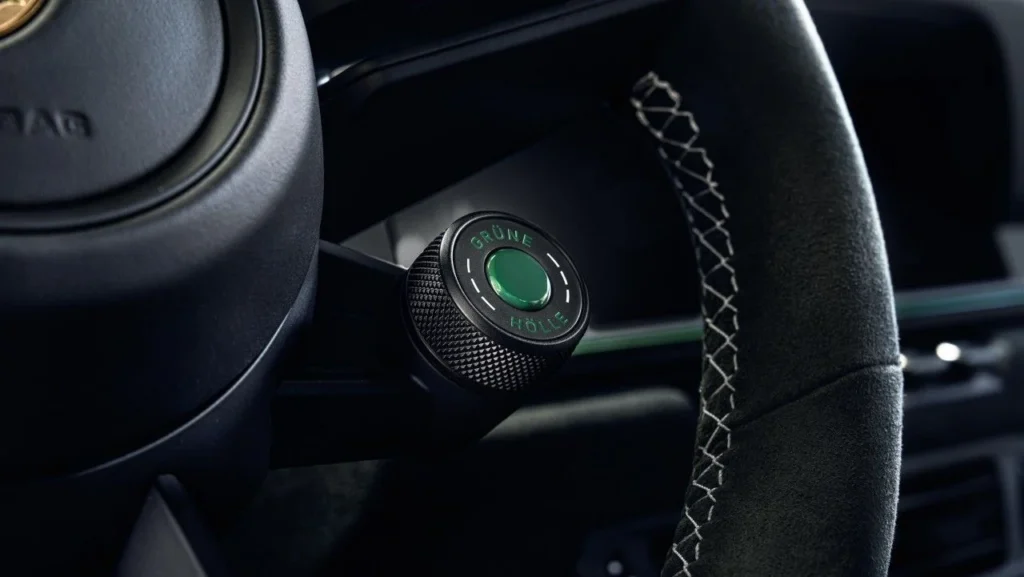
Grüne Hölle on the Steering Wheel
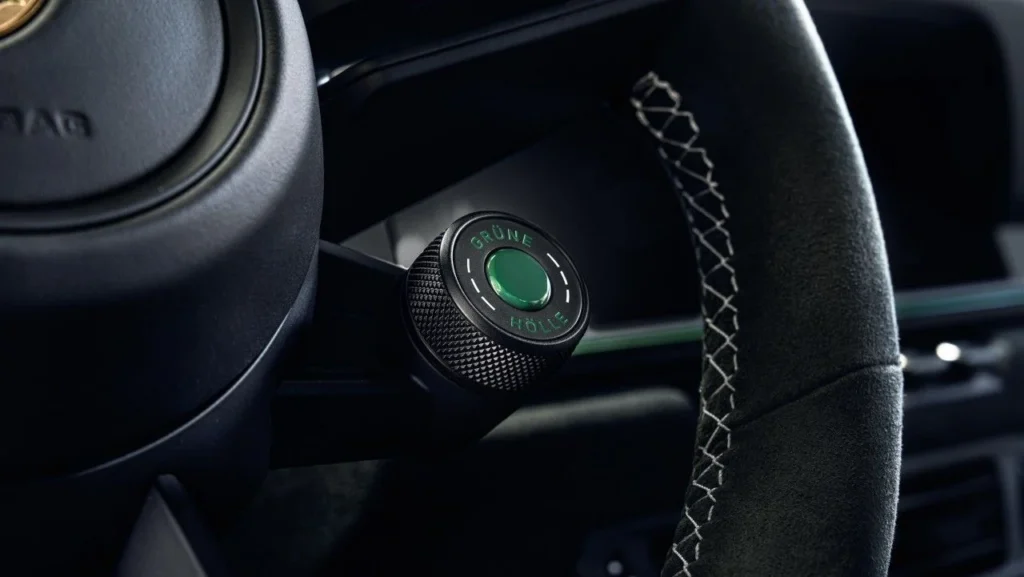
The mode selector on the GT steering wheel carries the words:
Grüne Hölle.
Green Hell.
Even the push-to-pass button is finished in green.
The dashboard trim receives a high-gloss green finish.
Gear markings are green.
Almost every functional area of the cockpit includes some visual reference to the circuit.
Normally, such a concentration of themed details could become excessive.
Here, the coherence prevents that.
Everything points to the same place.
Stitching Inspired by Nürburgring Kerbs
Even the stitching carries meaning.
The upper dashboard and doors use a special cross-pattern design.
Three black stitching lines combine with one in GT Silver.
Porsche says the arrangement takes inspiration from the appearance of Nürburgring kerbs.
Again, this is a tiny detail.
But that is precisely why it works.
The best limited editions reveal themselves gradually.
Not everything needs to announce itself from ten metres away.
The Manthey Kit Changes the Character Completely
For customers who want the anniversary model to become considerably more serious, Porsche offers an optional Manthey Kit finished to match the car’s colour scheme.
Manthey is based directly beside the Nürburgring.
Few companies could be more appropriate for this particular project.
The package includes revised suspension.
Optimised braking components.
And a comprehensive aerodynamic programme.
With the kit installed, the GT3 generates up to 540 kilograms of downforce at 285 km/h.
At that point, the anniversary model moves far beyond visual celebration.
It becomes a deeply serious circuit machine.
Porsche 911 GT3 RS Sonderwunsch Macadamia Metallic
6:50.853 on the Nordschleife
The Manthey-equipped GT3 has already demonstrated its potential.
Reigning DTM champion Ayhancan Güven recorded a Nordschleife lap time of 6:50.853.
That figure matters.
But interestingly, Porsche does not make it the central message of the anniversary edition.
The car itself exists to celebrate the circuit.
The Manthey package simply proves that the tribute has genuine performance credibility.
This is not a Nürburgring-themed GT3 that merely looks prepared for the track.
It actually is.
Sonderwunsch Manthey Experience
Porsche goes even further by offering owners something that cannot be attached to the car.
An experience.
Buyers can participate in the Sonderwunsch Manthey Experience during the anniversary year.
Manthey’s headquarters sit immediately beside the Nürburgring.
The programme offers owners behind-the-scenes access to the company, interaction with motorsport specialists and a deeper understanding of what the Manthey Kit actually does.
This is a smart evolution of the limited-edition concept.
The owner does not simply receive a car celebrating Nürburgring culture.
They are invited into that culture.
Manthey and Porsche
The relationship between Porsche and Manthey is unusually close.
Manthey has spent decades developing and racing Porsche GT cars.
Porsche AG has held a majority stake in the company since 2013.
The partnership combines factory engineering with specialist circuit expertise.
That makes Manthey an almost perfect representation of the relationship between road car and racing car.
The anniversary GT3 sits directly in the middle.
A road-legal Porsche.
Developed around racing philosophy.
Celebrating the circuit where much of that philosophy is tested.
A Matching Porsche Design Chronograph
Naturally, Porsche has also created a watch.
But this is not a generic branded accessory.
The Chronograph 1 – 911 GT3 100 Jahre Nürburgring is available exclusively to buyers of the car.
Its titanium case receives a black coating.
The dial carries the historic Nürburgring logo.
The strap uses genuine Porsche interior leather.
Its perforation pattern reveals green material underneath, mirroring the seats.
GT Silver stitching matches the cabin.
Even the movement rotor is designed to resemble the car’s California Gold wheels.
The watch is built by Porsche Design in Switzerland.
Car and chronograph effectively become one specification.
Porsche’s First Nürburgring Appearance
The historical relationship between Porsche and the circuit stretches back to the early years of the marque.
On 31 May 1953, Porsche competed in the Eifelrennen with the 550 Spyder.
Only a few months later, another 550 Spyder appeared during practice for the German Grand Prix carrying the newly developed Type 547 engine.
That engine later became known as the legendary Fuhrmann engine.
From 1954 onwards, the name Carrera became associated with it.
The Nürburgring therefore played a role not simply in Porsche racing history, but in terminology still used across the company’s road cars today.
Porsche’s First 1,000-Kilometre Victory
In 1967, Porsche won the Nürburgring 1,000-kilometre race for the first time with the Porsche 910.
More victories followed.
The circuit became one of the defining proving grounds for Porsche’s endurance-racing machinery.
And over time, the relationship extended increasingly towards road-car development.
The Green Hell stopped being somewhere Porsche merely raced.
It became somewhere Porsche engineered cars.
TECHART Tsport R: A Purist 911 Reimagined for the Driver
Stefan Bellof and the 956
Few Nürburgring moments are more legendary than Stefan Bellof’s 1983 lap.
Driving a Porsche 956 during qualifying, Bellof recorded 6:11.13.
The lap became part of Nürburgring mythology.
For decades, nothing came close.
Its combination of speed, commitment and the extraordinary capabilities of Group C machinery established Bellof as one of the great names associated with the circuit.
For Porsche, the record became another chapter in an already deep relationship with the Nordschleife.
Timo Bernhard and the 919 Hybrid Evo
Then, in 2018, Porsche returned with something even more extraordinary.
The 919 Hybrid Evo.
Freed from racing regulations, Porsche’s engineers transformed the Le Mans prototype into an unrestricted demonstration of what the platform could achieve.
Timo Bernhard completed the Nordschleife in 5:19.546.
It remains one of the most astonishing laps ever recorded.
Again, Porsche did not simply use Nürburgring history.
It created more of it.
Why Porsche Tests Here
There is another side to the relationship.
Away from race weekends and record attempts, Porsche engineers use the Nürburgring as a brutal development laboratory.
The track can simulate enormous levels of stress within a relatively short distance.
High-speed corners load the suspension.
Compressons punish dampers.
Crests test stability.
Rough sections expose structural weaknesses.
Long braking zones generate extreme heat.
Constantly changing surfaces challenge traction and chassis calibration.
A few kilometres here can represent far more wear than the equivalent distance on a normal road.
That efficiency makes the Nordschleife invaluable.
Singer vs Gunther Werks — Defining the Ultimate Porsche Reimagined
There Is Nürburgring in Every Porsche
This is perhaps the most important reason the anniversary GT3 works.
The relationship is genuine.
Porsche is not attaching Nürburgring branding to a random model because the name sounds exciting.
The circuit genuinely influences how Porsche develops cars.
Especially GT cars.
The GT3 itself is inseparable from that process.
Its suspension.
Aerodynamics.
Braking.
Cooling.
Tyres.
Chassis balance.
All have been developed through countless kilometres of testing on tracks including the Nordschleife.
The anniversary edition simply makes that invisible connection visible.
Why the GT3 Was the Right Car
Porsche could have chosen almost any model.
A Turbo S would have been faster.
A GT3 RS more extreme.
A Carrera perhaps more broadly accessible.
The GT3 feels more appropriate than all of them.
It occupies the perfect position between road and race.
Naturally aspirated.
Rear-wheel drive.
Available with a manual gearbox.
Serious enough for repeated circuit use.
Civilised enough to drive there.
The GT3 represents exactly what Nürburgring culture has become for many enthusiasts.
Drive to the circuit.
Complete laps.
Drive home.
A Love Letter, Not a Lap-Time Special
That may ultimately be the most charming thing about the 911 GT3 100 Jahre Nürburgring.
Porsche could easily have turned the anniversary into another stopwatch exercise.
More power.
Stickier tyres.
A lap record.
A press release built around tenths of a second.
Instead, the standard anniversary car makes no new performance claim.
It simply celebrates.
The Green Hell graphics.
Gold wheels.
Historic logos.
The graffiti-inspired race number.
The roll cage.
The seat details.
The watch.
The Manthey experience.
Together they create something far more emotional than another specification sheet.
The Nürburgring Isn’t Just Somewhere Porsche Goes
The Porsche 911 GT3 100 Jahre Nürburgring works because it celebrates something deeper than racing success.
The Nürburgring has shaped Porsche.
The circuit has tested its cars.
Broken them.
Improved them.
Provided victories.
Created legends.
And forced generations of engineers to discover weaknesses before customers ever could.
A century after the Nürburgring opened, Porsche has created a GT3 that makes that relationship visible.
Not through more horsepower.
But through details.
Green paint.
Gold wheels.
A handwritten number.
A roll cage.
A map of 20.8 kilometres of asphalt projected onto the ground when the door opens.
One hundred years.
One hundred cars.
And countless laps connecting Porsche with the Green Hell.
This is not another Nürburgring record car.
It may be something more meaningful.
A thank-you note with a 9,000-rpm flat-six.