
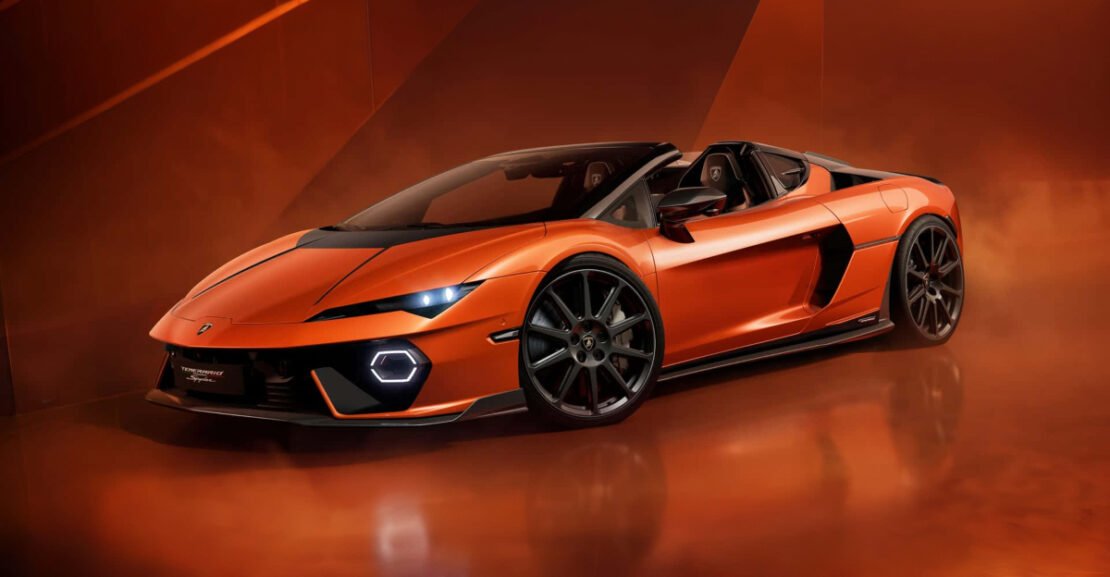
Lamborghini unveils the Temerario Spyder, combining a 920 CV twin-turbo V8 hybrid powertrain with the first retractable hardtop in the marque’s open-top production history. With extraordinary engineering, unmistakable Italian design and a 10,250-rpm engine, the latest creation from Sant’Agata Bolognese redefines the experience of driving a supercar beneath the open sky.
For more than half a century, Lamborghini has explored the emotional connection between extraordinary performance and open-air driving. From the pioneering Silhouette to the dramatic Diablo Roadster and the celebrated Gallardo and Huracán Spyders, each generation has offered a different interpretation of Italian automotive passion.
Now, that tradition enters an entirely new chapter.
The Lamborghini Temerario Spyder, unveiled in November 2026, transforms the marque’s latest electrified supercar into an exceptionally sophisticated open-top machine.
With 920 CV, a twin-turbocharged V8 capable of reaching 10,250 rpm and acceleration from 0 to 100 km/h in just 2.8 seconds, the new Spyder brings extraordinary performance to a vehicle designed around the sensations of open-air motoring.
Yet its most important innovation lies above the passenger compartment.
For the first time in Lamborghini’s history, a production Spyder incorporates a fully retractable hardtop, replacing the fabric and removable-roof solutions traditionally associated with the marque.
Developed through an ambitious structural and aerodynamic engineering programme, the roof is designed to preserve the Temerario’s driving dynamics while creating a more direct connection between the driver, the engine and the surrounding environment.
The result is considerably more than a conventional convertible interpretation.
It is a new expression of Lamborghini’s philosophy: combining emotional intensity, technological ambition and an unmistakable sense of occasion.
Fifty Years of Lamborghini Open-Air Supercars
The arrival of the Temerario Spyder carries particular historical significance.
In 1976, Lamborghini introduced the Silhouette, establishing a new tradition of open-top, mid-engined production sports cars.
The concept would evolve through the Jalpa, the spectacular Diablo Roadster, the Gallardo Spyder and successive generations of the Huracán Spyder.
Each brought its own personality to the experience.
The Diablo Roadster introduced extraordinary visual theatre, while the Gallardo Spyder made open-air Lamborghini performance accessible to a wider international clientele.
The Huracán Spyder later combined naturally aspirated V10 performance with increasingly sophisticated chassis technology.
The Temerario Spyder continues this lineage but introduces two fundamental changes.
The first is electrification, with a high-performance hybrid powertrain replacing the naturally aspirated V10 architecture of its predecessor.
The second is the adoption of a retractable hardtop, an engineering solution previously absent from Lamborghini’s production Spyder range.
Together, these innovations reflect the brand’s determination to preserve its emotional identity while exploring new technological possibilities.
Lamborghini Revuelto SV: The Super Veloce Legacy Enters the Hybrid Era
A Retractable Hardtop That Changes Everything
The Temerario Spyder’s defining feature is its newly developed retractable roof.
Unlike the traditional fabric systems used on previous Lamborghini convertibles, the new roof features rigid panels operated entirely electrically.
The mechanism uses ten electric actuators, eliminating the conventional electro-hydraulic architecture often associated with folding hardtops.
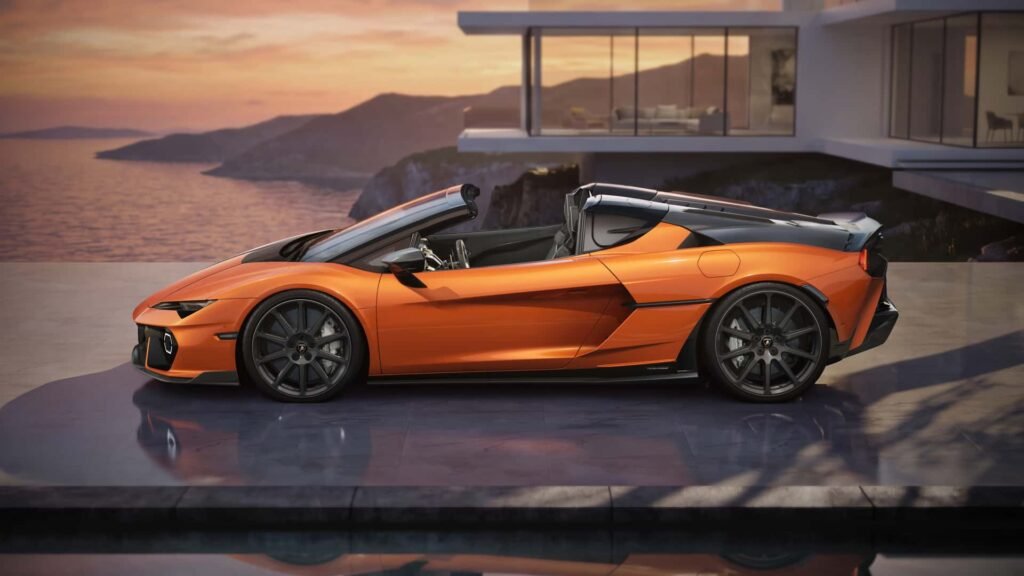
Opening or closing takes approximately 17 seconds and can be performed at speeds of up to 50 km/h.
However, the most remarkable element is the way the roof is stored.
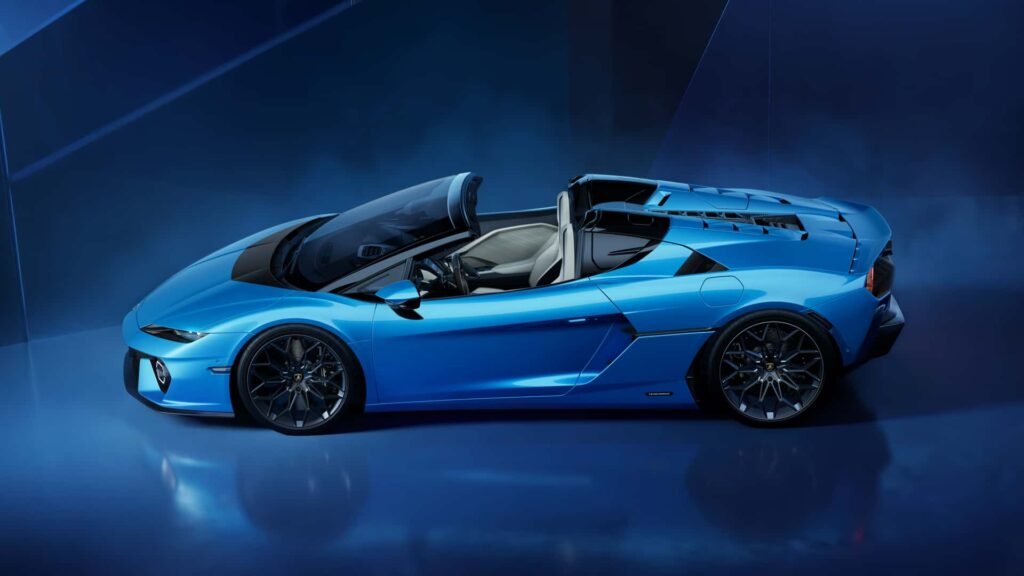
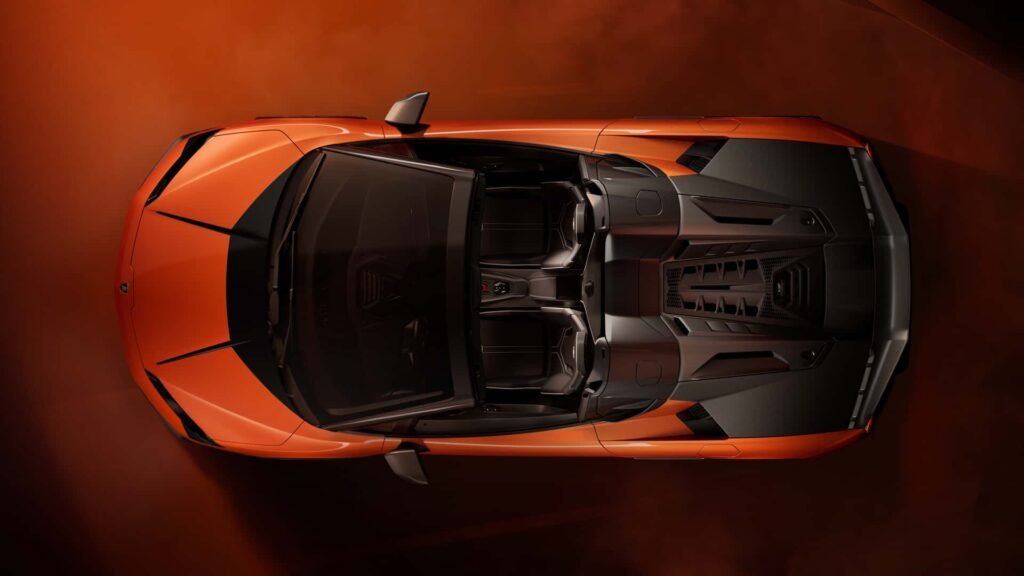
Rather than folding horizontally into a compartment above the engine, it moves into a patented vertical position immediately behind the seats.
This unconventional arrangement provides several advantages.
By positioning the roof within the central portion of the vehicle, Lamborghini has preserved the Spyder’s front-to-rear weight distribution.
More unusually, the car’s centre of gravity actually becomes 3 millimetres lower when the roof is open compared with the closed configuration.
The difference may appear small, but it illustrates the level of precision involved in developing the mechanism.
Conventional retractable roofs can introduce additional weight in locations that negatively affect vehicle balance.
Lamborghini has instead developed a system intended to preserve the handling characteristics of the original coupé.
It is a particularly elegant example of how intelligent engineering can transform an apparent compromise into a functional advantage.
Designed by Centro Stile Lamborghini
The Temerario Spyder’s exterior has been developed under the direction of Mitja Borkert, Design Director of Automobili Lamborghini.
Rather than simply removing the roof from the coupé, the team at Centro Stile Lamborghini reconsidered the relationship between the passenger compartment, engine cover and rear bodywork.
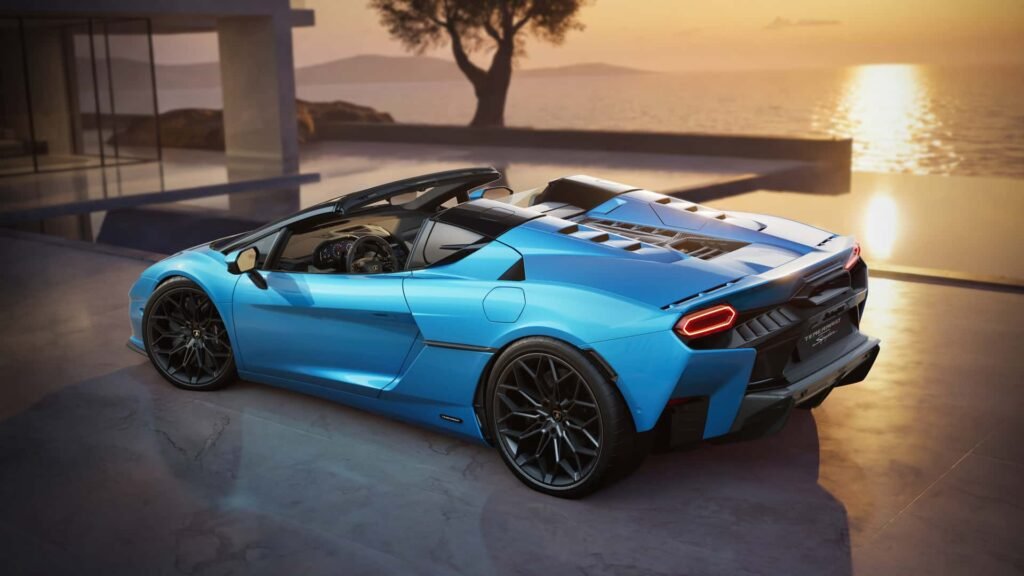
The result retains the Temerario’s distinctive proportions while introducing two sculptural rear cowls behind the seats.
Their geometric design creates a visual connection between the open cockpit and the rear of the automobile.
The surfaces also emphasize Lamborghini’s characteristic hexagonal design language.
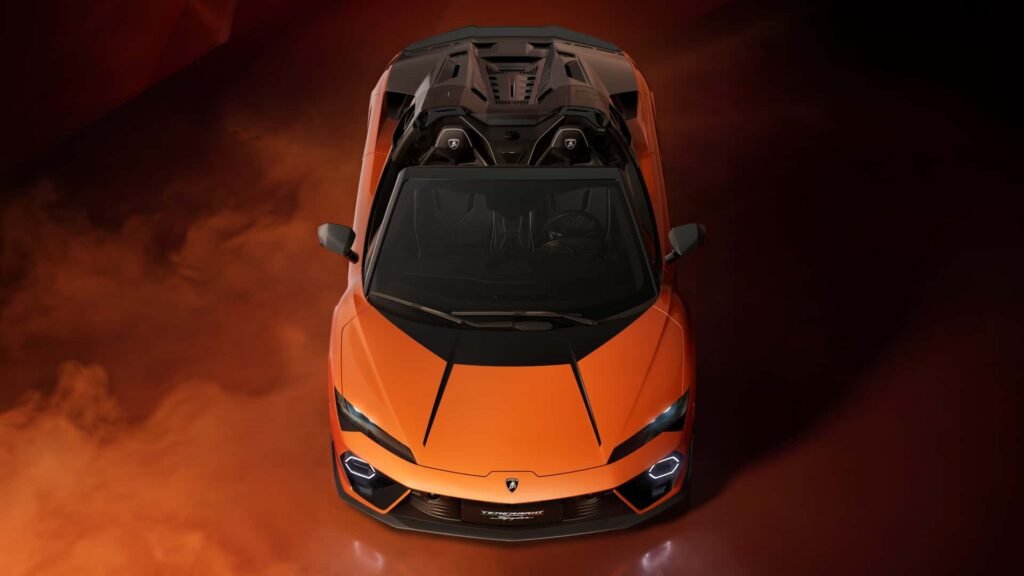
When the retractable hardtop is closed, the Spyder maintains a clean, continuous silhouette closely related to the coupé.
With the roof lowered, the car reveals an entirely different personality.
The rear cowls become more prominent, the cabin feels more integrated with the surrounding environment and the powerful V8 becomes an even greater part of the visual composition.
Importantly, Lamborghini has retained the ability to admire the engine through its specially designed cover.
This is a defining aspect of the brand’s design philosophy.
Mechanical engineering is not something to conceal. It is an essential part of the automobile’s aesthetic identity.
A 920 CV Hybrid V8 That Revives the Art of High-Revving Performance
At the heart of the Temerario Spyder lies one of the most technically ambitious engines developed by Lamborghini.
The powertrain combines a 4.0-litre twin-turbocharged V8 with three axial-flux electric motors, creating a total system output of 920 CV (677 kW).
The combustion engine alone develops 800 CV, an extraordinary figure for a road-going four-litre V8.
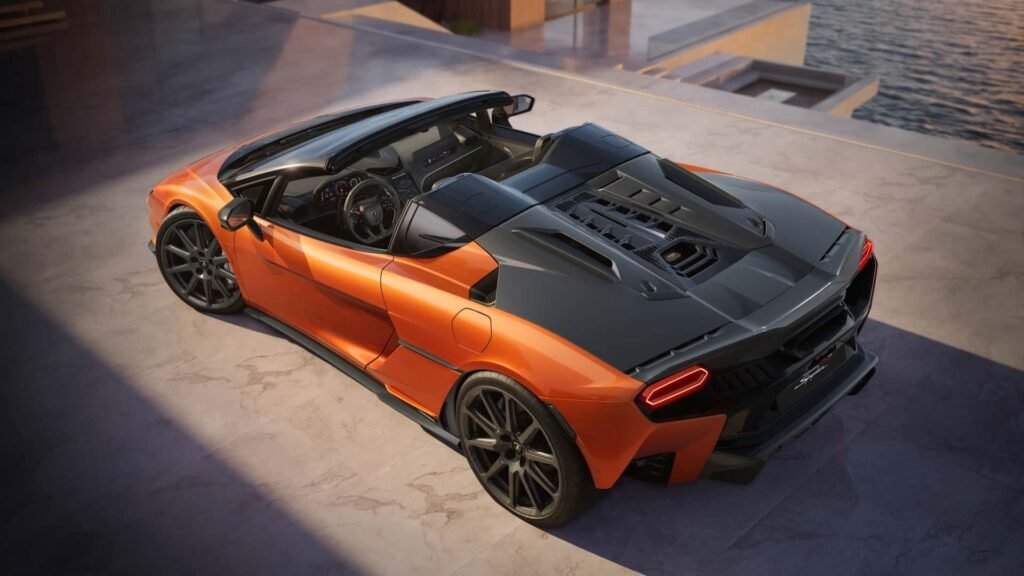
Its architecture incorporates a 180-degree flat-plane crankshaft, titanium connecting rods and advanced internal components engineered to withstand exceptionally high rotational speeds.
The two turbochargers are positioned within the engine’s V configuration and operate at boost pressures of up to 2.5 bar.
Yet the most fascinating characteristic is its ability to rev to 10,000 rpm.
With Launch Control engaged, the limit briefly rises to 10,250 rpm.
For a twin-turbocharged production V8, this represents an exceptionally ambitious engineering achievement.
Lamborghini Urus SE Performante: The Evolution of the Ultimate Super SUV
The electric motors complement the combustion engine rather than attempting to replace its emotional character.
Two motors drive the front axle, while a third is integrated into the rear powertrain architecture.
Together, they provide immediate torque response, advanced traction management and electrified all-wheel drive.
In a market increasingly defined by very high power figures, the Temerario’s appeal lies not simply in its output, but in the unusual combination of turbocharged performance, electrification and extremely high engine speeds.
Supercar Performance Without the Roof
Removing the fixed roof from a high-performance automobile traditionally introduces additional engineering challenges.
A convertible requires structural reinforcement to compensate for the loss of the roof’s contribution to body rigidity.
The Temerario Spyder addresses this through an extensively developed aluminium spaceframe.
Compared with the previous Huracán Spyder, Lamborghini reports a 6% increase in static torsional rigidity, alongside improvements in dynamic bending and torsional stiffness.
The new architecture also substantially reduces the number of structural components and heat-intensive welds compared with the Huracán EVO Spyder.
These improvements contribute to a chassis intended to preserve the precision and responsiveness associated with the Temerario coupé.
The official performance figures are remarkable.
Acceleration from 0 to 100 km/h takes just 2.8 seconds, while 200 km/h is reached in 7.3 seconds.
Maximum speed is 343 km/h (213 mph).
Such figures place the Temerario Spyder among the fastest contemporary open-top supercars.
Yet outright speed is only one component of the experience.
With the roof lowered, the combination of immediate electric torque, high-revving V8 performance and direct exposure to the surroundings creates an entirely different relationship between driver and machine.
The Sound of a 10,000-RPM V8
For Lamborghini, sound has always been an essential part of the supercar experience.
The transition from the Huracán’s naturally aspirated V10 to the Temerario’s twin-turbocharged V8 introduced a different acoustic character.
However, the extraordinary operating range of the new engine creates an unusually intense soundtrack.
The flat-plane crankshaft produces a distinctive high-frequency character, while the engine’s acoustic intensity increases progressively as it approaches 10,000 rpm.
In the Spyder, this experience becomes even more direct.
An electronically adjustable rear window allows occupants to control how much engine sound enters the cabin, independently of the roof’s position.
This means the driver can experience more of the V8’s mechanical soundtrack even with the hardtop closed.
For customers seeking an even more expressive acoustic character, Lamborghini offers an optional titanium exhaust system developed with Akrapovič.
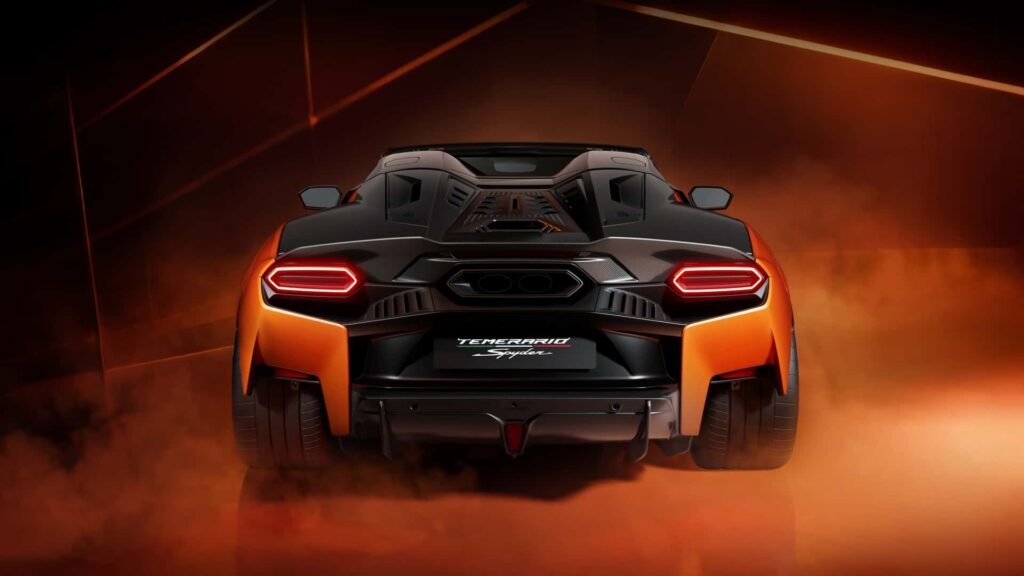
Weighing approximately 11.4 kilograms, the system is around 12% lighter than the standard exhaust and features distinctive black tailpipes.
Its sound has been engineered to provide a deeper tone at lower engine speeds, becoming progressively sharper as the V8 approaches its upper rev range.
In an open-top supercar, this connection between mechanical sound and driving experience becomes an essential part of its identity.
Aerodynamics Designed Around Open-Air Comfort
Developing a supercar capable of exceeding 340 km/h while offering a refined open-air experience requires much more than a sophisticated roof mechanism.
The Temerario Spyder features extensive aerodynamic development around the windscreen, roof structure and rear bodywork.
These components work together to manage airflow above and around the passenger compartment.
With the roof lowered, aerodynamic turbulence becomes particularly important.
Excessive airflow can produce unwanted noise, discomfort and instability inside the cabin.
Lamborghini has therefore carefully shaped the windscreen cross-member and the rear roof elements to reduce turbulence while preserving the car’s dramatic proportions.
The adjustable rear window provides another degree of control.
By regulating its position, occupants can modify airflow and the intensity of engine sound entering the cabin.
The objective is not to eliminate the sensation of driving an open-top supercar.
Instead, it is to provide a more refined and adaptable experience without compromising the emotional qualities that make a Spyder desirable.
A More Spacious and Refined Interior
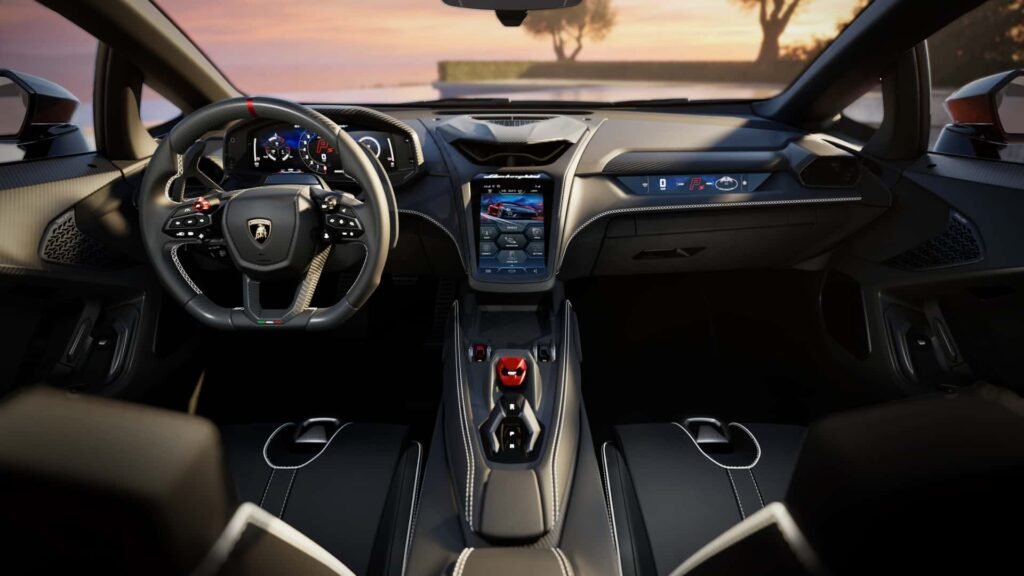
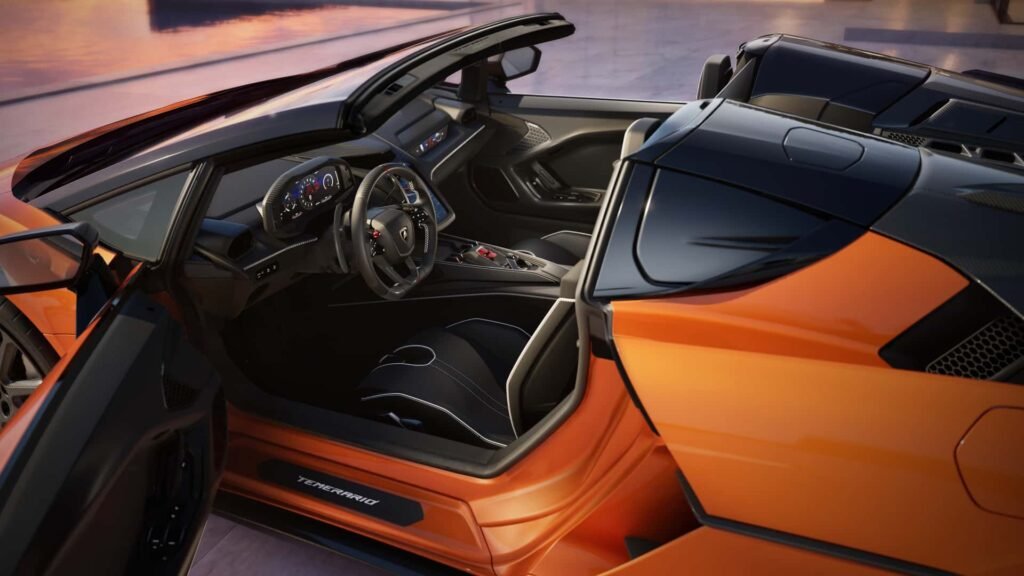
The Temerario Spyder also benefits from significant improvements in cabin ergonomics compared with the Huracán EVO Spyder.
Lamborghini reports an additional 46 mm of legroom, 22 mm of headroom and 9 mm of shoulder and elbow room.
The cabin is designed to accommodate occupants approaching two metres in height.
These improvements are particularly relevant for a mid-engined supercar, where exterior proportions and packaging requirements often restrict interior space.
The Spyder also introduces a three-level neck-warming system integrated into the seats.
This feature allows occupants to enjoy open-air driving in cooler conditions, extending the usability of the convertible beyond warm summer days.
The climate and aerodynamic systems work together to create a more comfortable environment when the roof is lowered.
A 112-litre front luggage compartment provides additional practicality, while suspension calibration has been developed to reduce secondary vibrations over uneven road surfaces.
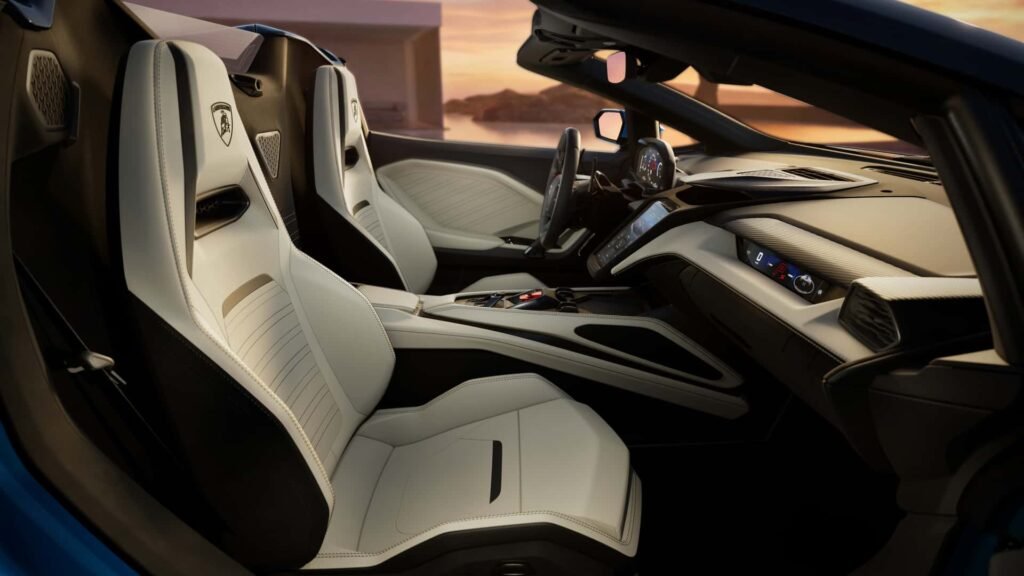
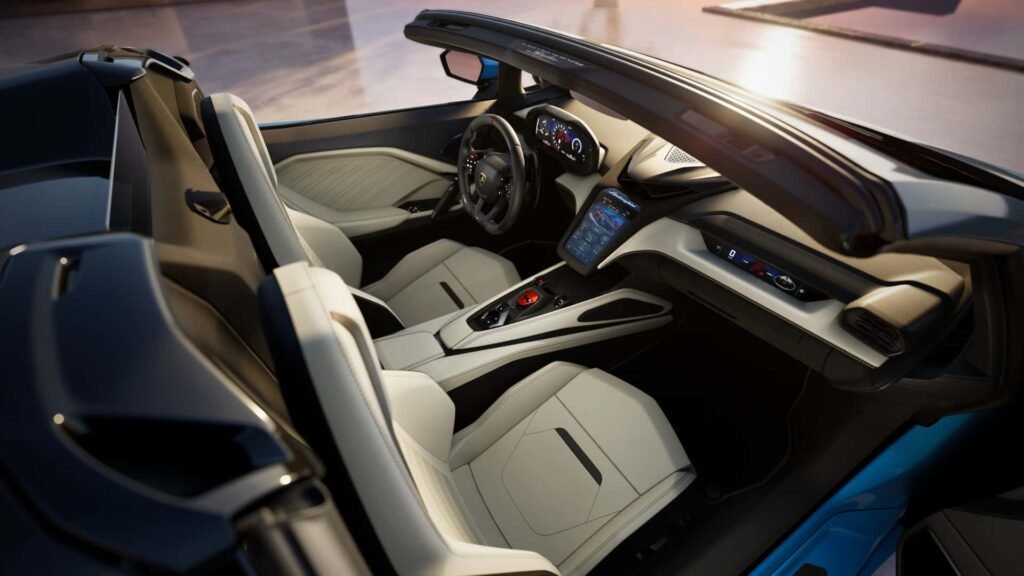
The interior retains the distinctive digital architecture of the Temerario family, combining advanced displays with a driver-focused layout.
For Lamborghini, the objective is to preserve the visual drama of a contemporary supercar while making everyday driving substantially more accommodating.
Thirteen Driving Experiences and Electrified All-Wheel Drive
The Temerario Spyder offers an extensive range of driving configurations.
Through combinations of the Città, Strada, Sport, Corsa and Corsa ESC Off settings with Recharge, Hybrid and Performance powertrain strategies, drivers can access 13 distinct driving experiences.
Each modifies the relationship between the combustion engine, electric motors, chassis systems and electronic stability controls.
In Città mode, the Temerario can operate using electric propulsion alone, with up to 190 CV available.
This provides a very different character from the full performance configuration.
At the opposite extreme, Corsa mode maximizes the car’s dynamic capabilities for more demanding driving environments.
A three-level Drift Mode also allows the driver to explore controlled oversteer, supported by the sophisticated electric all-wheel-drive system.
These features demonstrate the versatility of Lamborghini’s hybrid architecture.
The same automobile can move quietly through an urban environment before transforming into an exceptionally powerful and engaging supercar.
For the Spyder, the additional dimension of open-air driving creates an even greater variety of experiences.
Alleggerita: A More Focused Temerario Spyder
For buyers seeking a more performance-oriented specification, Lamborghini offers the Alleggerita package.
The package incorporates extensive carbon-fibre-reinforced polymer components, including the front splitter, rear engine cover, underbody elements and exterior trim.
Additional lightweight details extend into the interior.
Optional carbon-fibre wheels further reduce unsprung mass, an important consideration for steering response and suspension performance.
The result is a configuration developed around reducing unnecessary weight and emphasizing the vehicle’s dynamic potential.
The World’s First Lamborghini Temerario on Vossen VPS-3 Wheels
While the standard Temerario Spyder already offers extraordinary acceleration and chassis technology, Alleggerita gives customers the opportunity to pursue a more focused interpretation.
The package also introduces a distinctive visual identity, particularly when combined with contrasting exterior finishes and exposed carbon-fibre components.
It is an option especially suited to owners who view their Lamborghini primarily as an enthusiast’s automobile rather than simply an expression of luxury.
Ad Personam: Nearly Unlimited Individual Expression
Personalization is another essential part of the Temerario Spyder’s character.
Through Lamborghini’s Ad Personam programme, customers can explore approximately 400 exterior colours, including historical shades, contemporary finishes and more unusual personalized specifications.
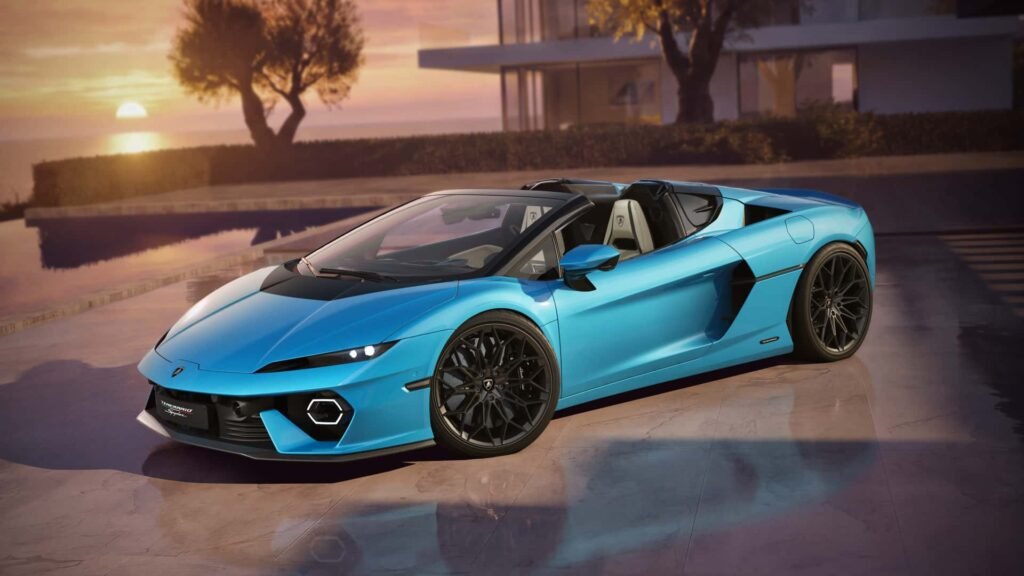
Among the available finishes are Blu Hal, Verde Agave, Oro Alba and Celeste Kami.
The programme also offers distinctive liveries, Italian Tricolore details, personalized illuminated entry sills and individually commissioned carbon-fibre interior plaques.
Customers can develop combinations of materials, colours and decorative elements intended to reflect their personal tastes.
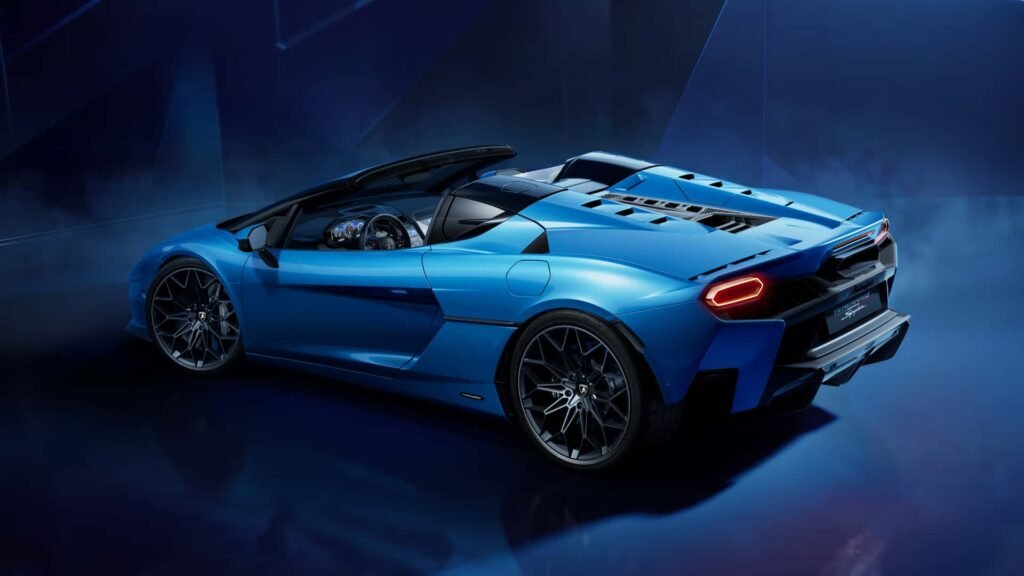
The model’s launch presentation highlights the elegant Blu Cepheus finish, while the more dynamic Alleggerita specification can be configured in striking Arancio Egon.
Such possibilities are increasingly important in the high-end supercar market.
For buyers accustomed to exceptional performance, individuality often becomes a defining element of the ownership experience.
The Temerario Spyder therefore provides not only a sophisticated engineering platform, but also an opportunity to create a highly personal interpretation of Lamborghini’s latest design philosophy.
Lamborghini Temerario Spyder Price and Availability
The Temerario Spyder enters the market above the equivalent coupé, reflecting the additional engineering and complexity of its retractable hardtop architecture.
For the United States, a starting price of approximately $390,900 has been reported.
This figure should not be interpreted as a confirmed European retail price, as local taxes, homologation requirements and optional equipment can substantially influence final pricing.
Orders opened around the model’s November 2026 presentation, with initial customer deliveries expected during spring 2027.
The Temerario Spyder is not announced as a numerically limited-production model.
Instead, it joins the Temerario coupé as a regular member of Lamborghini’s electrified supercar range.
For collectors and enthusiasts, the first year of production will nevertheless represent an important moment in the marque’s history.
The Spyder introduces a new roof architecture while continuing Lamborghini’s transition toward electrified high-performance vehicles.
From Gallardo and Huracán to a New Generation
The Temerario Spyder follows two particularly important models in Lamborghini’s modern history.
The Gallardo Spyder, introduced in 2005, helped establish a new generation of open-top Lamborghini ownership.
Its naturally aspirated V10, compact proportions and distinctive design made it one of the company’s most recognizable modern supercars.
The Huracán Spyder subsequently refined the formula, introducing increasingly sophisticated aerodynamics, electronics and chassis technology while retaining the emotional character of the V10.
The Temerario represents a much more fundamental technological shift.
Its hybrid architecture delivers substantially greater performance, while its high-revving twin-turbocharged V8 introduces a different mechanical personality.
The retractable hardtop further distinguishes it from its predecessors.
Yet the fundamental philosophy remains unchanged.
A Lamborghini Spyder should provide a more immediate connection between driver, automobile and surroundings.
It should transform every journey into an occasion.
And it should combine exceptional performance with a visual identity that is unmistakably Italian.
CAVËN Atelier HOMMAGE 26: Giugiaro Reimagines the Lamborghini Gallardo
The Future of Open-Air Lamborghini Performance
The Lamborghini Temerario Spyder demonstrates how contemporary engineering can preserve the emotional appeal of traditional supercars while introducing new forms of performance and usability.
Its 920 CV hybrid powertrain delivers extraordinary acceleration, but the vehicle’s most significant achievement may be the sophistication with which its systems work together.
The retractable hardtop preserves weight distribution and even lowers the centre of gravity when open.
The aluminium spaceframe provides greater rigidity than its predecessor.
Aerodynamic development improves passenger comfort, while the adjustable rear window allows the engine’s soundtrack to become an integral part of the experience.
The optional Alleggerita package adds another level of dynamic focus, and the Ad Personam programme ensures extensive possibilities for individual expression.
Together, these elements create an automobile that goes considerably beyond the conventional definition of a convertible supercar.
The Temerario Spyder is not simply the open-top version of Lamborghini’s latest V8 hybrid. It represents a new interpretation of what driving a Lamborghini beneath the open sky can feel like — combining technical precision, extraordinary performance and the unmistakable emotion of Italian automotive design.
Half a century after the Silhouette established a new chapter in Lamborghini’s history, the Temerario Spyder demonstrates that the appeal of open-air supercars remains as compelling as ever.