
For more than half a century, two letters have carried a very particular meaning at Lamborghini.
SV.
Super Veloce.
Not simply faster.
Lighter.
Sharper.
More focused.
More extreme.
From the Miura SV to the Diablo SV, Murciélago LP 670-4 SV and Aventador SV, the badge has traditionally marked the moment when Lamborghini takes an already extraordinary V12 flagship and removes another layer of restraint.
Now that philosophy enters a completely new technological era.
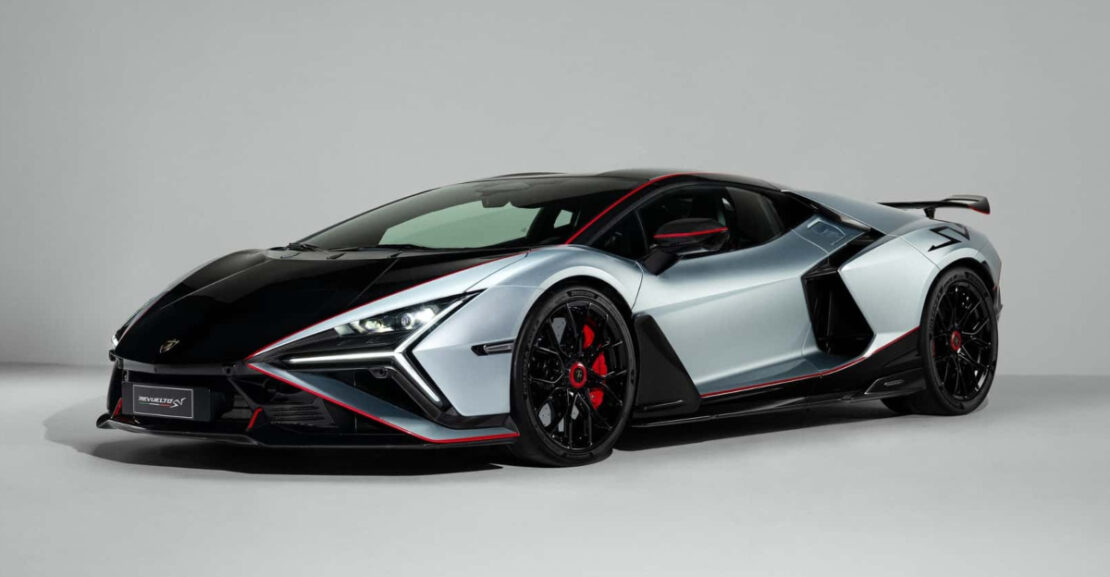
The Lamborghini Revuelto SV takes the company’s first V12 hybrid flagship and transforms it into the most powerful and fastest production Lamborghini ever built in Sant’Agata Bolognese.
Its naturally aspirated V12 remains.
Its three electric motors remain.
But almost everything surrounding them has been reconsidered.
More power and downforce.
More precise chassis control.
And, perhaps most importantly, a far greater emphasis on sustained circuit performance.
The Revuelto introduced Lamborghini’s hybrid future.
The Revuelto SV makes that future unmistakably Super Veloce.
The Return of Super Veloce
The SV lineage began 55 years ago with the Miura SV.
That original car established the philosophy that would define the badge for generations: take the existing flagship and refine every element around performance.
The Diablo followed.
Then the Murciélago LP 670-4 SV.
Then the Aventador SV.
Each interpreted the formula differently.
But the objective remained remarkably consistent.
Less compromise.
Greater precision.
A more intense relationship between driver and machine.
The Revuelto SV now becomes the first electrified Lamborghini to inherit that legacy.
And instead of treating hybridisation as something that dilutes the formula, Lamborghini uses it to push the idea further.
1,065 CV from a Hybrid V12
The mechanical heart remains Lamborghini’s magnificent 6.5-litre naturally aspirated V12.
On its own, the combustion engine produces 825 CV at 9,250 rpm and continues to approximately 9,500 rpm.
That alone would make the Revuelto SV remarkable.
But the V12 works alongside three electric motors.
Two axial-flux motors power the front axle.
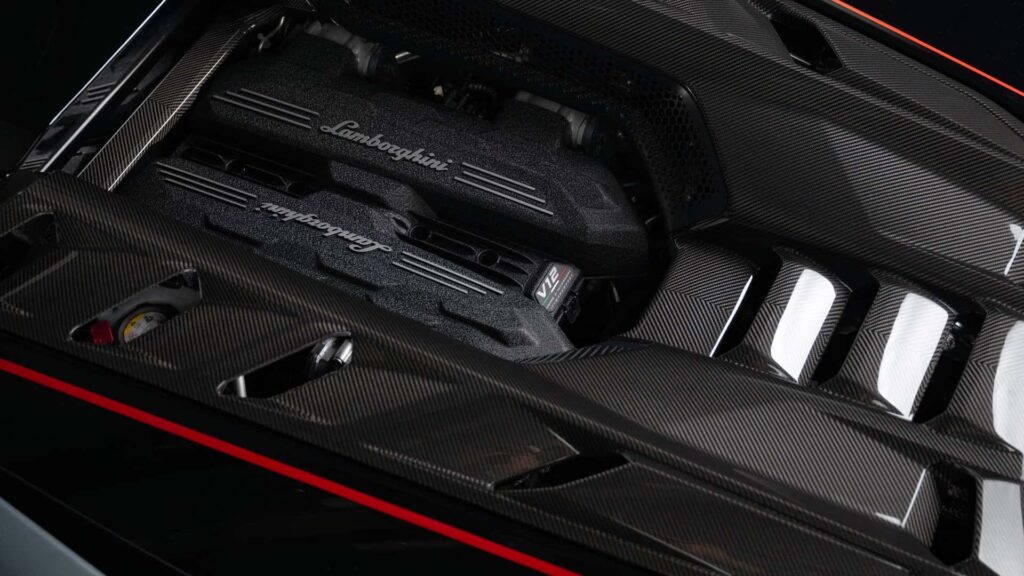
A third radial-flux motor is integrated above the eight-speed dual-clutch transmission positioned behind the V12.
Together, they raise total system output to 1,065 CV.
That represents an increase of 50 CV compared with the standard Revuelto.
More impressive still is the torque.
Maximum combined system output reaches 1,425 Nm.
This is not simply about explosive acceleration.
The electric architecture also enables extremely precise torque vectoring across the front axle, allowing the car to alter its behaviour through a corner in ways a traditional mechanical drivetrain simply cannot replicate.
The Complete Lamborghini V12 Legacy: From Miura to Revuelto
A Larger Battery for Consistency, Not Range
One of the most important changes is hidden beneath the bodywork.
The standard Revuelto uses a compact high-performance battery designed around rapid power delivery rather than electric range.
For the SV, Lamborghini increases capacity to 7.3 kWh.
The objective is not to make the car travel substantially further in silence.
It is to maintain maximum performance for longer.
Lamborghini says the revised battery system provides up to four times greater performance consistency than the standard Revuelto during demanding track use.
That distinction matters.
Hybrid hypercars can produce spectacular peak numbers relatively easily.
Maintaining those numbers lap after lap is considerably harder.
Heat builds.
Battery charge decreases.
Systems begin reducing output.
The Revuelto SV has been engineered specifically to resist that decline.
Heat Was the Real Enemy
Increasing output from the hybrid system created an obvious challenge.
Temperature.
During extended circuit driving, the combustion engine, electric motors, battery, brakes and tyres all generate enormous thermal loads.
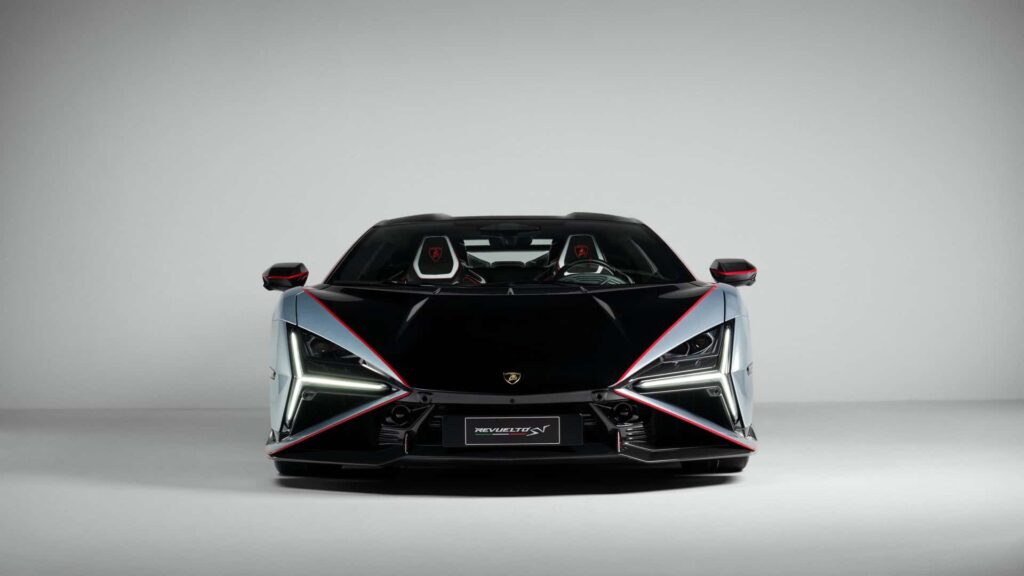
The Revuelto SV therefore required extensive aerodynamic and cooling development to maintain consistent performance rather than simply deliver a spectacular first lap.
New front airflow management directs more energy towards the side coolers.
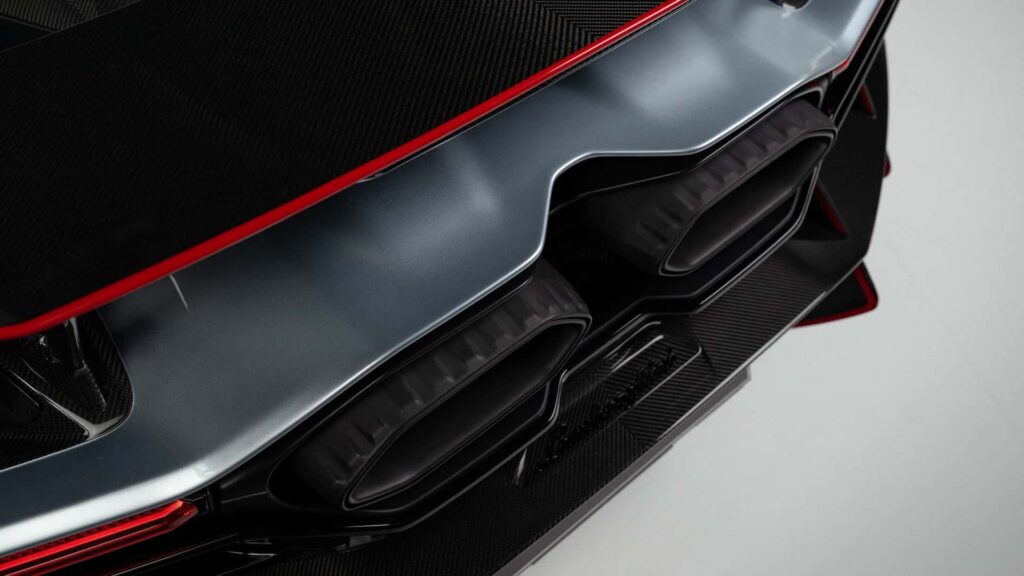
The rear bodywork has been reconsidered around thermal extraction.
Additional brake-cooling channels manage temperatures under repeated heavy braking.
The result is a supercar designed not simply to be fast once, but to remain fast.
0–100 km/h in 2.4 Seconds
The numbers remain extraordinary.
The Revuelto SV accelerates from 0 to 100 km/h in just 2.4 seconds.
200 km/h arrives in 6.7 seconds.
Maximum speed exceeds 345 km/h.
That makes the SV both the fastest and the most powerful production Lamborghini ever created at Sant’Agata Bolognese.
Yet those figures do not tell the most important part of the story.
Straight-line acceleration was never the fundamental limitation of the standard Revuelto.
The SV concentrates on what happens after the braking zone.
Lamborghini Fenomeno Roadster — The Ultimate Open-Air Expression of Sant’Agata
80 Percent More Downforce
Aerodynamics represent one of the most dramatic developments.
The Revuelto SV generates 80 percent more total downforce than the standard car.
Lamborghini says that figure is even around 10 percent greater than the Aventador SVJ, while the relationship between downforce and drag improves by approximately 60 percent compared with the regular Revuelto.
Those are significant changes.
And they explain why the SV looks considerably more aggressive.
The body is not simply decorated differently.
Airflow has fundamentally changed the design.
A Fixed Rear Wing Replaces the Active Solution
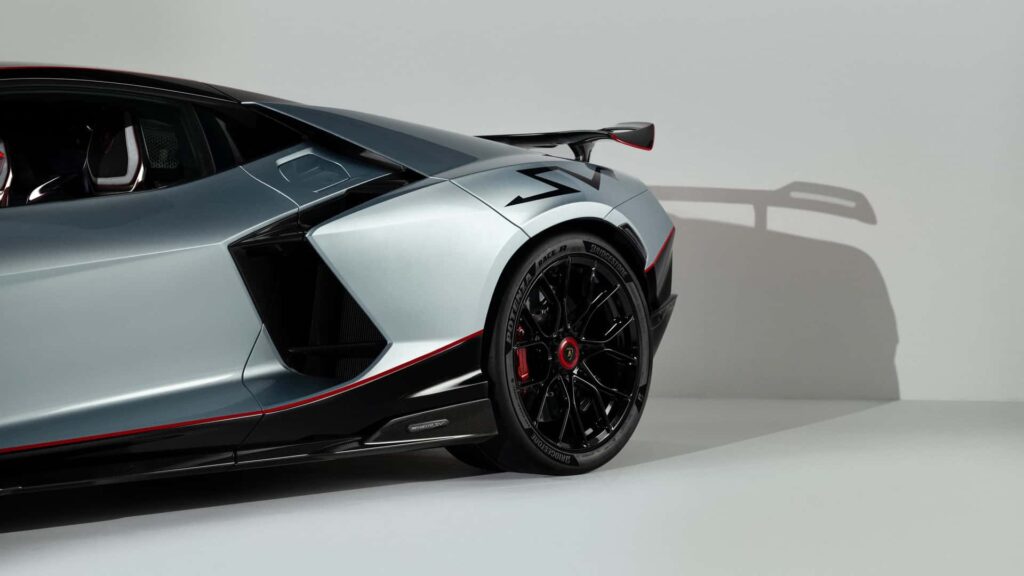
The standard Revuelto uses active aerodynamics at the rear.
The SV takes a more conventional motorsport-inspired approach.
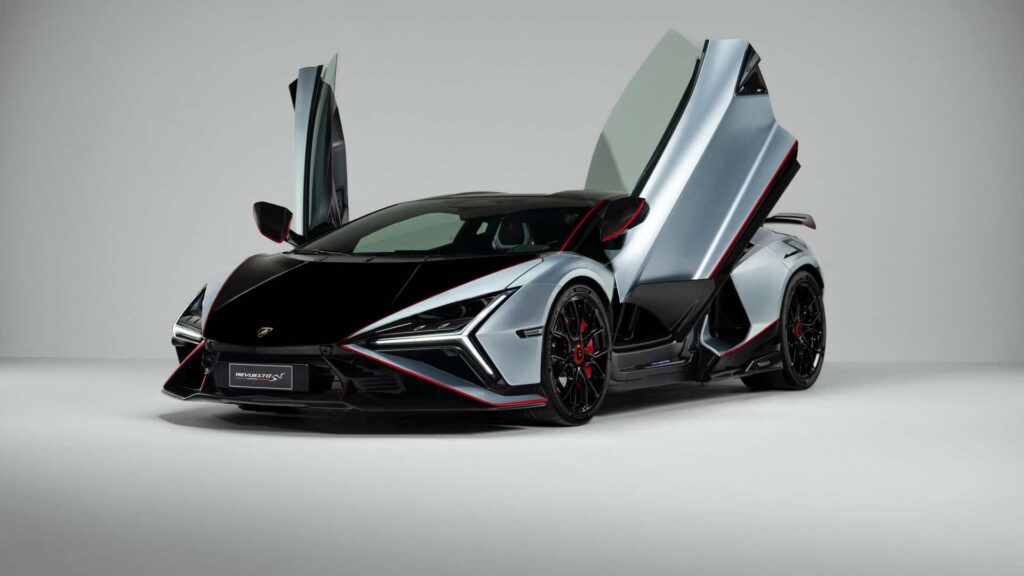
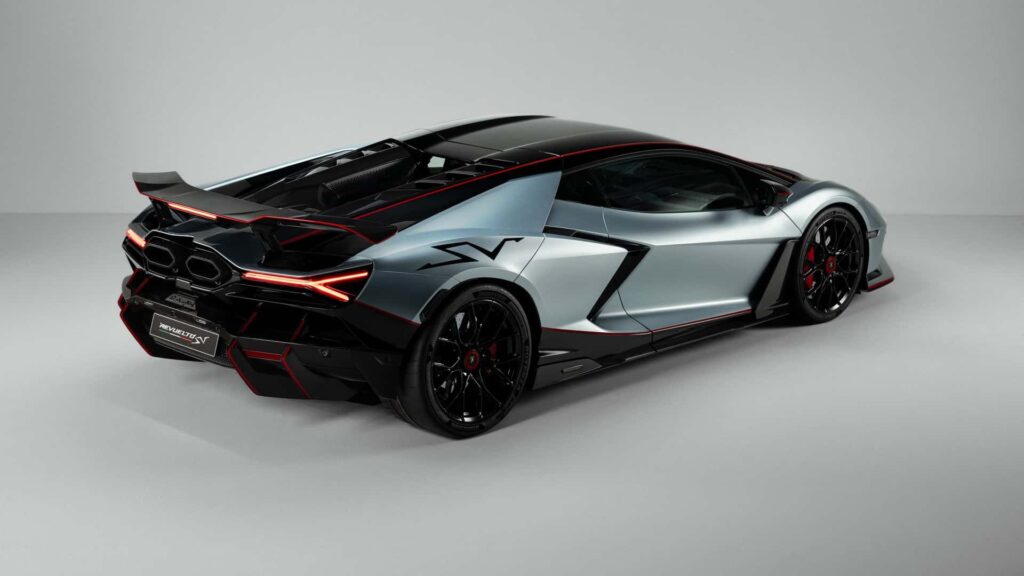
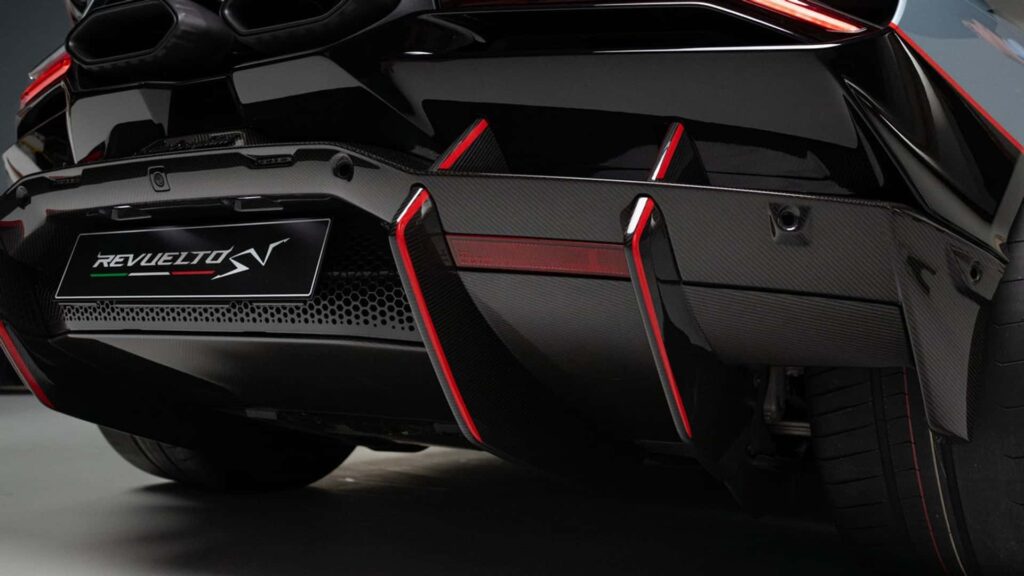
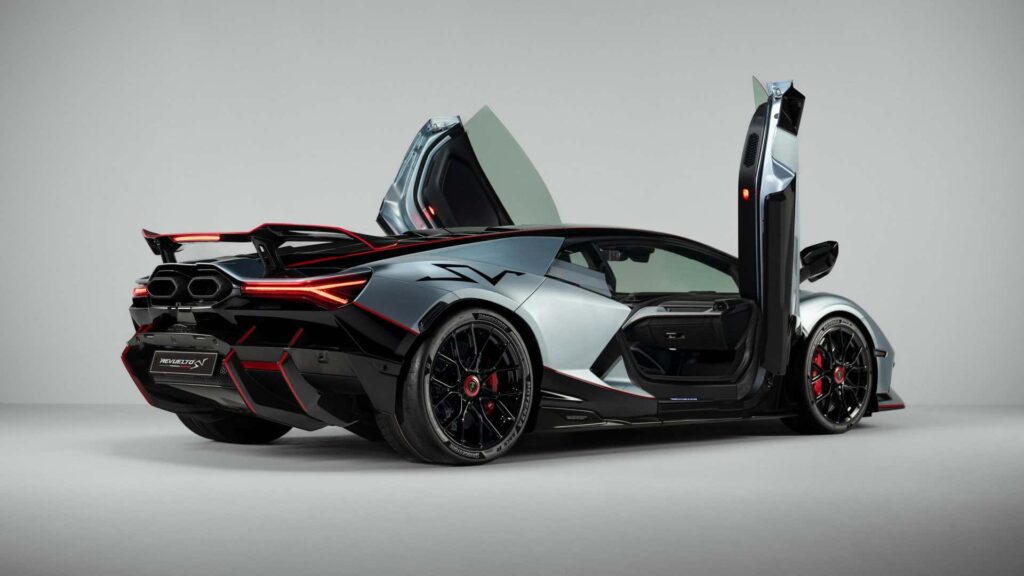
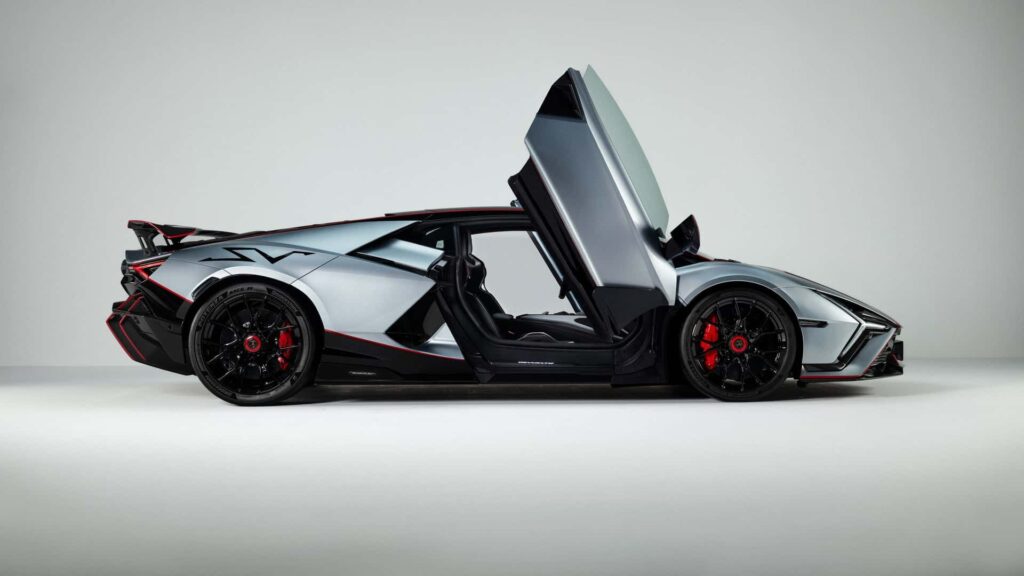
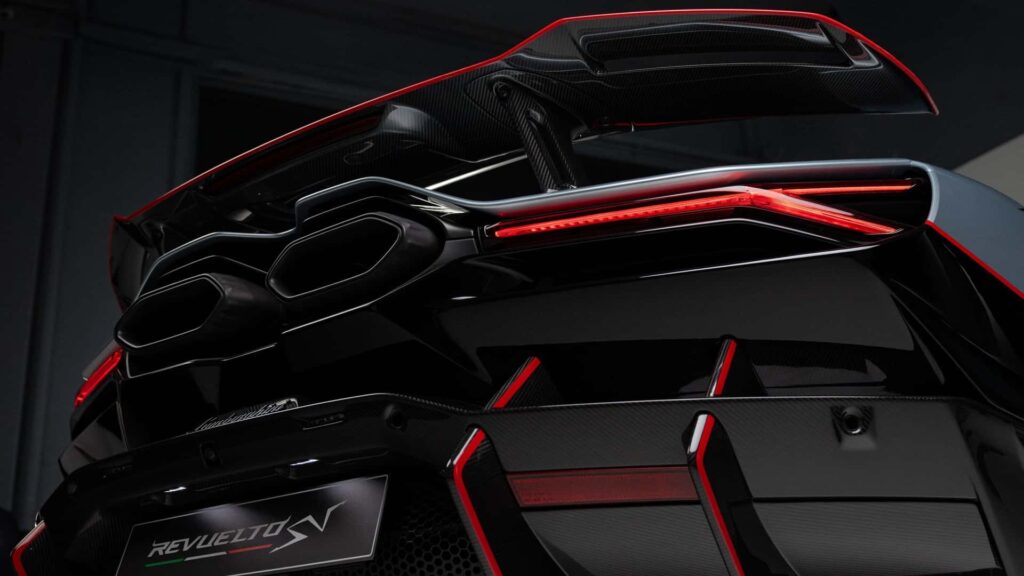
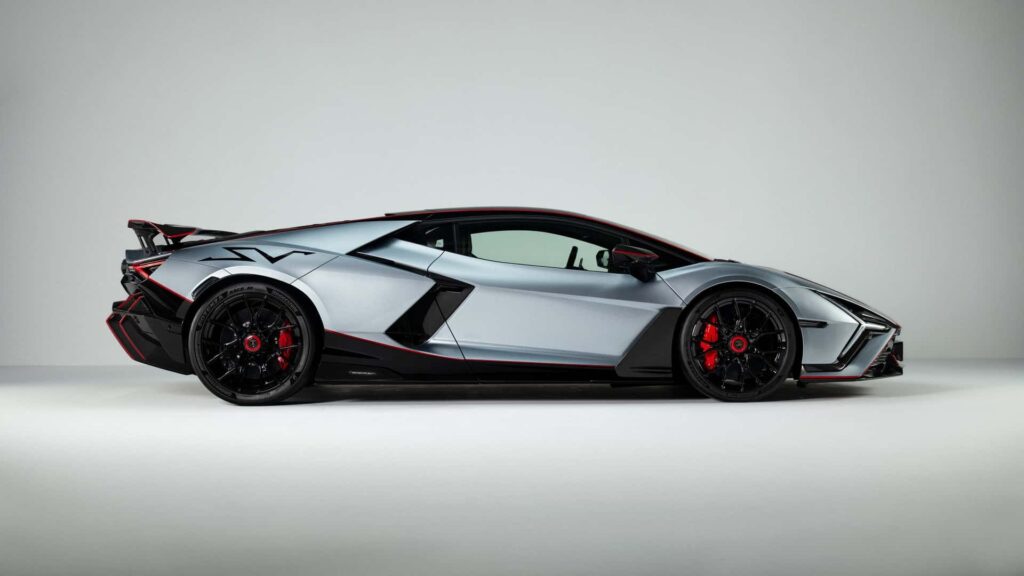
A large fixed rear wing dominates the tail.
Its geometry uses a distinctive double-wing treatment towards the outer sections while maintaining a shallower central angle to balance downforce with aerodynamic efficiency.
A Gurney flap further modifies airflow over the rear deck and assists extraction from the cooling system beneath.
The solution says something important about the SV.
Ultimate circuit consistency matters more than visual cleanliness or the versatility of an active road-focused system.
The Front Becomes More Aggressive
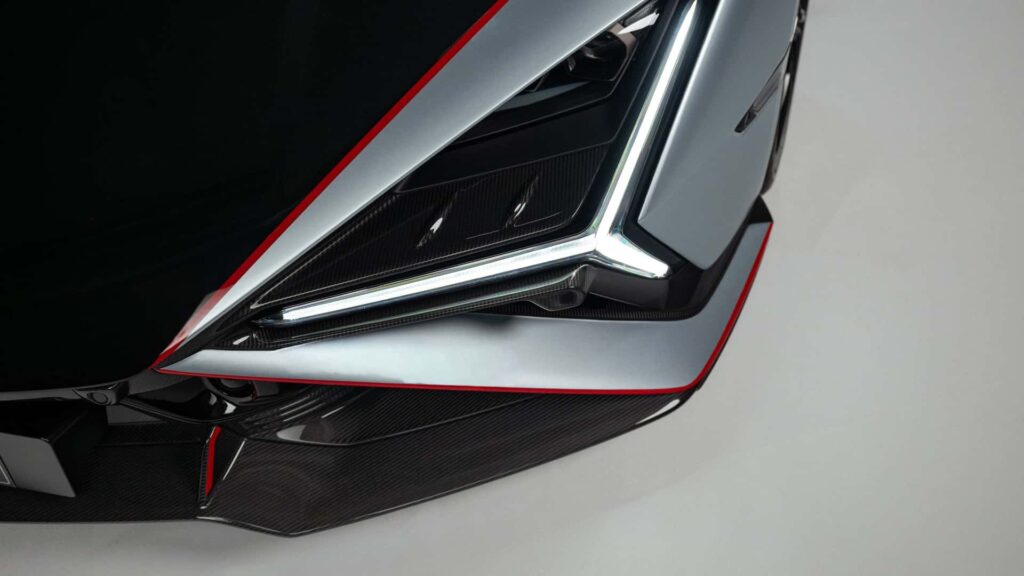
The front receives equally significant attention.
A redesigned splitter works alongside an extensively reworked underbody.
Angled aerodynamic fins around the bumper improve the seal surrounding the front wheel arches while simultaneously directing additional airflow towards the side cooling systems.
The aerodynamic balance also moves further forward.
That improves initial response during turn-in and creates a more neutral relationship between front and rear aerodynamic load.
Lamborghini has not merely added more downforce.
It has changed where that downforce acts.
Brake Cooling Improves by 12 Percent
Aerodynamic work also contributes directly to braking.
Revised cooling channels increase brake cooling performance by approximately 12 percent.
That may sound less dramatic than another 50 horsepower.
On a circuit, it is arguably more important.
Repeated heavy braking from more than 250 km/h can overwhelm even sophisticated carbon-ceramic systems.
Lower temperatures mean more consistent pedal response.
More predictable braking distances.
And greater confidence over an entire track session.
New CCM-R Plus Brakes
The braking system itself is completely new.
The Revuelto SV introduces CCM-R Plus carbon-ceramic brakes, technology developed around the requirements of endurance racing and influenced by Formula 1 construction methods.
Front discs measure 420 x 40 mm.
Rear discs measure 410 x 32 mm.
Lamborghini claims an 11 percent increase in peak deceleration, 23 percent greater heat dissipation and approximately 12 percent lower disc temperatures compared with the standard Revuelto.
The car can stop from 200 km/h in approximately 110 metres.
But, as with the battery, consistency becomes more important than the isolated number.
A 6D Sensor Watches Everything
The SV also introduces a far more sophisticated vehicle dynamics monitoring system.
A new 6D sensor sits close to the car’s centre of gravity and continuously measures acceleration in three dimensions:
lateral,
longitudinal,
vertical.
It simultaneously measures rotational movement around all three axes:
pitch,
roll,
yaw.
This information feeds a new Integrated Vehicle Estimator capable of calculating variables such as slip angle, road friction and vehicle speed with exceptional precision.
The technology allows braking, stability management, torque vectoring and traction systems to react using a far more accurate model of what the car is actually doing.
Electronic Intelligence Without Removing the Driver
This kind of technology can easily create a contradiction.
A car intended to feel more analogue and involving becomes increasingly dependent on software.
Lamborghini approaches the issue differently.
The objective is not to drive the car for the driver.
It is to give the driver access to more of the car’s capability.
The electronic systems work behind the scenes to manage enormous power and complex hybrid torque distribution, while the controls allow the driver to progressively reduce intervention.
That philosophy reaches its clearest expression through a new driving mode.
Pilota Mode
For the first time on the Revuelto, Lamborghini introduces Pilota mode.
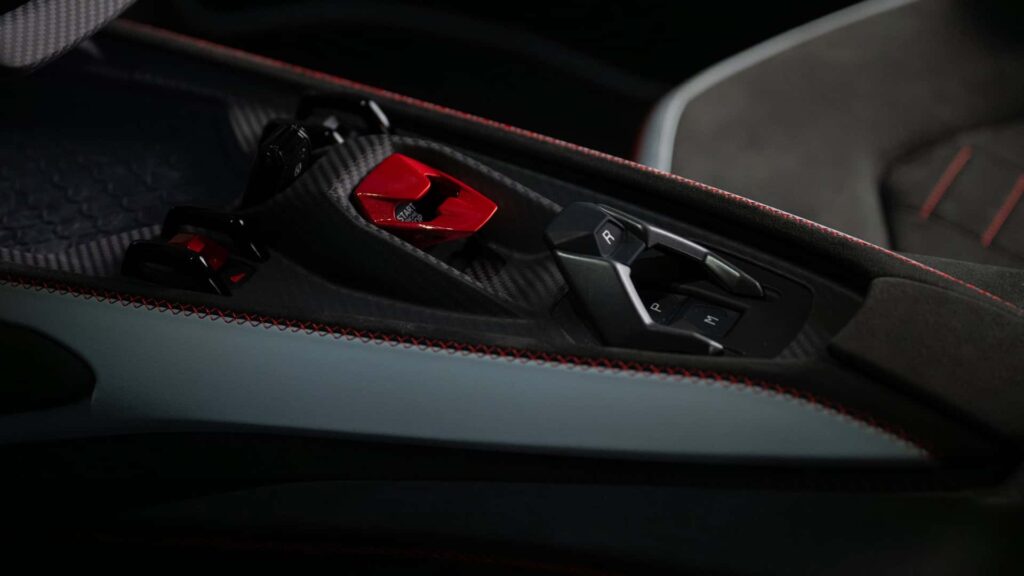
Activated through a dedicated red rotary controller on the steering wheel, it opens access to a five-stage traction-control system inspired directly by Lamborghini’s GT3 racing programme.
Rather than simply offering traction control on or off, the driver can progressively alter the level of intervention according to conditions.
Tyre wear.
Circuit grip.
Driving confidence.
Weather.
The system can be adjusted around all of them.
This makes the SV substantially more configurable for experienced circuit drivers.
GT3-Derived Suspension
The suspension moves further towards motorsport than any previous road-going Revuelto.
Lamborghini replaces the standard car’s approach with manually adjustable passive dampers inspired by GT3 racing technology.
This is a fascinating decision.
Modern high-end supercars increasingly rely on extremely sophisticated electronically adaptive suspension systems.
The SV deliberately introduces greater mechanical adjustability.
Customers can use recommended setups for smooth circuits, bumpy surfaces or wet conditions.
The dampers become something to tune rather than simply something software controls.
It is an unusually purist detail in an extraordinarily complex hybrid supercar.
Lamborghini Urus SE Performante: The Evolution of the Ultimate Super SUV
17 Percent More Agility
The changes are measurable.
Lamborghini claims approximately 17 percent greater agility compared with the standard Revuelto.
Lateral grip increases by around 10 percent.
Those numbers help explain what SV means in this generation.
The standard car is already enormously fast.
The SV’s objective is to make that performance feel more immediate and more precise rather than simply increasing engine output.
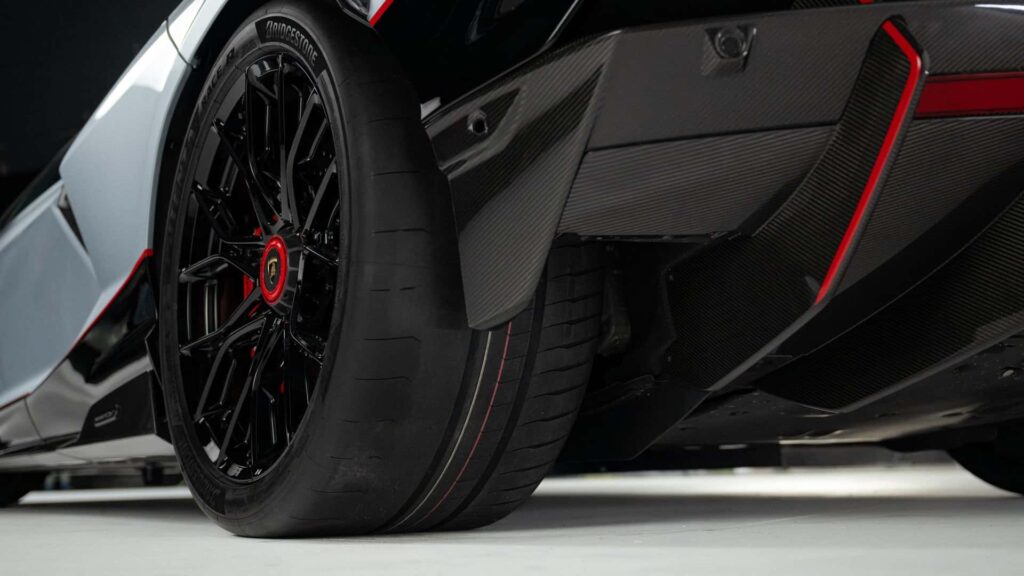
Bespoke Bridgestone Potenza Race R Tyres
Tyres receive equally serious development.
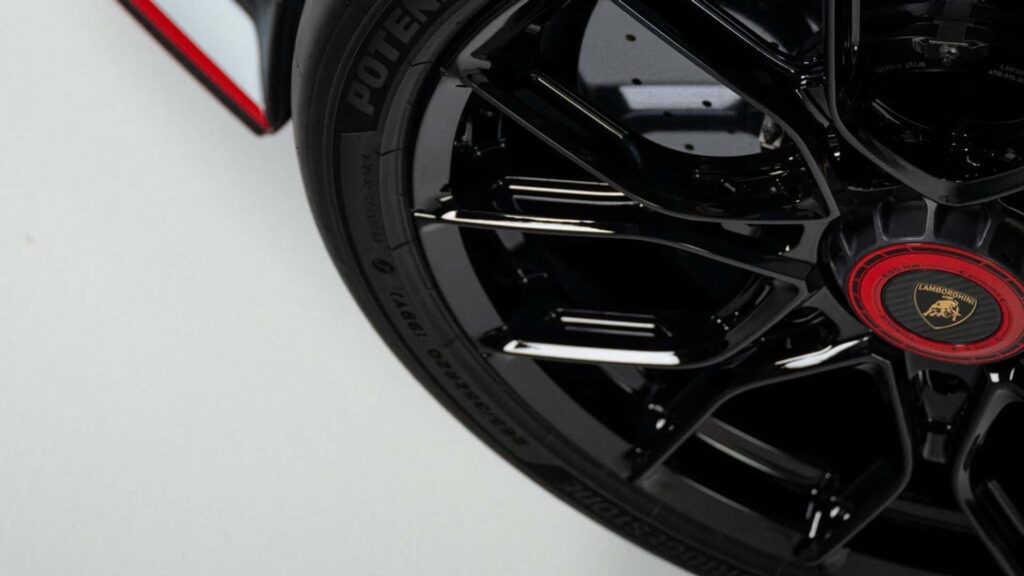
Bridgestone created a new Potenza Race R semi-slick specifically for the Revuelto SV.
The tyre uses a motorsport-derived compound and an aggressive tread pattern focused around dry grip, rapid warm-up and consistent performance over repeated laps.
Crucially, it remains road legal.
For owners wanting greater everyday versatility, bespoke Potenza Sport tyres are also available.
Even winter tyres have been developed for the car.
That last option may seem absurd for a 1,065 CV SV.
It also reinforces the fact that Lamborghini still expects these cars to be driven.
Centre-Lock Wheels for the First Time
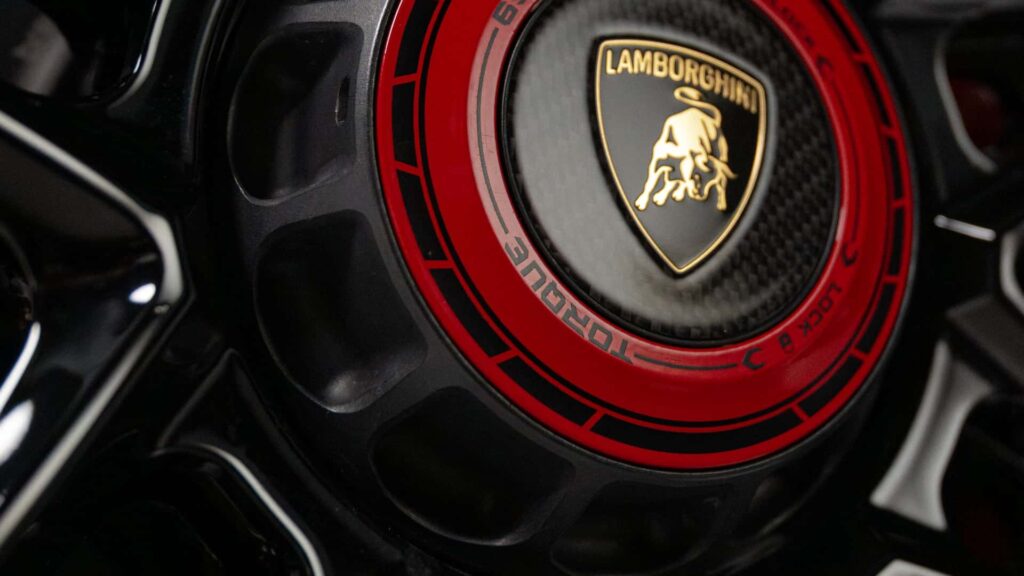
The SV introduces another first for a series-production Lamborghini.
Centre-lock wheels.
The new 3D-Superlight Dromos forged wheels measure 20 inches at the front and 21 inches at the rear.
Their intricate hexagonal internal structure reduces weight while remaining visually connected with Lamborghini’s long-standing geometric design language.
Reducing unsprung mass improves suspension response, steering precision and wheel control.
The motorsport-style central locking system also gives the SV another clear visual distinction from the standard Revuelto.
More Carbon Than Any Previous Revuelto
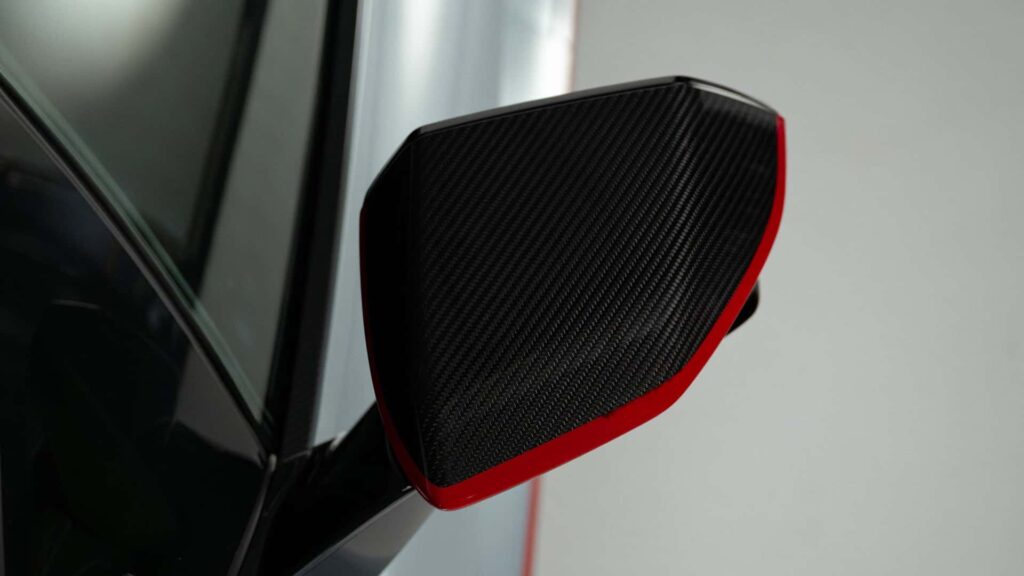
Lightweight construction runs throughout the project.
Up to 25 exterior components can be specified in visible carbon fibre.
Carbon door panels are standard.
The rear wing can be exposed carbon.
The front aerodynamic components can follow the same treatment.
Inside, carbon becomes even more prominent.
The result improves the power-to-weight ratio to approximately 1.66 kg per CV, compared with 1.75 kg/CV for the standard Revuelto.
Again, the gains come from the complete package rather than one spectacular weight-saving measure.
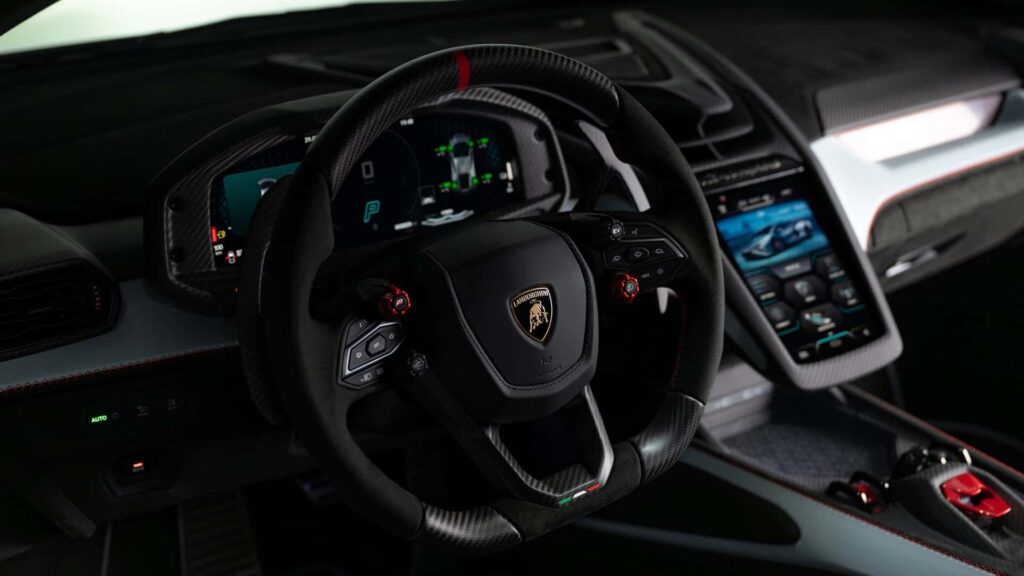
A More Focused Cabin
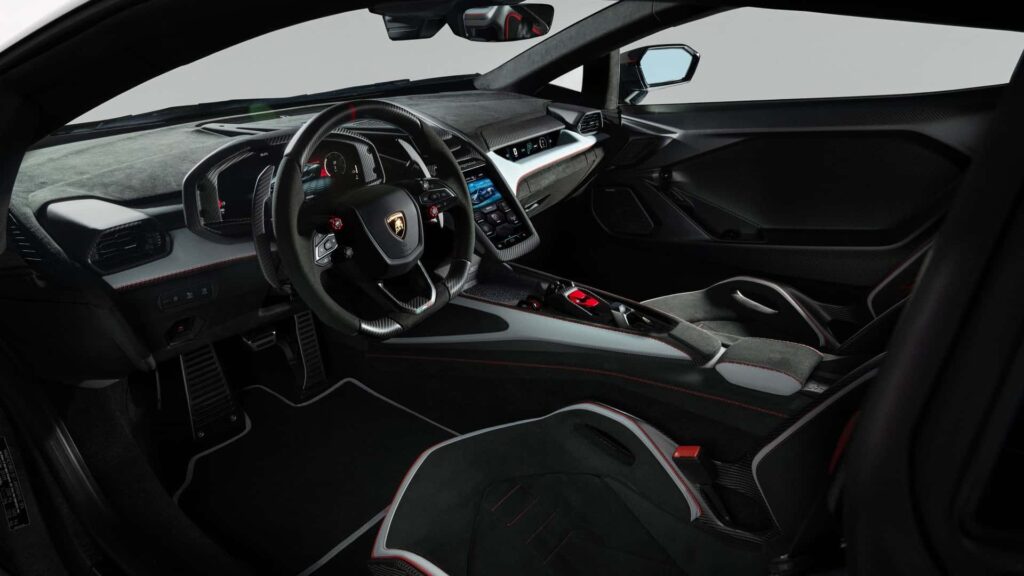
The interior adopts Lamborghini’s Feel Like a Pilot philosophy in its most concentrated form.
Carbon-fibre door panels remove visual and physical weight.
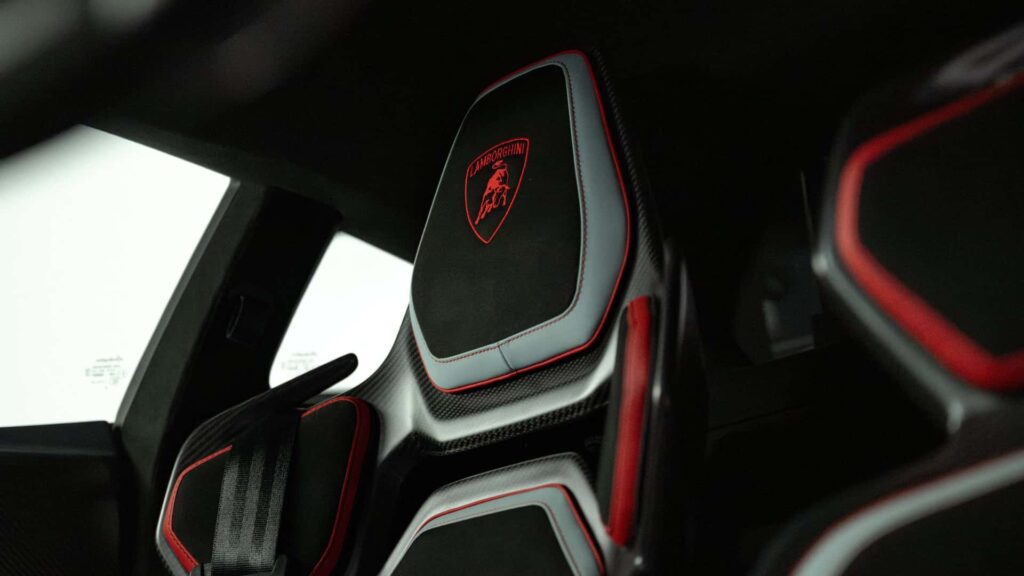
New racing seats reduce mass.
The steering wheel receives motorsport-inspired controls.
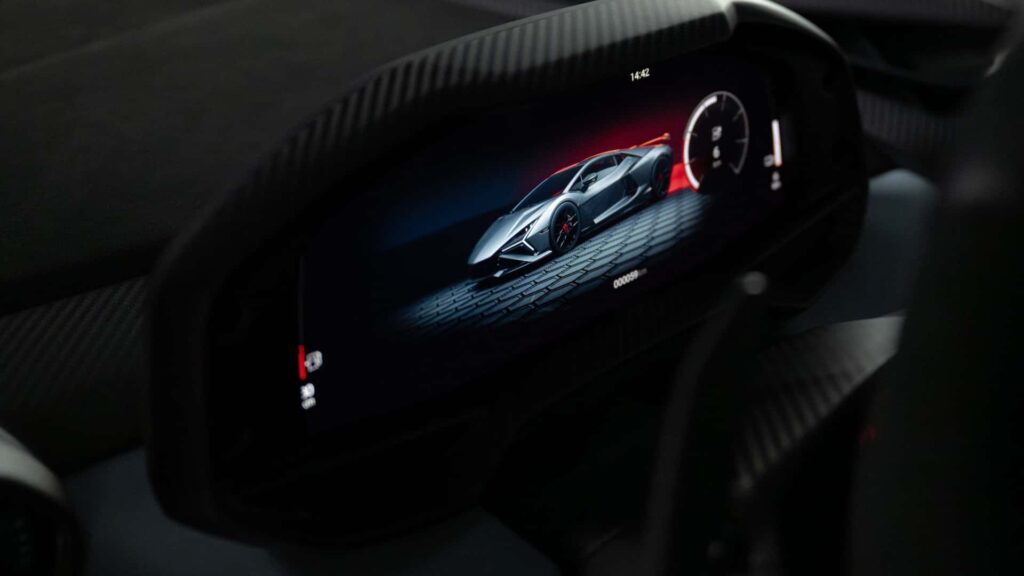
SV-specific graphics replace standard digital animations.
And the dedicated red Pilota selector immediately distinguishes the new car from a conventional Revuelto.
The standard sport seats still retain enough adjustment for road use.
For customers wanting something considerably more serious, optional carbon monocoque Race Seats provide greater lateral support and additional weight reduction.
Ad Personam Still Matters
Track focus does not eliminate personalisation.
Quite the opposite.
Lamborghini offers four different exterior SV logo treatments and a dedicated series of liveries developed specifically for the model.
Centre-lock mechanisms can be finished in multiple colours.
Brake calipers can be extensively customised.
Carbon can be exposed or painted.
Interior leather and Corsa-Tex combinations remain highly configurable.
The result illustrates the curious dual identity of a modern limited-production Lamborghini.
It must be a serious performance machine.
It must also function as an object of personal luxury.
1,963 Examples
Unlike some historical SV models produced in tiny quantities, the Revuelto SV will be built in 1,963 examples.
The number references 1963, the year Lamborghini was founded.
By contemporary exotic-car standards, that is a substantial production run.
But it also reflects the scale Lamborghini has achieved compared with previous decades.
More importantly, it provides the SV with a clear commemorative identity while ensuring it remains far rarer than the regular Revuelto.
Faster Than Any Production Car at Hockenheim
Before its public debut, Lamborghini took the Revuelto SV to Hockenheimring.
Factory driver Marco Mapelli completed the circuit in 1:41.6.
Lamborghini describes that as the fastest production-car lap officially recorded at the circuit.
The significance goes beyond the record itself.
Hockenheim combines heavy braking zones, high-speed sections and technical corners.
That makes it an appropriate environment for demonstrating the areas Lamborghini changed most dramatically.
Cooling.
Braking.
Aerodynamics.
Lateral grip.
Repeatability.
Eccentrica V12 Roadster: The Lamborghini Diablo Reimagined Without a Roof
The Hybrid SV Was Inevitable
There will inevitably be enthusiasts who argue that an SV should be simpler.
Lighter.
Less electrified.
Closer to the traditional V12 formula.
But the Revuelto SV demonstrates something interesting.
Lamborghini has not attempted to make hybrid technology disappear.
It has made the technology serve the SV philosophy.
Electric motors sharpen torque vectoring.
The larger battery maintains performance over longer sessions.
Software controls enormous torque with extraordinary precision.
The combustion engine still revs to 9,500 rpm.
The V12 remains the emotional centre.
Electrification becomes another performance tool.
From Miura SV to Revuelto SV
The technological distance between the 1971 Miura SV and the 2026 Revuelto SV is almost impossible to comprehend.
The Miura relied on a naturally aspirated V12.
A manual transmission.
The Revuelto SV uses computational vehicle dynamics, hybrid power, advanced carbon-ceramic brakes and six-dimensional motion sensing.
Yet philosophically, the two cars remain strangely connected.
Both take Lamborghini’s contemporary flagship and push it further.
Both sacrifice a degree of comfort and simplicity for greater performance.
Technology changes.
The purpose survives.
Super Veloce Still Means Something
The greatest risk with legendary badges is dilution.
Apply them too frequently and they become marketing.
The Revuelto SV avoids that trap because the changes extend far beyond another 50 horsepower.
The power increases.
But so does sustained hybrid performance.
Aerodynamics improve dramatically.
Cooling improves.
Braking changes completely.
Suspension becomes more mechanically focused.
Tyres become more specialised.
Driver-adjustable traction becomes more sophisticated.
The entire car moves closer to circuit use.
That is what Super Veloce has always been supposed to represent.
The V12 Hybrid Finds Its Sharpest Form
The standard Revuelto proved that Lamborghini could electrify its flagship without abandoning the naturally aspirated V12.
The Revuelto SV answers the next question.
Can a hybrid Lamborghini still become genuinely more raw, more focused and more emotionally intense?
The answer appears to be yes.
Not by pretending electrification never happened.
But by exploiting everything it can contribute.
1,065 CV.
1,425 Nm.
80 percent more downforce.
GT3-derived suspension.
New racing brakes.
Semi-slick tyres.
Centre-lock wheels.
Five-stage traction control.
And a V12 still screaming towards 9,500 rpm.
The technology is more complicated than ever.
The objective remains beautifully simple.
Go faster.
Feel more.
That is Super Veloce