

Some automotive comebacks begin with nostalgia.
Others begin with technology.
Spyker has chosen something far more characteristic.
Craftsmanship.
The new C8 Preliator XXV Coupé marks the return of one of Europe’s most eccentric and fascinating supercar manufacturers, but it does so without abandoning the qualities that made Spyker distinctive in the first place.
A hand-formed aluminium body.
A cockpit inspired by aviation.
An exposed mechanical gear linkage.
Rear-wheel drive.
Hydraulic steering.
And a genuine six-speed manual transmission connected to an 800-horsepower twin-turbocharged V8.
There are no shift paddles.
Almost no screens.
And remarkably little interest in following contemporary supercar convention.
Only 25 examples will be built.
For Spyker, the C8 Preliator XXV is not simply another limited-production model.
It is the first automobile of a new era.
A Dutch Marque With 146 Years of History
Spyker’s history stretches much further back than its modern supercars suggest.
The company traces its origins to 1880, when brothers Hendrik Jan and Jacobus Spijker established their business in the Netherlands as coachbuilders.
Their first automobile followed in 1898.
By 1903, Spyker had already created one of the most technically ambitious automobiles of its era: a six-cylinder machine featuring four-wheel drive.
Four years later, a Spyker competed in the legendary Peking-to-Paris endurance event, covering approximately 15,000 kilometres and finishing second.
But another chapter would ultimately shape the company’s modern identity more strongly.
Aviation.
Rezvani Beast X: 1,560 HP of American Hypercar Excess
When Cars Met Aircraft
In 1914, Spyker merged with the Dutch Aircraft Factory.
Aircraft production subsequently became part of the company’s story, and aviation would leave a permanent mark on the brand’s design language.
By 1919, the extraordinary Spyker C1 Aerocoque had already demonstrated how aircraft principles could influence automotive design.
That connection resurfaced dramatically when the marque was revived in 2000.
The modern C8 Spyder, C8 Laviolette and C8 Double12 carried propeller-inspired wheels, polished aluminium switchgear and cockpits resembling vintage aircraft.
Later models pushed the theme towards jet aviation.
The C8 Preliator XXV continues that evolution.
But now the inspiration is integrated more deeply into the engineering itself.
XXV Marks a New Beginning
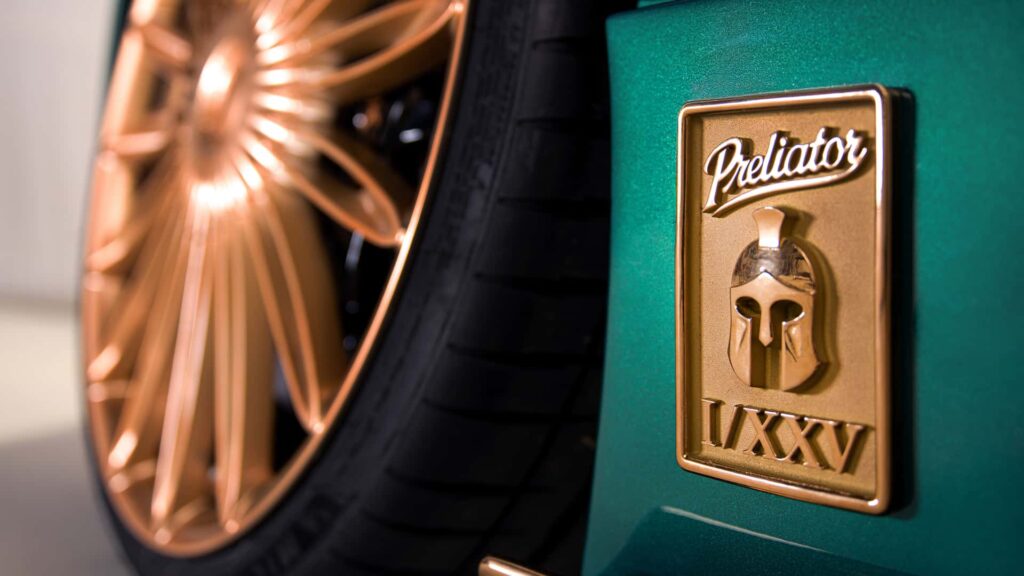
The Preliator name is not entirely new.
Spyker originally revealed an earlier C8 Preliator concept in 2016, followed by a Spyder derivative.
Those cars never reached meaningful series production.
The C8 Preliator XXV, however, is described by Spyker as an entirely new automobile rather than a continuation of those earlier concepts.
The company has developed a new spaceframe internally and surrounded it with a completely reshaped aluminium body.
That distinction matters.
Spyker is not simply restarting production of an old design.
It is attempting to establish the foundation for its future.
Why Aluminium Still Matters
Modern exotic-car engineering has become almost synonymous with carbon fibre.
Monocoques.
Body panels.
Aerodynamic structures.
Even wheels.
Spyker deliberately chooses another material.
Aluminium.
Every exterior panel of the Preliator XXV is formed by hand in partnership with Coventry Prototype Panels in the United Kingdom.
From a purely engineering perspective, carbon fibre could offer compelling advantages.
Spyker’s reasoning is different.
Aluminium can be shaped.
Hammered.
Finished.
Polished.
And altered directly by the hands of a skilled craftsperson.
Tiny variations inevitably remain.
For Spyker, that individuality is not an imperfection.
It is part of the value.
Around 2,100 Hours for One Car
The scale of the craftsmanship becomes clearer through one number.
Approximately 2,100 hours.
That is how long Spyker says it takes to construct a single C8 Preliator XXV.
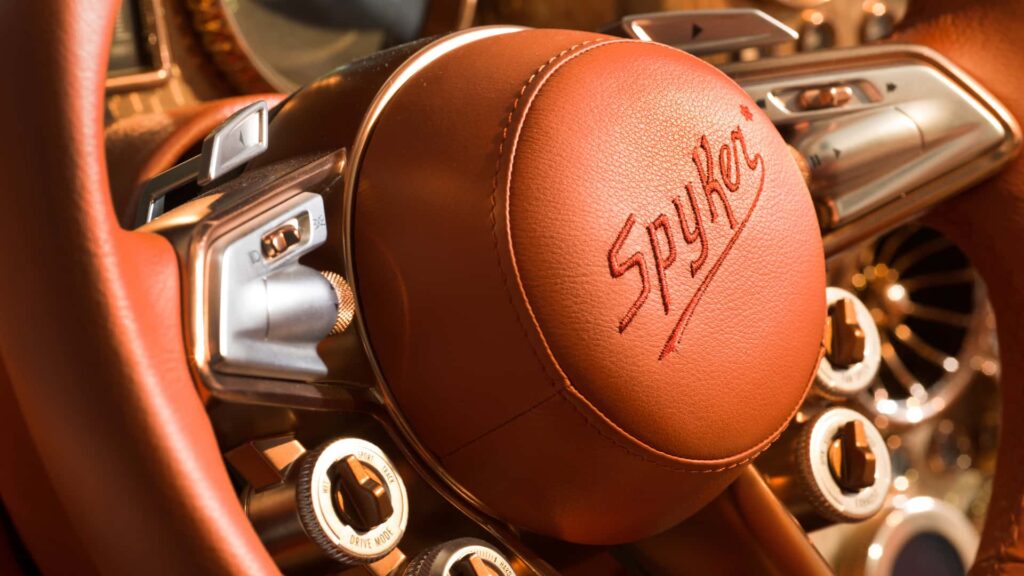
The steering wheel alone requires around four hours of hand stitching by one craftsperson using two needles simultaneously.
The turned-aluminium dashboard is manufactured using traditional techniques.
Every visible screw head inside the cabin is manually aligned in the same direction.
Even the chassis number is stamped individually into the aluminium spaceframe by hand.
No two impressions are exactly identical.
These details contribute almost nothing to outright performance.
That is precisely why they matter.
They exist because someone cared enough to do them.
Chassis Number 270
The car revealed at The Quail carries another piece of Spyker history.
It is chassis number 270.
Spyker says it is the latest of only 255 modern-era Spykers produced since the marque’s revival in 2000.
That statistic puts the company’s scale into perspective.
Many supposedly exclusive supercars exceed that number within a single model year.
Spyker has produced barely more than 250 automobiles across more than a quarter of a century.
The Preliator XXV intends to continue that deliberately tiny scale.
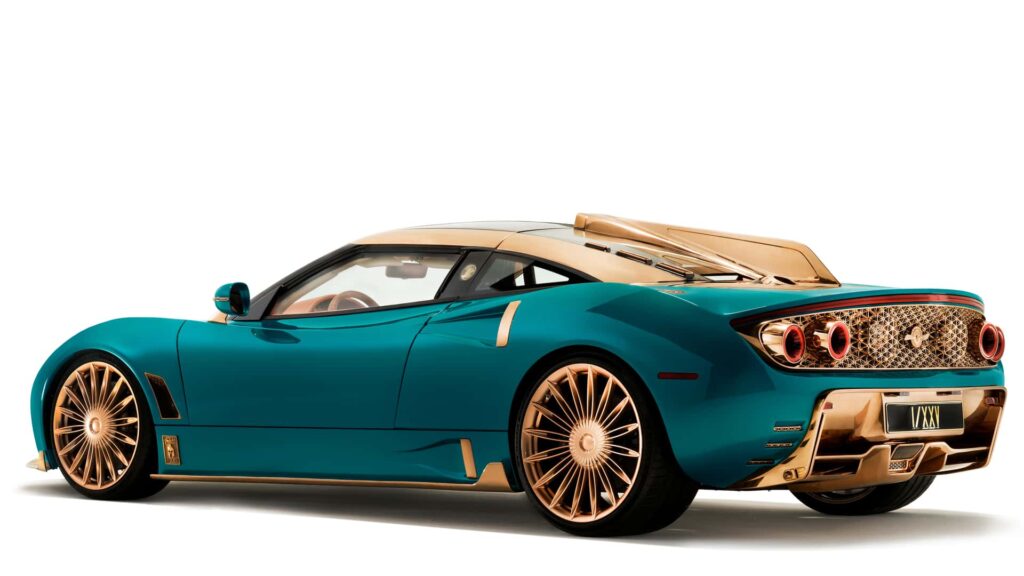
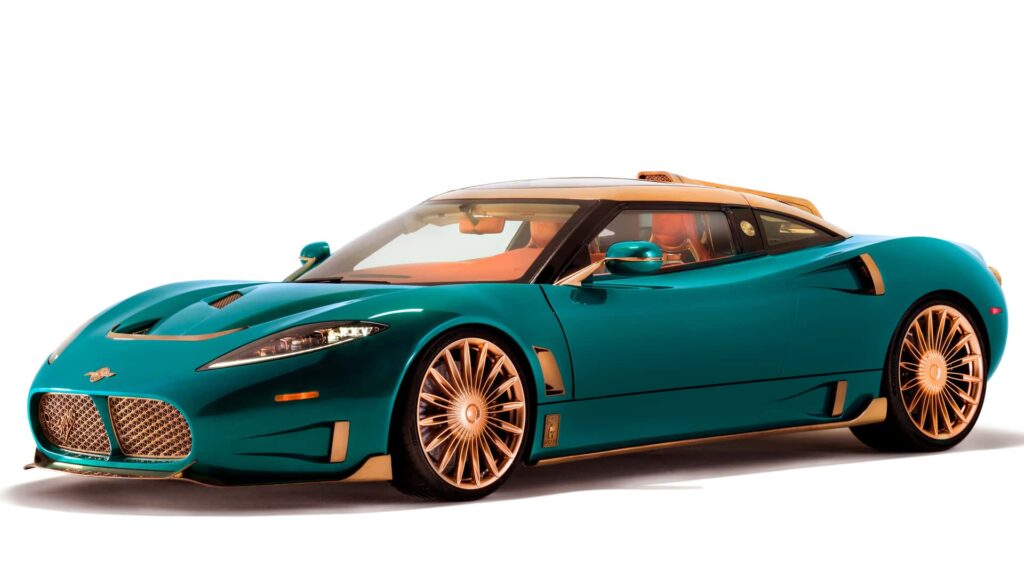
Quail Green and Rose Gold
The Monterey launch car is impossible to ignore.
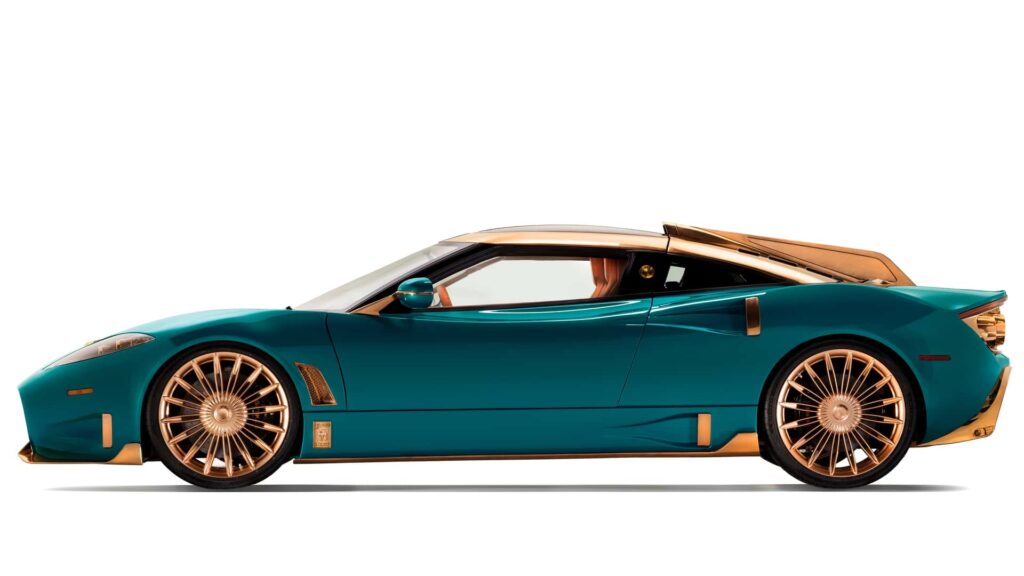
Its exterior is finished in Quail Green, developed specifically around its debut at The Quail.
Look closely and the metallic paint reveals subtle rose-gold particles.
That theme continues across the exterior brightwork.
Instead of conventional polished aluminium, the presentation car uses extensive rose-gold detailing across its trim and wheels.
The result could easily have become excessive.
On a Spyker, it somehow feels appropriate.
These have never been automobiles designed for anonymity.
Aviation Becomes More Explicit
The Preliator XXV pushes the aviation references further than previous modern Spykers.
The body incorporates NACA ducts, originally developed for aircraft to allow efficient airflow into internal systems with relatively little aerodynamic disturbance.
At the rear, the taillights resemble jet-engine afterburners.
A prominent central fin runs along the rear bodywork, recalling both motorsport aerodynamics and the tail section of an aircraft.
Hennessey Blackbird: The Return of the Pure Driver’s Hypercar
The shape is also a historical reference to the 1919 C1 Aerocoque.
Modern performance.
Jet-age imagery.
Pre-war company history.
All exist within the same design.
The Headlights Say XXV
Even the lighting contains a hidden signature.
The front lighting graphics form the letters and numerals XXV.
It is another example of Spyker’s obsession with detail.
Rather than attaching anniversary badging to the body, the model designation itself becomes part of the lighting architecture.
The reference is visible only once someone knows where to look.
That type of discovery has always been part of the appeal of Spyker interiors and exteriors.
The closer you look, the more you find.
Isogrid Everywhere
One of the most technically interesting design themes is an isogrid lattice formed from interlocking triangular structures.
The concept originates in aerospace engineering, where triangular lattice structures can create excellent stiffness while reducing unnecessary material.
Spyker uses the pattern throughout the car.
Grilles.
Air vents.
Pedals.
Exhaust mesh.
Even the seat upholstery.
Engineering becomes decoration.
Decoration references engineering.
It is perhaps the clearest expression of the entire Spyker design philosophy.
An Audi-Sourced 4.0-Litre Twin-Turbo V8
Behind the occupants sits a 4.0-litre twin-turbocharged V8 derived from Audi architecture.
That relationship is appropriate.
Previous modern Spykers also relied on Audi V8 power, establishing a connection between the two manufacturers that stretches back through much of the modern C8 lineage.
For the Preliator XXV, the engine produces 800 horsepower and 1,000 Nm of torque.
U.S. output is typically quoted at around 789 hp.
Performance is appropriately serious.
0–100 km/h in 2.9 Seconds
Spyker claims the Preliator XXV can accelerate from 0 to 100 km/h in approximately 2.9 seconds.
Maximum speed exceeds 217 mph, or roughly 349 km/h.
Those figures place the car comfortably within contemporary supercar territory.
Yet Spyker does not appear particularly interested in building the story around them.
That is unusual.
And refreshing.
The Preliator XXV’s most interesting performance component is not the engine.
It is the transmission attached to it.
Six Speeds. No Paddles.
The C8 Preliator XXV uses a six-speed manual gearbox supplied by Graziano Oerlikon.
Power reaches the rear wheels through a limited-slip differential.
There are no paddle shifters.
No automated manual modes attempting to imitate mechanical involvement.
No software deciding when another ratio should be selected.
Three pedals.
A gear lever.
A clutch.
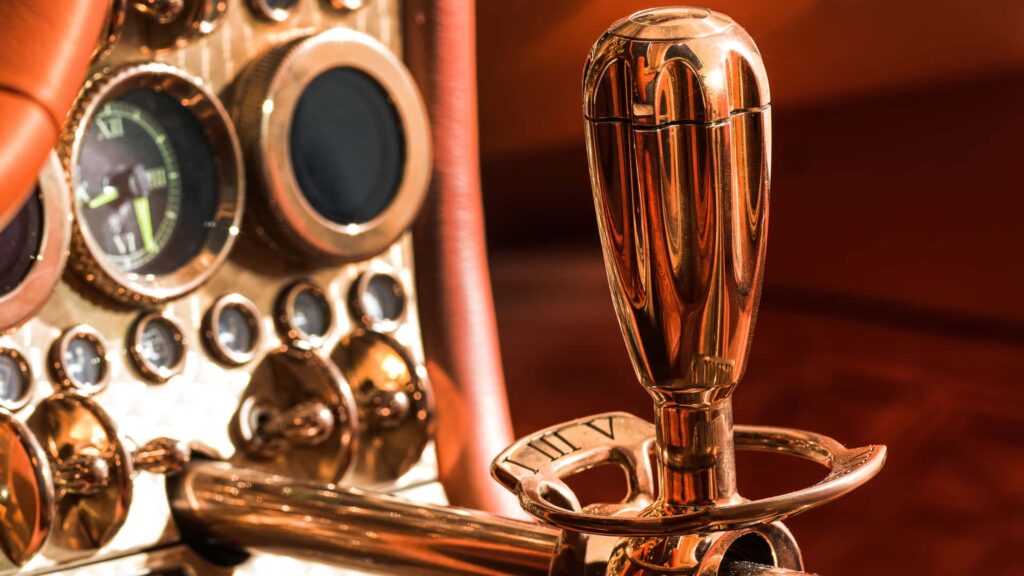
And an exposed linkage running through the centre of the cabin.
Few components identify a Spyker more immediately.
The Exposed Gear Linkage Returns
The exposed transmission linkage has been central to modern Spyker design from the beginning.
Instead of hiding the mechanical process beneath leather and plastic, Spyker turns it into sculpture.
Rods.
Joints.
Metal.
Movement.
Everything remains visible.
On the Preliator XXV launch car, even that mechanism receives the rose-gold treatment.
Every gear change therefore becomes both a mechanical act and a visual event.
Modern supercars often work very hard to conceal how complicated their engineering has become.
Spyker does the opposite.
It lets you watch the machinery work.
Hydraulic Steering
The analogue approach continues through the steering.
Spyker uses hydraulic assistance rather than the electrically assisted systems now found in almost every contemporary high-performance automobile.
Electric steering brings efficiency, easier integration with driver-assistance technologies and almost unlimited calibration possibilities.
Hydraulic systems offer something harder to quantify.
Texture.
Load.
Feedback.
For a company deliberately building a manual, rear-wheel-drive supercar, the decision feels completely consistent.
Apollo EVO ‘Caribbean Dragon’: The First Customer Car Brings Apollo’s Vision to Life
Double-Wishbone Suspension
The chassis uses independent double-wishbone suspension at each corner.
A dynamic damping system allows the car to adapt to changing conditions while preserving the precision expected from a high-performance machine.
Braking comes from four-piston Brembo calipers front and rear.
The wheel arrangement is staggered.
20 inches at the front.
21 inches at the rear.
Michelin Pilot Sport 4S tyres provide the contact with the road.
The specification is modern.
The philosophy remains decidedly traditional.
1,550 Kilograms Without Carbon Fibre
Curb weight stands at approximately 3,417 pounds, or around 1,550 kilograms.
That is an interesting figure considering the extensive use of aluminium rather than carbon-fibre body construction.
Spyker clearly could have pursued a more aggressive lightweight strategy.
Instead, it prioritises materials that support the handcrafted nature of the car.
This is not an exercise in extracting the final tenth of a second around a circuit.
It is a high-performance object designed to feel special every time someone approaches it.
The Interior Refuses the Screen Era
Perhaps nowhere is Spyker’s philosophy clearer than inside.
Almost every new premium automobile now places enormous displays across the dashboard.
The Preliator XXV barely has one.
The only conventional visual digital interface is a head-up display.
Everything else remains intentionally analogue.
Mechanical switches.
Physical controls.
Traditional instrumentation.
Turned aluminium.
Leather.
Visible fasteners.
And the exposed gear mechanism.
The interior does not look like consumer electronics.
It looks like a machine.
Tuscan Saddle Leather
The Quail presentation car uses Tuscan Saddle leather, an orange-brown hide that contrasts dramatically with the green exterior and rose-gold detailing.
The combination reinforces the strange timelessness of Spyker design.
Nothing looks entirely contemporary.
Nothing looks genuinely retro either.
Instead, the cabin seems to exist somewhere between a pre-war aircraft, a mechanical watch and an imagined luxury machine from another era.
That visual identity is almost impossible to confuse with anything else.
Butterfly Mode
One of Spyker’s most theatrical features also returns.
At the press of a button, multiple sections of the car open simultaneously in what Spyker calls Butterfly Mode.
The body effectively unfolds.
Doors rise.
Compartments open.
The mechanical heart of the car becomes exposed.
Because the engine bay is meant to be displayed this way, Spyker says it has been finished to the same obsessive standard as the visible exterior and cabin.
The company compares the movement to the operation of a fine mechanical watch.
It is theatrical.
But Spyker has never regarded theatre as something a supercar should avoid.
Zenvo Aurora Tur: Redefining the Modern Grand Touring Hypercar
The Fuel Tank Moves
The new chassis also required a rethink of basic packaging.
The fuel tank has moved from the side sills to a trapezoidal space behind the occupants and ahead of the engine.
That position reflects solutions previously used on Spyker’s Le Mans competition cars.
The rear luggage compartment disappears entirely.
Instead, luggage capacity moves to the front.
Again, the change illustrates that the XXV is more than a superficial revision of the earlier Preliator concept.
The underlying architecture has been reconsidered.
Twenty-Five Individual Commissions
Production will be limited to only 25 examples.
Each will be individually commissioned.
That means paint.
Leather.
Metal finishes.
Decorative treatments.
Technology.
Virtually every visible element can become part of an individual specification.
The Quail Green and rose-gold combination is therefore not intended to establish a standard appearance.
It demonstrates what is possible.
Owners can be considerably more restrained.
Or considerably less.
Knowing Spyker, the latter may be more appropriate.
Rose Gold Alone Costs €58,000
Spyker has not yet announced a standard list price for the Preliator XXV.
But some option pricing already reveals the level at which these cars operate.
The rose-gold exterior brightwork fitted to the Monterey car costs approximately €58,000.
An upgraded Kharma Signature audio system adds another €50,000.
At this level, conventional option-list logic becomes almost meaningless.
The client is effectively commissioning an object.
The final price depends heavily on how far that commission goes.
Reports suggesting figures around $1.6 million remain unofficial, so I would avoid presenting that number as confirmed.
Why Spyker Disappeared
The significance of the XXV becomes clearer when placed against Spyker’s recent history.
The modern company was revived in 2000 and quickly attracted attention with the C8 family.
Its designs were distinctive.
Its interiors unlike anything else.
But the business itself experienced repeated financial difficulties, including bankruptcy, failed product programmes and ownership complications.
The company never achieved the scale required to turn its extraordinary brand identity into a consistently sustainable manufacturing operation.
For years, another Spyker revival seemed increasingly unlikely.
And yet here it is.
Again.
Victor Muller Returns
Founder and CEO Victor Muller remains central to the new chapter.
The company has also received new investment following the involvement of Volodymyr Nosov and a strategic partnership with W Group, which focuses on digital infrastructure and financial technology.
That might sound slightly contradictory for a manufacturer that proudly refuses to fill its cars with screens.
Spyker’s position is that digital technology should support the world surrounding the automobile rather than dominate the automobile itself.
Client experiences.
Ownership services.
Digital infrastructure.
Communication.
Those areas can evolve.
The car remains analogue.
Spyker Says the Cars Will Stay Analogue
That promise may ultimately be one of the most important things the company has said about its future.
Spyker explicitly states that its hypercars will remain analogue.
That creates a very clear niche.
The industry is becoming increasingly electrified.
Increasingly automated.
Increasingly digitised.
Spyker intends to build automobiles that move in another direction.
Manual transmissions.
Mechanical controls.
Handcrafted aluminium.
Physical interaction.
Tiny production numbers.
That philosophy could become considerably more valuable precisely because fewer manufacturers are willing to pursue it.
The D8 Peking-to-Paris May Finally Return
The Preliator XXV is only intended to be the beginning.
Spyker says its future plans include reviving development of the long-delayed D8 Peking-to-Paris SSUV.
The project has existed in various conceptual forms for around two decades.
If it finally reaches production, it would give Spyker a second model family and potentially provide a more commercially viable counterpart to the extremely limited C8.
The historical name also connects directly with the marque’s remarkable 1907 participation in the original Peking-to-Paris event.
And GT3 Racing Could Follow
Spyker also wants to return to GT3 endurance racing.
That would reconnect the company with another important part of its modern history.
Spyker previously competed at Le Mans with cars derived from the C8 family.
For such a small manufacturer, motorsport was always enormously ambitious.
But it also gave the company credibility beyond extraordinary interiors and unusual styling.
A genuine GT3 programme would provide the new Spyker with something especially valuable.
Competition relevance.
The Anti-Digital Hypercar
The Preliator XXV arrives at a fascinating moment.
The world’s most advanced hypercars now use hybrid powertrains.
Active aerodynamics.
Artificial intelligence.
Complex torque-vectoring systems.
Enormous digital displays.
Software controls almost every part of the experience.
Spyker responds with an aluminium body and a manual gearbox.
That could appear technologically backward.
It is actually a very deliberate form of positioning.
Spyker cannot out-Bugatti Bugatti.
It cannot out-Koenigsegg Koenigsegg.
It does not possess the industrial resources to compete in a technological arms race.
Nor should it try.
Its advantage is difference.
A Supercar Built Like a Mechanical Object
This is what makes the C8 Preliator XXV compelling.
Almost everything about it celebrates physical construction.
Aluminium that has been shaped.
Leather that has been stitched.
Metal that has been turned.
Screws that have been aligned.
A gear lever that physically moves mechanisms.
A steering system that communicates through hydraulic pressure.
An engine that sends its power through a mechanical limited-slip differential to the rear wheels.
The specification might contain contemporary technology.
The experience is deliberately mechanical.
800 HP Is Almost Secondary
In another car, 800 horsepower would dominate the headline.
Here, it almost feels secondary.
The Preliator XXV is interesting before the engine starts.
That is rare.
Its appeal begins with the materials.
The shape.
The history.
The cabin.
The engineering details.
Then comes the 4.0-litre twin-turbo V8., with the manual gearbox.
Performance reinforces the identity rather than creating it.
That distinction may be exactly what Spyker needs.
Twenty-Five Cars to Prove Spyker Can Return
The C8 Preliator XXV therefore carries an unusual responsibility.
It needs to be more than beautiful.
More than fast.
More than rare.
It needs to prove that Spyker can once again build cars.
Twenty-five examples may seem almost insignificant compared with conventional production volumes.
For this company, they represent something much larger.
A restart.
A proof of capability.
And potentially the foundation for everything that follows.
The Warrior Returns
The word Preliator means warrior in Latin.
It has always suited Spyker.
Few automotive marques have experienced so many extraordinary highs, financial crises, revivals and near-disappearances while continuing to return.
The company’s motto has remained the same since the aviation era:
Nulla Tenaci Invia Est Via.
For the tenacious, no road is impassable.
The new C8 Preliator XXV embodies that idea perhaps better than any Spyker before it.
A company founded in 1880 disappears, returns, struggles, disappears again and then re-emerges in Monterey with an 800-horsepower aluminium supercar carrying a six-speed manual gearbox.
Rational?
Perhaps not.
Predictable?
Never.
But Spyker has never built its identity around either.
The C8 Preliator XXV is a reminder that the automotive world still has room for machines created with personality rather than algorithms.
And after everything Spyker has survived, twenty-five hand-built cars may be exactly enough to begin again.