

A One-of-One V12 Supercar with a Gated Manual Gearbox and Rear-Wheel Drive
Few supercars represent the raw, uncompromising spirit of Lamborghini quite like the Murciélago.
Introduced in 2001 as the successor to the legendary Diablo, the Murciélago became one of the defining supercars of the early twenty-first century. Its dramatic proportions, naturally aspirated V12 and unmistakable scissor doors established it as a modern interpretation of Lamborghini’s most celebrated traditions.
Yet this particular 2008 example is unlike almost any other Murciélago.
Originally manufactured as a Lamborghini Murciélago LP640, it has undergone an extensive restoration and bespoke transformation inspired by the legendary Murciélago LP670-4 SuperVeloce.
The project goes far beyond conventional exterior modifications.
Its original E-Gear transmission has been replaced with a traditional six-speed gated manual gearbox, while the factory all-wheel-drive system has been converted to rear-wheel drive.
The bodywork and interior have also been extensively redesigned using bespoke carbon-fibre components, creating a distinctive interpretation of Lamborghini’s most extreme Murciélago.

According to the vehicle’s detailed project description, the transformation required approximately 24 months and 3,841 documented labour hours.
Finished in Lime Essence with a Black Alcantara interior, this extraordinary car has covered 28,700 kilometres and is offered by Hollmann International for €1,080,000.
It is important to distinguish this vehicle from an original factory-produced LP670-4 SuperVeloce. Its identity remains that of a genuine 2008 Murciélago LP640, professionally rebuilt and modified into a unique SV-inspired configuration.
That distinction is central to its character.
Rather than being another example of an already rare Lamborghini, this is an individually engineered automobile created around a very specific philosophy: the purest possible connection between a naturally aspirated V12, a manual gearbox and the rear wheels.
The Murciélago: Lamborghini’s Last Great Analogue Generation
The Murciélago occupies a particularly important position in Lamborghini history.
It was the first new flagship developed following Audi’s acquisition of the Italian manufacturer, combining traditional Lamborghini extravagance with a substantially more sophisticated engineering foundation.
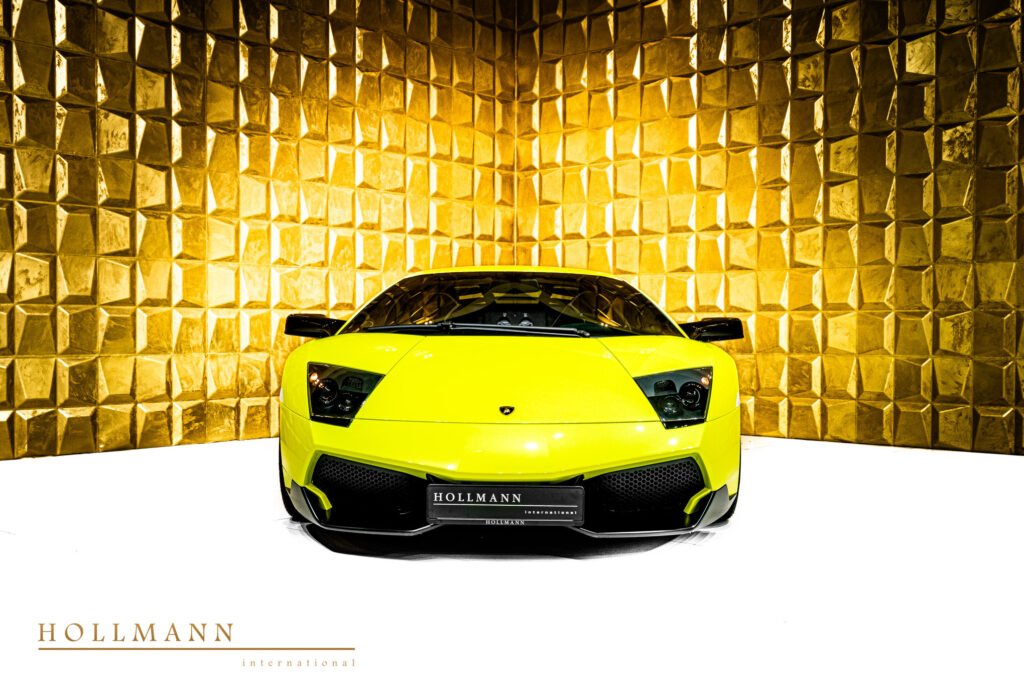
The original Murciélago featured a 6.2-litre naturally aspirated V12, permanent all-wheel drive and a six-speed manual transmission.
Its dramatic styling was created under the direction of Luc Donckerwolke, introducing a cleaner and more architectural interpretation of Lamborghini’s traditional wedge-shaped design.
In 2006, the Murciélago evolved into the LP640.
The updated model received a larger 6.5-litre V12, revised styling, improved mechanical systems and substantially increased performance.
The LP640 designation reflected the longitudinal rear-mid-engine layout and the engine’s 640 PS output.
It was one of the most powerful production supercars of its era.
More importantly, it belonged to a generation in which the driving experience remained fundamentally mechanical.
Hydraulic steering, enormous naturally aspirated engines and relatively limited electronic intervention created a character quite different from that of modern hybrid supercars.
This particular LP640 takes that philosophy even further.
The 6.5-Litre Naturally Aspirated V12
At the heart of this extraordinary Murciélago remains Lamborghini’s legendary 6,496 cc naturally aspirated V12.
Producing 640 PS (471 kW), the engine represents one of the final major developments of the twelve-cylinder architecture that had defined Lamborghini’s flagship models for decades.
Unlike contemporary turbocharged or hybrid powertrains, the LP640’s V12 relies on displacement, high engine speeds and naturally aspirated response.
Its character is unmistakable.

Power builds progressively as the engine accelerates through the rev range, accompanied by the mechanical intensity and distinctive exhaust note associated with Lamborghini’s traditional twelve-cylinder supercars.
In its original factory configuration, the Murciélago LP640 could accelerate from 0–100 km/h in approximately 3.4 seconds and reach a maximum speed of around 340 km/h.
Those figures describe the standard model, not independently verified performance measurements for this modified example.
The conversion to rear-wheel drive and a manual gearbox fundamentally changes how the car delivers its performance.
The emphasis is no longer simply on maximum acceleration.
It is on mechanical involvement.
The Gated Manual Conversion: A Return to Driving Purity
Perhaps the most significant modification is the transmission.
The original Murciélago LP640 was available with Lamborghini’s E-Gear automated manual transmission, which allowed rapid gear changes through steering-wheel-mounted paddles.
Although technically advanced for its era, E-Gear offered a very different experience from a conventional manual gearbox.
For this project, the original transmission arrangement was professionally converted into a traditional six-speed gated manual system.
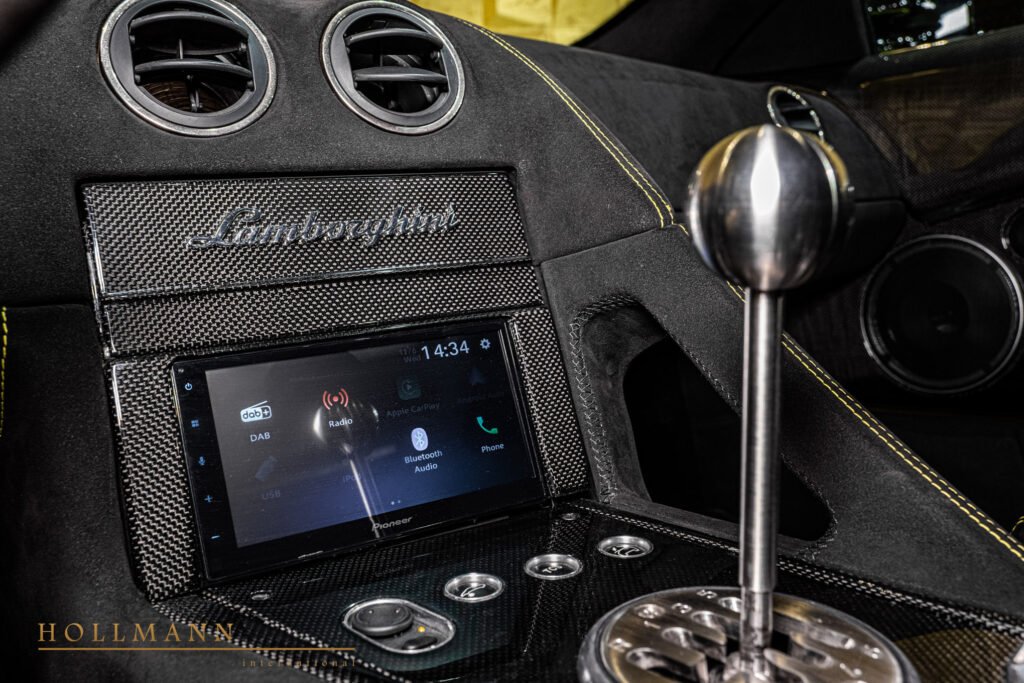
The conversion incorporates a bespoke precision-engineered shifting mechanism, restoring one of the most celebrated features of classic Lamborghini supercars.

The exposed metal shift gate is more than a nostalgic detail.
It changes the entire relationship between driver and machine.
Every gear change requires deliberate mechanical input. The driver controls the clutch, selects each ratio and becomes directly involved in managing the enormous V12’s power delivery.
In a modern automotive landscape increasingly dominated by dual-clutch transmissions and electronically managed performance systems, that level of involvement has become exceptionally rare.
The Murciélago’s naturally aspirated engine makes the combination particularly compelling.
A 640 PS V12 and a traditional manual gearbox create a driving experience defined by sound, timing and mechanical feedback.
Rear-Wheel Drive: Reimagining the Murciélago Formula
The second major engineering transformation is equally significant.
The Murciélago LP640 originally used a permanent all-wheel-drive system, designed to distribute the V12’s considerable power between the front and rear axles.
For this project, the drivetrain was professionally converted to rear-wheel drive.
The result is a fundamentally different mechanical configuration.
All 640 PS are now delivered through the rear wheels, creating a driving character more closely associated with Lamborghini’s earlier rear-wheel-drive supercars.
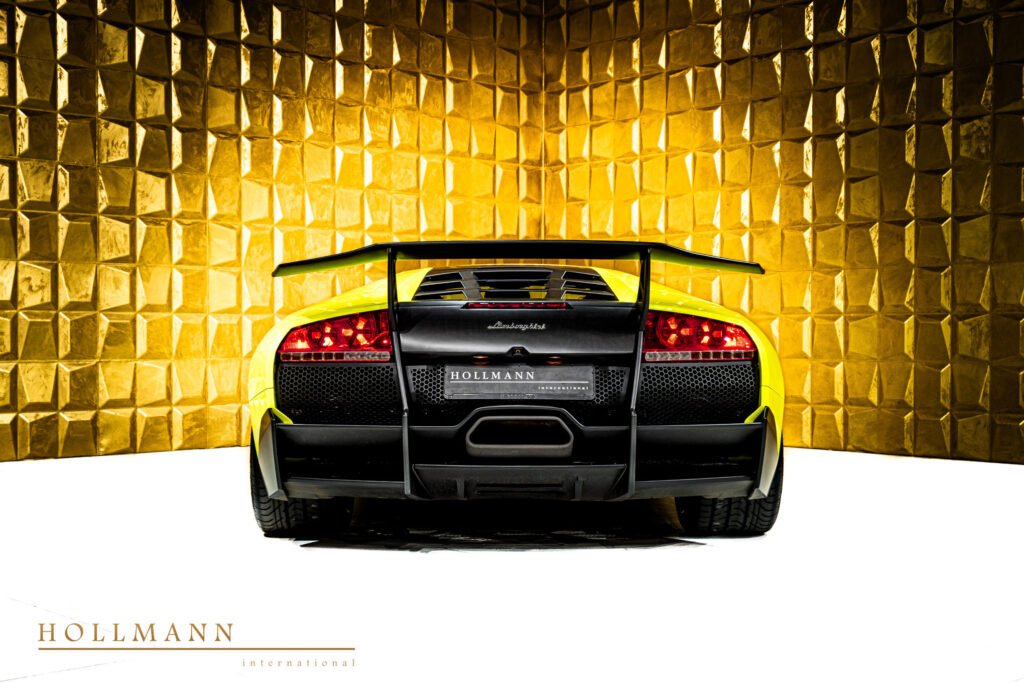
This conversion changes the way the car responds to throttle inputs, particularly during acceleration and cornering.
It also introduces different traction and handling characteristics from those of a factory LP640.
Combined with the six-speed manual gearbox, the rear-wheel-drive layout creates an unusually direct connection between the driver and the engine.
It is important to recognize that this is a bespoke engineering configuration rather than a factory Lamborghini specification.
Its appeal lies precisely in that individuality.
Inspired by the Legendary LP670-4 SuperVeloce
The visual inspiration for the project comes from one of the most celebrated Murciélago variants ever produced.
Introduced in 2009, the Lamborghini Murciélago LP670-4 SuperVeloce represented the ultimate factory evolution of the model.
The SuperVeloce featured more power, reduced weight, extensive carbon-fibre construction and a dramatically redesigned aerodynamic package.
Its enormous rear wing, aggressive front bumper and lightweight interior made it one of the most recognizable Lamborghini supercars of its generation.
The LP670-4 SV also became one of the most desirable modern Lamborghinis, thanks to its limited production and exceptional performance.

This 2008 LP640 takes inspiration from that design philosophy.
However, the project introduces a mechanical configuration that differs substantially from the original SuperVeloce.
Where the factory LP670-4 SV retained all-wheel drive, this car uses rear-wheel drive.
And where most SV examples were equipped with E-Gear, this rebuilt LP640 features a traditional gated manual transmission.
The result is an SV-inspired interpretation with its own distinct mechanical identity.
A 24-Month Restoration and Transformation
The scale of the project is one of its most remarkable characteristics.
According to the seller’s project information, the transformation required approximately 3,841 labour hours over 24 months.
This was not simply a matter of fitting replacement bumpers and wheels.
The restoration involved extensive work across the chassis, bodywork, drivetrain, suspension, cooling system, electrical components and interior.
Original Lamborghini components were retained or professionally restored wherever appropriate, while numerous SV-inspired elements were individually manufactured.

Such a comprehensive project requires considerably more coordination than a conventional cosmetic conversion.
The mechanical changes alone demand careful attention to component compatibility, drivetrain geometry, shifting mechanisms and the interaction between the engine and transmission.
The bodywork transformation adds another level of complexity.
Custom carbon-fibre panels must be manufactured, fitted and aligned to achieve the desired appearance and finish.
The result is a vehicle that reflects a substantial investment in specialist engineering and craftsmanship.
A Bespoke Carbon-Fibre Exterior
The Murciélago’s original design already possesses extraordinary visual presence.
Its low roofline, wide rear bodywork, enormous side air intakes and distinctive scissor doors make it immediately recognizable.
This example builds upon that foundation with an extensive SV-inspired carbon-fibre transformation.
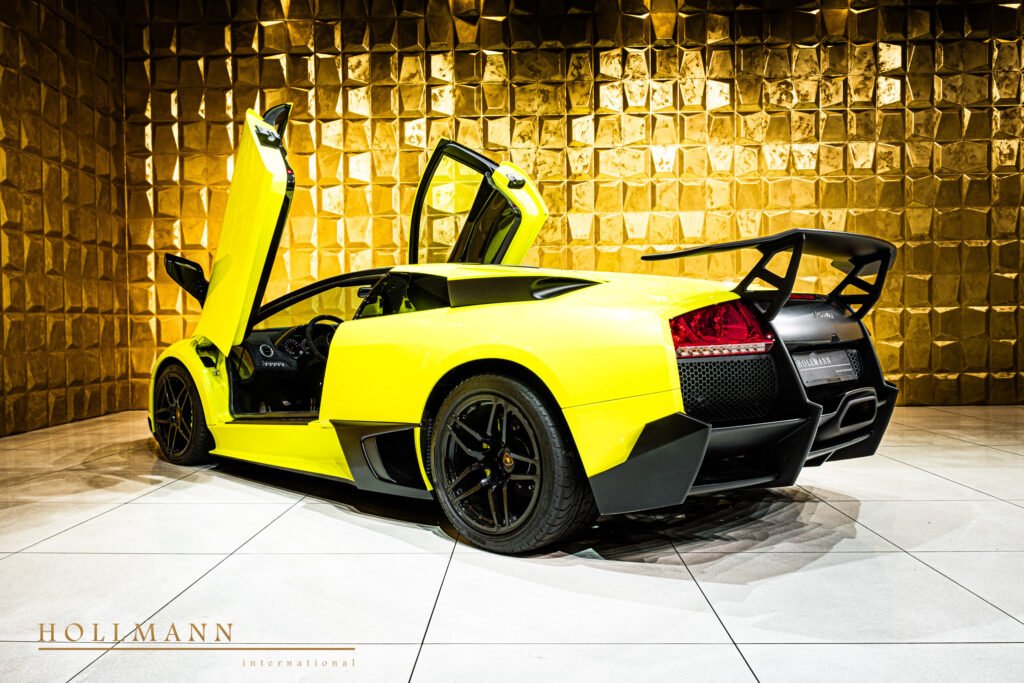
The project includes individually manufactured front and rear bumpers, front wings, rear body panels, a rear wing, an engine cover and a roof panel.
The objective was to recreate the dramatic visual character of the SuperVeloce while maintaining the identity of the underlying LP640.
Carbon fibre plays a central role in the transformation.
Beyond its association with lightweight construction, the material allows complex shapes and highly detailed aerodynamic elements to be manufactured with exceptional precision.
The resulting bodywork creates a more aggressive interpretation of the Murciélago’s original architecture.
The enlarged aerodynamic elements and revised body panels give the car a purposeful appearance, emphasizing its motorsport-inspired character.
Lime Essence: A Colour That Demands Attention
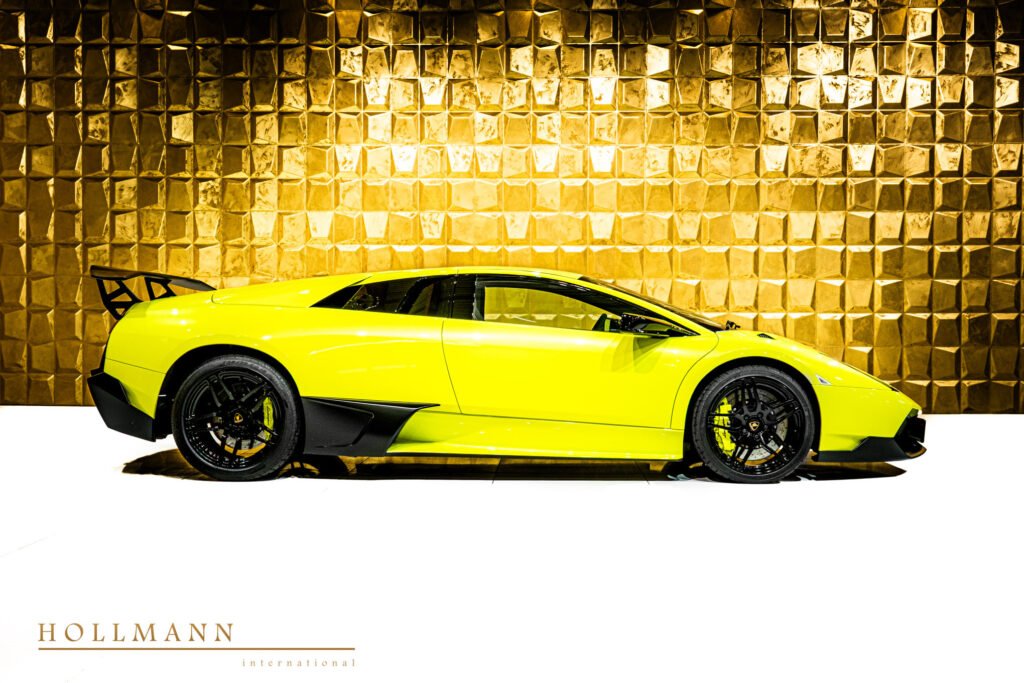
The exterior is finished in Lime Essence, a vivid colour that perfectly complements the Murciélago’s extraordinary proportions.
Lamborghini has a long tradition of using bright, unconventional colours to emphasize the dramatic architecture of its supercars.
From the Miura and Countach to the Diablo and Murciélago, vibrant greens and yellows have become closely associated with the brand’s visual identity.
On this example, the striking exterior finish provides a dramatic contrast to the extensive carbon-fibre elements.
The dark aerodynamic components emphasize the front air intakes, rear bodywork and prominent rear wing.
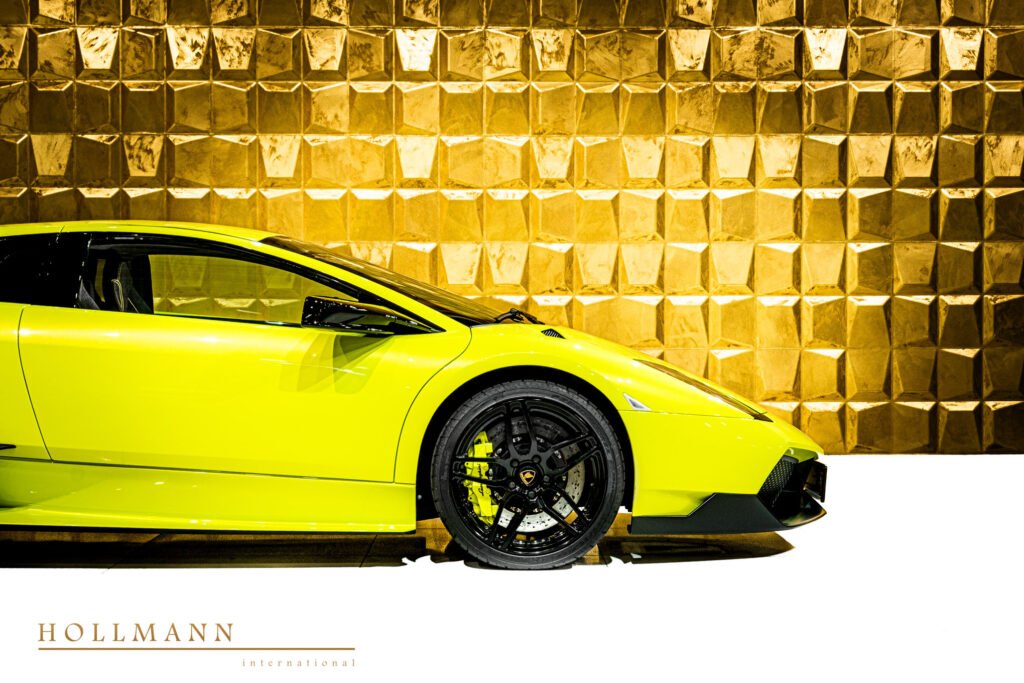
The car is fitted with 18-inch forged SV-style wheels finished in gloss black, reinforcing the contrast between the vivid body colour and the darker mechanical details.
The result is unmistakably Lamborghini.
It is theatrical, aggressive and entirely unwilling to disappear into ordinary traffic.
An Interior Rebuilt Around the Driver
The transformation extends into the passenger compartment.
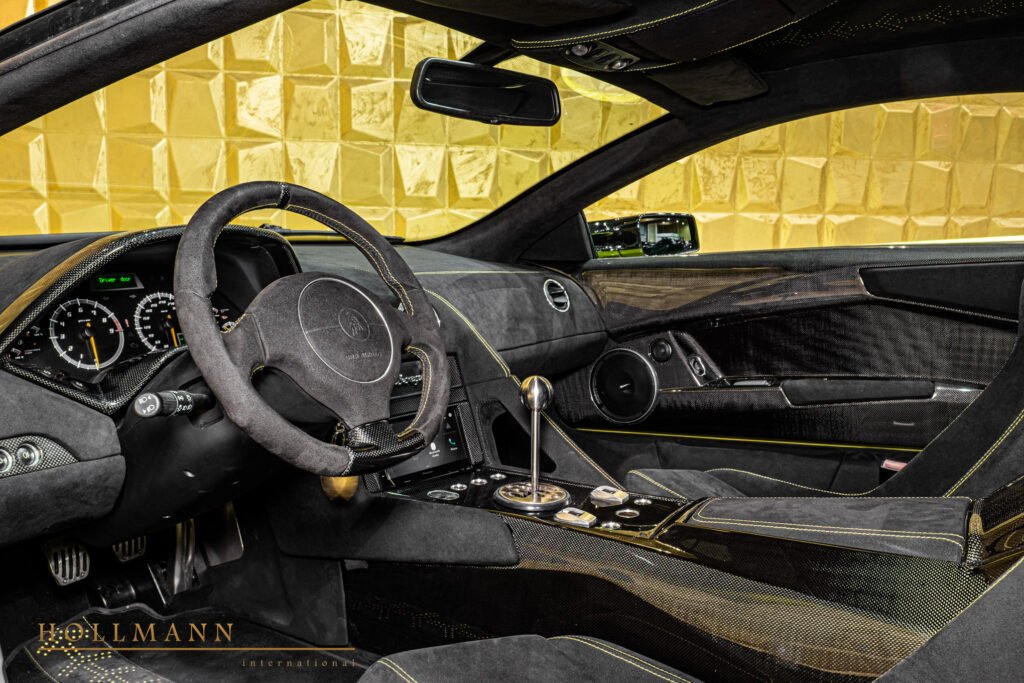
The original interior has been extensively redesigned with Black Alcantara upholstery, bespoke carbon-fibre bucket seats and numerous SV-inspired details.
Carbon-fibre door panels, a redesigned central tunnel and individually manufactured trim elements create a more focused environment than the conventional LP640 interior.
The extensive use of Alcantara introduces a motorsport-inspired character, while the carbon-fibre surfaces emphasize the technical nature of the project.

Yet the most important interior feature remains the gated manual shifter.
Positioned within the redesigned central tunnel, it becomes the visual and mechanical centrepiece of the cockpit.
Unlike the paddle-operated E-Gear transmission, the manual system requires direct interaction with the driver.
That single change transforms the entire atmosphere of the cabin.
The interior is no longer simply the control environment of an extremely powerful Lamborghini.
It becomes a space designed around the physical experience of driving.
Carbon-Fibre Bucket Seats and Bespoke Craftsmanship
The bespoke carbon-fibre bucket seats are another defining feature.
Their design reinforces the SV-inspired philosophy while introducing a more focused seating environment.
The combination of carbon-fibre structures and Alcantara upholstery creates an aesthetic closely associated with lightweight high-performance automobiles.
The surrounding cabin follows the same approach.

Custom door panels, carbon-fibre trim and the redesigned centre tunnel contribute to a cohesive visual identity.
Rather than appearing as isolated modifications, the interior elements form part of a comprehensive design concept.
The attention devoted to alignment, materials and finishing is especially important in a project of this scale.
A bespoke automobile must feel coherent if it is to transcend the impression of a conventional aftermarket conversion.
Here, the objective has clearly been to create an integrated interpretation of Lamborghini’s SuperVeloce philosophy.
Documentation and German Road Approval
One of the most important aspects of any extensively modified collector car is documentation.
This Murciélago is accompanied by a comprehensive photographic record of its restoration and transformation.
According to the seller, the documentation covers the project from its initial stages through the completed vehicle.
That transparency is particularly valuable because the modifications extend far beyond cosmetic changes.
The manual transmission conversion, rear-wheel-drive transformation and bespoke bodywork all represent significant departures from the original factory specification.

The vehicle is also accompanied by German registration documents, a valid TÜV inspection and an individual approval under §21.
These documents establish the vehicle’s advertised road-legal status in Germany.
For an international buyer, however, registration requirements should be reviewed separately in the intended destination country, as approval in Germany does not automatically guarantee registration elsewhere.
The documentation provides an important foundation for evaluating the vehicle’s engineering, originality and legal status.
One Previous Owner and 28,700 Kilometres
This example was first registered in July 2008 and is listed with one previous owner.
The odometer shows 28,700 kilometres.
Its original specification was for the Gulf Cooperation Council market, reflecting Lamborghini’s longstanding popularity among collectors and enthusiasts in the Middle East.

The vehicle’s later restoration and transformation represent a distinct chapter in its history.
For prospective buyers, the combination of original factory identity and extensive bespoke modifications deserves careful consideration.
The underlying automobile remains a genuine Murciélago LP640.
Its current mechanical and visual specification, however, differs substantially from the configuration in which it originally left Lamborghini’s factory.
That distinction should be reflected in any assessment of provenance, value and long-term collectability.
Originality Versus Individuality
The collector market traditionally places considerable importance on originality.
Factory specifications, matching components, documented ownership and preservation frequently influence the desirability of rare automobiles.
This Murciélago presents a different proposition.
It is not intended to compete directly with an untouched factory LP670-4 SuperVeloce on the basis of originality.
Instead, its appeal lies in the scale, craftsmanship and individuality of its transformation.
The car combines several characteristics that are extremely unusual when considered together: a naturally aspirated 6.5-litre V12, a traditional six-speed gated manual transmission, rear-wheel drive and extensive SV-inspired carbon-fibre bodywork.

The seller describes it as a one-of-one configuration.
That description refers to the bespoke build rather than to a unique factory-produced Lamborghini model.
For the right collector, this distinction may be precisely what makes the car attractive.
The Appeal of the Analogue Supercar
The automotive industry has changed dramatically since the Murciélago was introduced.
Modern supercars increasingly rely on hybrid powertrains, advanced traction systems, sophisticated electronic control and rapid dual-clutch transmissions.
These technologies have delivered extraordinary improvements in performance, efficiency and accessibility.
Yet they have also changed the relationship between driver and machine.
The Murciélago belongs to a different era.
Its naturally aspirated V12, dramatic mechanical soundtrack and traditional supercar proportions provide an experience that modern engineering cannot reproduce in exactly the same form.

This particular example takes that philosophy further by introducing a gated manual gearbox and rear-wheel drive.
The result is an automobile designed around deliberate driver involvement rather than the pursuit of the fastest possible acceleration time.
Every gear change, throttle input and mechanical response becomes part of the experience.
For enthusiasts who value analogue performance, that approach has considerable emotional appeal.
A €1.08 Million Bespoke Lamborghini
With an asking price of €1,080,000, this Murciélago occupies a highly specialized segment of the collector market.
Its valuation cannot be assessed in the same way as an unmodified LP640 or an original factory LP670-4 SuperVeloce.
The car’s appeal is built around a combination of the underlying Lamborghini, the extensive restoration, bespoke carbon-fibre craftsmanship and the unusual drivetrain configuration.

The documented labour investment provides useful context regarding the scale of the project, although restoration expenditure does not necessarily translate directly into market value.
Ultimately, the car will appeal to a relatively specific audience.
It is intended for collectors who appreciate the Murciélago platform but seek an experience that Lamborghini never offered in precisely this form.
The manual transmission, rear-wheel drive and SV-inspired design create a distinctive mechanical and visual identity.
That individuality is the central proposition.
A Murciélago Unlike Any Other
The Lamborghini Murciélago LP640 remains one of the defining supercars of its generation.
Its naturally aspirated V12, dramatic design and unmistakable personality established it as a modern Lamborghini icon.
The LP670-4 SuperVeloce subsequently demonstrated how far the factory could push the platform through reduced weight, increased power and more aggressive aerodynamics.
This extraordinary 2008 example follows a different path.
It takes the LP640 as its foundation, introduces an extensive SV-inspired transformation and combines it with two of the most engaging mechanical features imaginable: a gated manual gearbox and rear-wheel drive.
The result is not an original SuperVeloce.
It is something deliberately different.
A bespoke Lamborghini created to celebrate the analogue driving experience through an exceptionally ambitious restoration and engineering project.
For a collector seeking absolute factory originality, there are other Murciélagos.
For someone seeking a unique interpretation of Lamborghini’s legendary V12 era, this car presents a fascinating alternative.
Vehicle Specifications
Model: Lamborghini Murciélago LP640 — SV-Inspired Rebuild
First Registration: July 2008
Original Market: GCC Specification
Mileage: 28,700 km
Previous Owners: 1 (Dealer Listed)
Engine: 6.5-Litre Naturally Aspirated V12
Displacement: 6,496 cc
Power: 640 PS / 471 kW
Transmission: Bespoke 6-Speed Gated Manual Conversion
Original Transmission: E-Gear
Current Drivetrain: Rear-Wheel Drive Conversion
Original Drivetrain: All-Wheel Drive
Exterior Colour: Lime Essence
Interior: Black Alcantara
Interior Trim: Bespoke Carbon Fibre
Seats: 2
Wheels: 18-Inch Forged SV-Style Wheels, Gloss Black
Bodywork: Bespoke SV-Inspired Carbon-Fibre Conversion
Restoration Duration: Approximately 24 Months
Documented Labour: 3,841 Hours
Emissions Standard: Euro 4
German Road Approval: TÜV and Individual §21 Approval
Factory Model Identity: Lamborghini Murciélago LP640
Production Status: Unique Bespoke Rebuild, Not a Factory LP670-4 SV
Location: Germany
Asking Price: €1,080,000 — VAT Not Applicable
Key Features
- Genuine 2008 Lamborghini Murciélago LP640
- Unique SV-Inspired Bespoke Transformation
- 6.5-Litre Naturally Aspirated V12
- 640 PS / 471 kW
- Six-Speed Gated Manual Conversion
- Rear-Wheel-Drive Conversion
- Approximately 24-Month Restoration
- 3,841 Documented Labour Hours
- Lime Essence Exterior
- Black Alcantara Interior
- Bespoke Carbon-Fibre Bucket Seats
- Custom Carbon-Fibre Front Bumper
- Custom Carbon-Fibre Rear Bumper
- Bespoke Front Wings and Rear Body Panels
- Carbon-Fibre Roof Panel
- Carbon-Fibre Engine Cover
- SV-Inspired Rear Wing
- Carbon-Fibre Door Panels
- Bespoke Carbon-Fibre Centre Tunnel
- 18-Inch Forged SV-Style Wheels
- Gloss Black Wheel Finish
- Extensive Chassis and Drivetrain Restoration
- Suspension and Cooling System Restoration
- Electrical System Restoration
- Comprehensive Photographic Documentation
- German Registration Documents
- Valid TÜV Inspection
- Individual §21 Approval
- One Previous Owner Listed
- 28,700 km
- Worldwide Export Available
Dealer Information
This 2008 Lamborghini Murciélago LP640 SV-Inspired Rebuild is offered by Hollmann International in Germany under reference 26G0908.
Originally manufactured as a GCC-specification LP640, the vehicle has undergone an extensive bespoke restoration and transformation featuring a six-speed gated manual gearbox, rear-wheel drive and individually manufactured SV-inspired carbon-fibre bodywork.
The dealer confirms that the car is accompanied by German registration documents, TÜV inspection and individual §21 approval.
VAT Status: Not Applicable
Mileage: 28,700 km
Location: Germany
Availability: In Stock
Worldwide Export: Available
Viewings are available by prior appointment.
Vehicle Inquiry
For additional information regarding this Lamborghini Murciélago LP640 SV-Inspired Rebuild, including its complete restoration documentation, engineering modifications, service history, registration approval and international purchase arrangements, contact Hollmann International through the original vehicle listing.
LuxeonCars presents exceptional luxury, performance and collector automobiles offered by specialist dealers worldwide.