

Some racing cars become legends because they win.
Others become legends because they never had the chance.
The Koenigsegg CCGT belongs firmly to the latter category.
Developed in the mid-2000s as the Swedish manufacturer’s first serious attempt at GT1 competition, the original CCGT was light, naturally aspirated and extraordinarily promising. Then, just as testing began, the regulations changed.
The project was effectively over before it had truly started.
Nearly two decades later, Koenigsegg has returned to that unfinished chapter.
The result is the CCGT1.
Unveiled during Monterey Car Week 2026, the new car takes the philosophy of the abandoned GT1 racer and combines it with the engineering foundation of the modern CC850. The result is a road-legal megacar producing up to 1,600 horsepower, generating around 800 kilograms of aerodynamic load at 250 km/h, and offering a level of track preparation unlike anything Koenigsegg has officially sold before.
It is not simply a tribute.
It is the racing programme that never happened, reborn for the road.
The Koenigsegg That Never Got to Race
Christian von Koenigsegg had motorsport in mind almost from the beginning.
During development of the company’s earliest cars, dimensions and proportions were considered with the possibility that a future racing version might eventually emerge.
That ambition ultimately produced the CCGT.
The car was developed around contemporary GT1 regulations and represented an unusually pure interpretation of Koenigsegg engineering.

A naturally aspirated 5.0-litre V8 produced around 600 horsepower.
Power went exclusively to the rear wheels.
A lightweight magnesium sequential gearbox handled transmission duties.
And the entire car weighed only around 1,000 kilograms.
Aerodynamics were equally serious, with the project expected to generate more than 600 kilograms of downforce.
On paper, the CCGT had almost everything required to become a formidable endurance racer.
Loris Bicocchi and a Promising Beginning
Legendary development driver Loris Bicocchi participated in testing.
The early results suggested the car possessed genuine potential.
Koenigsegg had done something remarkable for a company of its size: develop a credible GT1 racing machine almost entirely from scratch.

Then the rulebook changed.
Only around two months after testing began, the FIA revised the GT1 production requirements.
The new rules demanded production volumes that were fundamentally incompatible with Koenigsegg’s ultra-low-volume manufacturing model.
The CCGT was suddenly obsolete as a racing programme.
Not because it was too slow.
Because Koenigsegg was too small.
A Lost Chapter in Koenigsegg History
For years, the CCGT remained one of the most fascinating “what if” stories in modern motorsport.
What might have happened if Koenigsegg had competed at Le Mans?
Could the tiny Swedish manufacturer have challenged established names in endurance racing?
Would its lightweight philosophy have translated successfully into long-distance competition?
Nobody ever received an answer.
The project became part of Koenigsegg mythology.
The CCGT1 finally gives that idea another life.
From CCGT to CCGT1

The new car follows a philosophy similar to that of the CC850.
Just as the CC850 reinterpreted the original CC8S for a new generation, the CCGT1 revisits the spirit of the CCGT without attempting to recreate it literally.
The technical foundation comes from the CC850.
But the transformation is extensive.
Koenigsegg says practically every exterior panel has been redesigned, with essentially only the doors and removable roof carried over from the underlying architecture.
That distinction is important.
The CCGT1 is not simply a CC850 wearing a racing wing.
Its aerodynamic and mechanical objectives are fundamentally different.
Bugatti Destrier: When the Bolide Becomes a Rolling Sculpture
A Modern GT1 Silhouette
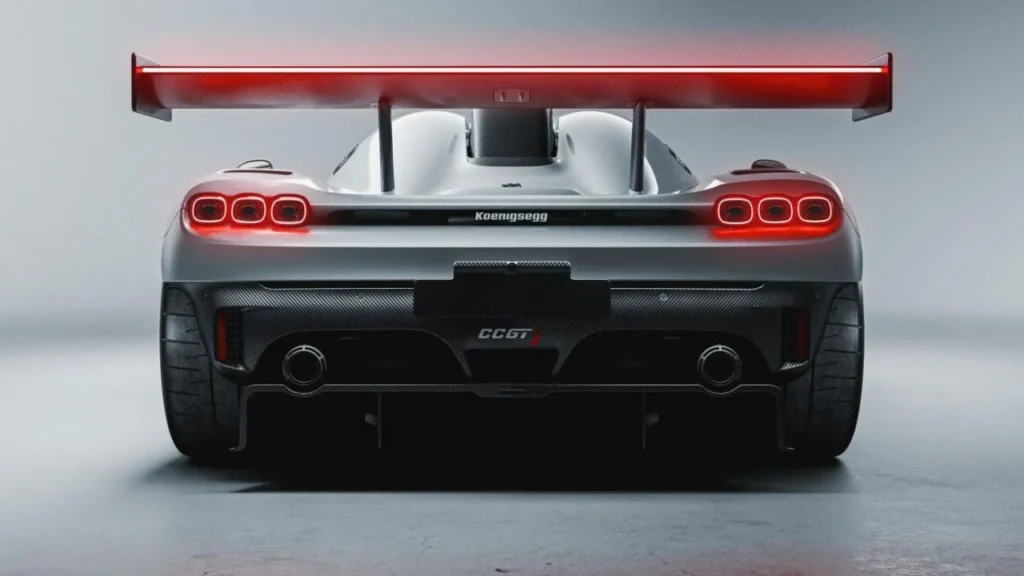
Visually, the CCGT1 immediately communicates its purpose.
The body is wider.
Lower.
More aggressive.
Every surface appears to have been designed around airflow.
The front splitter extends dramatically ahead of the body.
Large aerodynamic extraction zones appear around the wheels.
The underbody is completely flat.
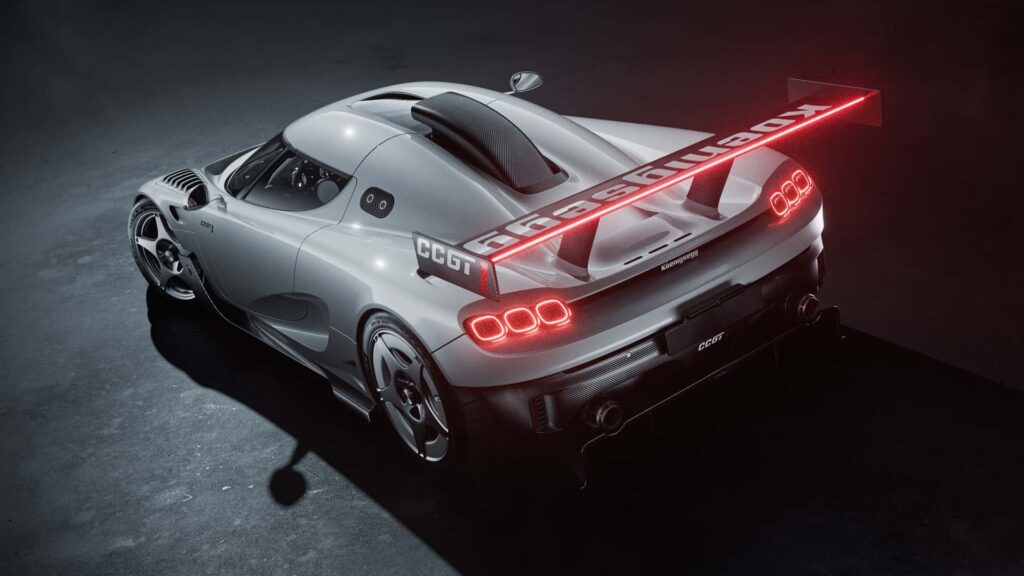
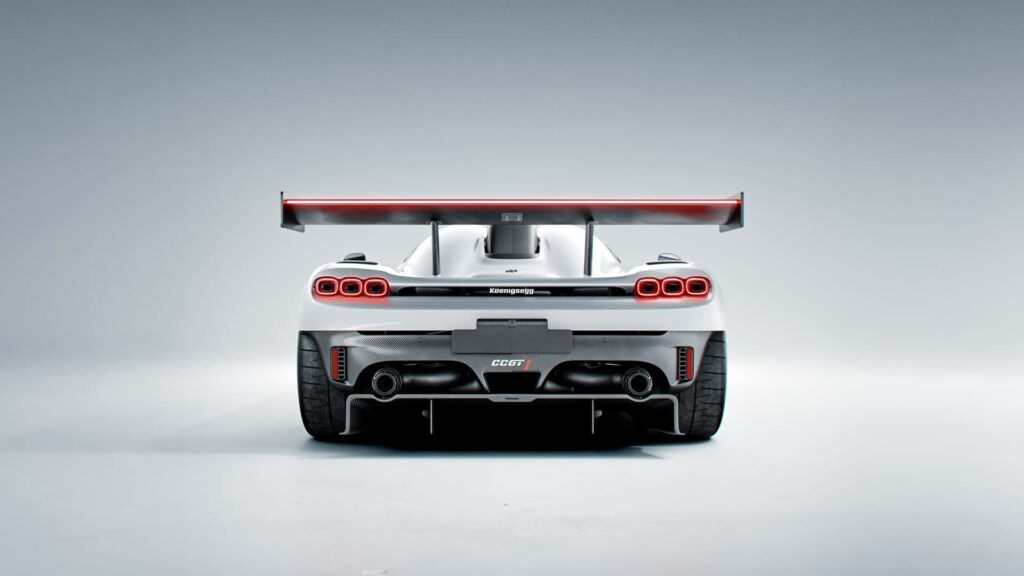
And the rear is dominated by an enormous active wing directly inspired by the original CCGT.
The result has the visual drama of a contemporary endurance prototype while remaining unmistakably Koenigsegg.
An Active Wing With a 30-Degree Range
The rear wing is far more sophisticated than its historical inspiration.
Its angle can vary automatically by approximately 30 degrees, allowing the system to operate in several distinct configurations.
Low drag for maximum speed.
High downforce during cornering.
And an air-brake function under heavy deceleration.
That versatility allows Koenigsegg to combine road usability with extreme circuit performance rather than forcing the car into a single aerodynamic compromise.
The wing is dramatic because it needs to be.
Not because it needs to attract attention.
Active Aerodynamics Continue Underneath
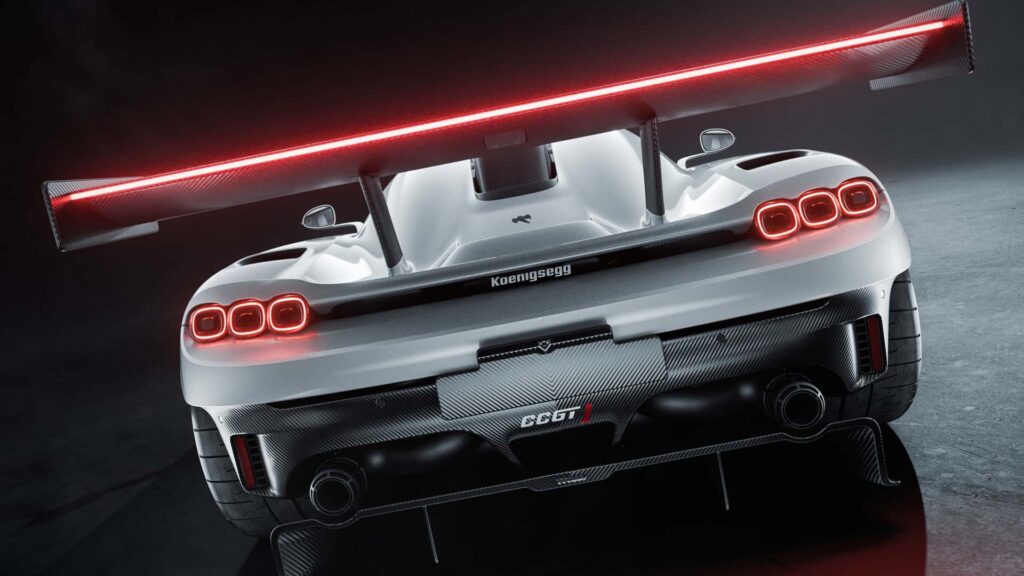
The rear wing is only one part of the aerodynamic system.
The CCGT1 also uses active underbody flaps, a completely flat floor and a specially developed rear diffuser.
Together, these components manage airflow beneath the car and help generate significant aerodynamic load without relying entirely on external wings.
At 250 km/h, Koenigsegg claims maximum downforce of approximately 800 kilograms.
That is an extraordinary figure for a road-legal automobile.
And it places the CCGT1 far closer to competition machinery than conventional grand touring cars.
Hennessey Blackbird: The Return of the Pure Driver’s Hypercar
Ghost Fibre: The Return of White Carbon
Another fascinating feature is something Koenigsegg calls Ghost Fibre.
The idea references the company’s famous Trevita technology from 2009, which created a distinctive silvery-white carbon-fibre appearance.
The new material goes further.
Ghost Fibre combines aramid fibre with carbon fibre, producing a structure designed to offer improved strength, reduced mass and useful sound-absorbing properties compared with conventional carbon construction.

It also creates a completely different visual texture.
Rather than the familiar dark weave associated with exposed carbon fibre, the material appears brighter and almost metallic.
For a car celebrating Koenigsegg’s own history, reviving the spirit of Trevita feels particularly appropriate.
1,600 Horsepower on E85
At the heart of the CCGT1 sits a modern Koenigsegg 5.0-litre twin-turbocharged V8.
On conventional gasoline, output reaches approximately 1,280 horsepower.
Fill the car with E85 ethanol and that figure rises to 1,600 horsepower.
The engine management system can also adapt to different mixtures of gasoline and ethanol.
That flexibility allows owners to use the car in different markets without sacrificing the full performance potential when E85 is available.
For context, Koenigsegg’s Jesko uses the same basic output figures: 1,280 hp on gasoline and 1,600 hp on E85. The company’s current Jesko specification also confirms an 8,500-rpm limit and the lightweight flat-plane V8 architecture that underpins its latest generation of combustion engineering.
A Completely Different Character From the Original CCGT
The contrast with the original racer is fascinating.
That car relied on a naturally aspirated V8 producing around 600 horsepower.
The CCGT1 produces well over twice as much power even before using E85.
Yet the underlying philosophy remains surprisingly similar.
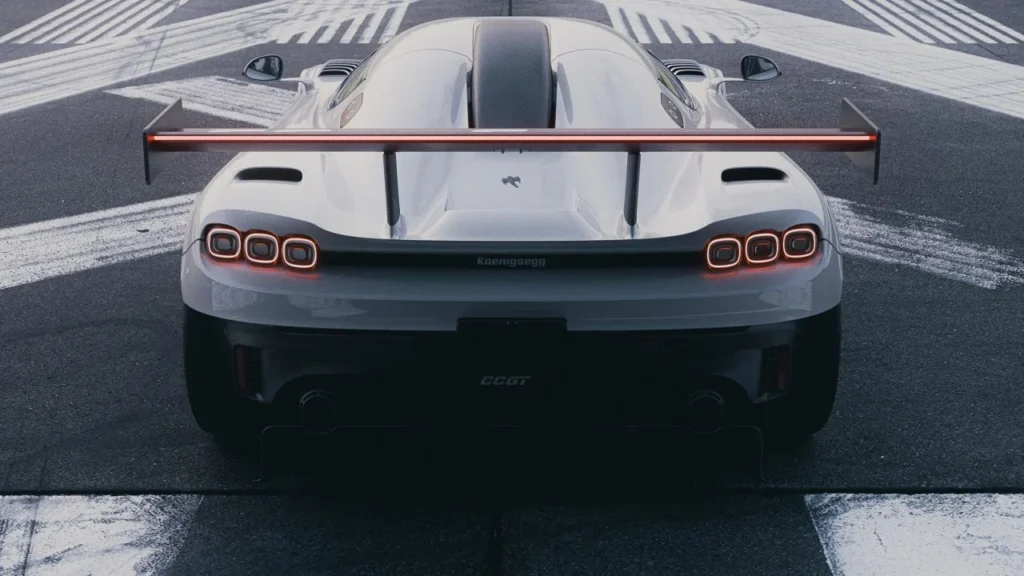
Low mass.
Rear-drive character.
Race-derived aerodynamics.
And an obsession with using advanced engineering rather than simply adding power.
The technology has changed enormously.
The intent has not.
Cooling Designed for Extended Track Use
Koenigsegg has also paid particular attention to something that rarely appears in headline specifications.
Heat.
Sustained circuit use places enormous demands on engine oil, dampers, brakes and transmission systems.
The CCGT1 therefore introduces additional cooling capacity specifically intended for prolonged track sessions.
A new roof intake feeds an enlarged oil cooler while also supplying a dedicated cooling circuit for the dampers.
This is exactly the kind of detail that distinguishes a car designed to survive repeated laps from one designed primarily to produce impressive acceleration figures.
Koenigsegg Sequential Shift
Perhaps the most technically interesting element of the car is its transmission.
The CCGT1 introduces Koenigsegg Sequential Shift, or KSS.
The system is derived from the company’s nine-speed Light Speed Transmission, but operates in a manner specifically designed around greater driver involvement.
Unlike a conventional dual-clutch transmission, the LST uses several wet multi-disc clutches and can move almost instantly between different gear ratios rather than progressing sequentially through every intermediate gear. Koenigsegg’s official technical information describes the complete LST as weighing only around 90 kilograms.
For the CCGT1, that sophisticated architecture receives a very different interface.
A Clutch Pedal — But Not as You Expect
The driver receives a physical clutch pedal.
It is used primarily for launching the car.
Once moving, shifts can be performed without using the clutch pedal because the system employs ignition cuts to unload the transmission and execute extremely rapid sequential gear changes.
That creates an unusual halfway point between a competition sequential gearbox and a conventional manual.
The driver still participates physically.
But the transmission technology underneath remains thoroughly modern.
Koenigsegg CC850: The Driver’s Hypercar
ASMR: Four Ways to Shift
A selector called ASMR allows the driver to choose between four transmission states:
Auto
Sequential
Manual
Reverse
The naming may be playful.
The underlying idea is serious.
Rather than forcing every owner into the same interaction model, Koenigsegg allows the CCGT1 to change character depending on whether it is being driven casually on the road or aggressively on a circuit.
That versatility is central to the entire car.
Or Choose a Real Six-Speed Manual
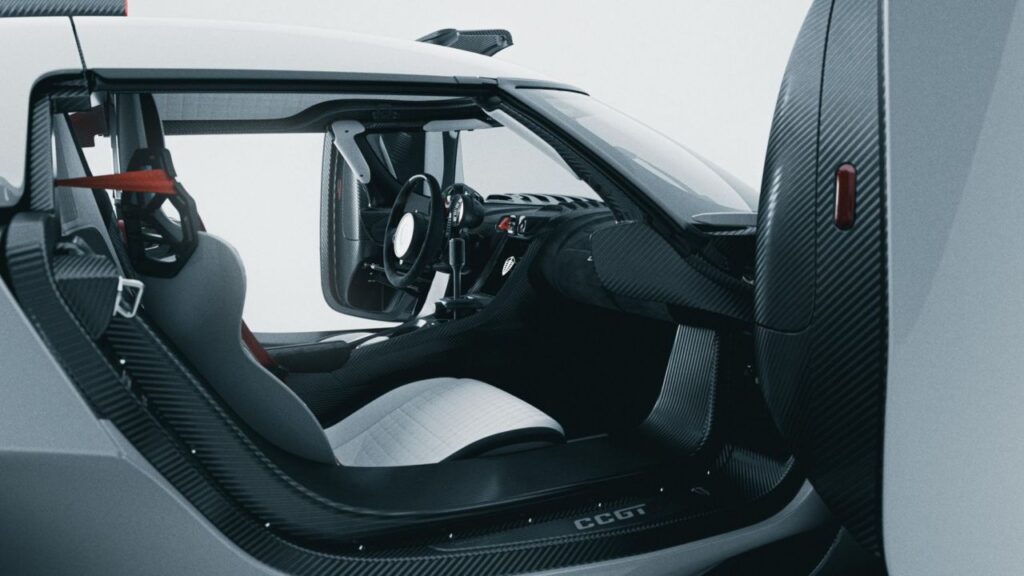
For customers who want something even more traditional, Koenigsegg offers another extraordinary option.
The Engage Shift System from the CC850 can be specified.
That means a six-speed gated manual gearbox with a conventional clutch pedal.
The CC850 famously introduced a transmission capable of functioning as both a physical manual and a fully automatic multi-ratio system using Koenigsegg’s advanced clutch architecture.
In the CCGT1, buyers can therefore choose between two radically different philosophies.
A race-inspired sequential system.
Or one of the most sophisticated manual gearbox experiences ever created.
Koenigsegg’s First Official Track Package
The CCGT1 also introduces another first for the company.
An official in-house track package.
Koenigsegg has produced extremely circuit-capable road cars before.
The Jesko Attack is explicitly presented by the company as its road-legal track legend.
But the CCGT1 takes that idea much closer to actual competition preparation.
The optional package effectively allows owners to transform the road car into something resembling a genuine race-weekend machine.

Roll Bar, Harnesses and Fire Suppression
The track package includes a carbon-fibre roll bar, HANS-compatible racing seats and six-point harnesses.
A fire-suppression system is integrated into the car.
Competition-focused suspension and brake components replace the road-biased settings.
A dedicated racing exhaust reduces restrictions and weight.
Slick tyres provide maximum dry grip.
A second set of wheels is included.
And additional aerodynamic optimisation pushes the chassis further towards circuit use.
This is no conventional “Track Pack” consisting of different wheels and a few carbon pieces.
It fundamentally alters the car’s mission.
Integrated Air Jacks
Perhaps the most revealing detail is the inclusion of integrated air jacks.
Connect an external compressed-air system and the car can lift itself from the ground for rapid wheel changes or chassis work.
That is race-car hardware.
It serves almost no purpose during normal road use.
Its presence demonstrates just how seriously Koenigsegg expects some customers to treat the CCGT1 on circuit.

Telemetry Included
The track package also includes dedicated telemetry systems.
That allows owners to analyse laps rather than simply experience them.
Braking points.
Corner speeds.
Throttle traces.
Potentially suspension and vehicle-dynamics data.
The car therefore becomes a platform for continuous driver improvement.
For a megacar costing seven figures, that is an unusual philosophy.
Owners are not simply encouraged to display it.
They are encouraged to learn how to use it.
Koenigsegg Says It Will Be Its Fastest Track Car
With the complete track package fitted, Koenigsegg says the CCGT1 will become the fastest Koenigsegg ever on a circuit.
That is a significant claim.
The current Jesko Attack was developed specifically around enormous downforce and track performance, while the Jesko Absolut pursues top speed by reducing aerodynamic resistance. Koenigsegg’s official figures show just how different those philosophies are: removing the Attack’s huge rear wing for the Absolut reduces downforce from roughly 1,400 kg to only around 150 kg.
The CCGT1 therefore sits in fascinating territory.
Road legal.
But with a factory pathway towards something even more focused than the Jesko Attack.
Road Car First, Race Car When Required
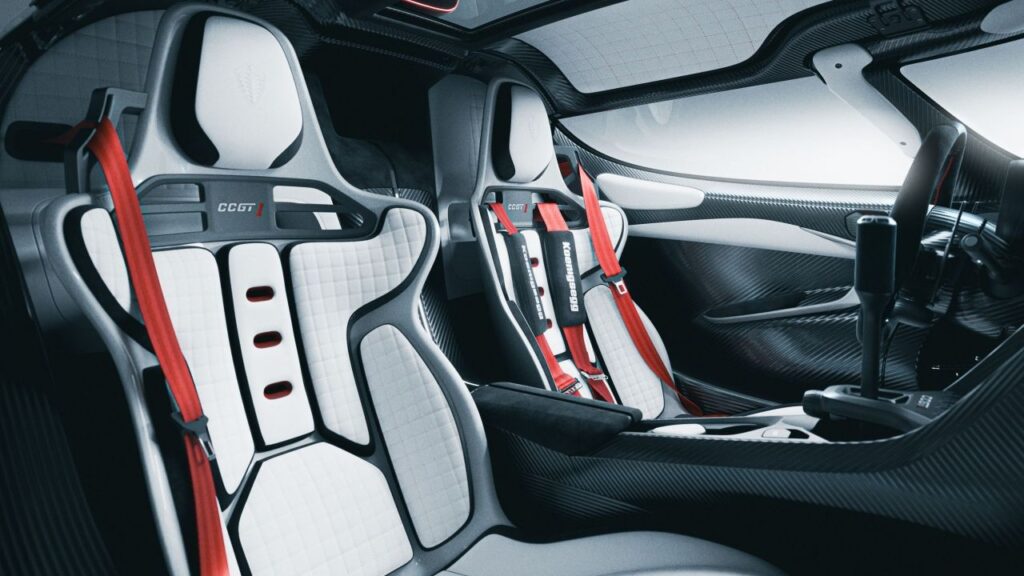
That dual identity may ultimately be the CCGT1’s most interesting characteristic.
Without the track package, it remains a fully road-legal megacar.
Removable roof.
Modern interior.
Extreme performance.
Enough usability to travel beyond circuit boundaries.
Install the track equipment and its personality changes.
Harnesses replace conventional restraints.
Slicks replace road tyres.
Fire suppression appears.
Air jacks become useful.
Telemetry becomes part of the experience.
The same automobile can move remarkably close to genuine racing specification.
Based on the CC850, But Visually Transformed
The CCGT1’s connection with the CC850 provides another fascinating layer.
The CC850 itself is a celebration of Koenigsegg history, created around the original CC8S but using thoroughly modern engineering.
Its proportions are relatively clean by contemporary Koenigsegg standards.
The CCGT1 takes that elegant foundation and turns it into something considerably more aggressive.
Almost every body panel changes.
The transformation mirrors what a racing department might historically have done with a road-going GT.
The road car provides the architecture.
Competition dictates the rest.
Koenigsegg Sadair’s Spear: Track-Ready, Road-Legal
Seventy Examples
Production will be limited to 70 examples worldwide.
For Koenigsegg, that is substantial enough to create a recognisable model while remaining extremely exclusive.
It is also vastly more achievable than the production numbers that killed the original CCGT programme.
There is a certain irony in that.

Regulations once prevented Koenigsegg from racing because it could not build enough road cars.
Now the company can create 70 examples of a road-legal tribute to the car those same regulations effectively killed.
History occasionally provides elegant symmetry.
Sold Out Within Hours
According to launch reporting, all 70 production allocations were claimed within hours of the car’s unveiling.
That is hardly surprising.
Koenigsegg production remains tiny by industry standards.
Demand for its cars consistently exceeds supply.
And the CCGT1 combines several ingredients collectors tend to value intensely.
A direct historical narrative.
Extreme performance.
New technology.
Limited production.
And the possibility of becoming one of the most capable circuit machines the company has ever built.
For many established customers, the decision was probably immediate.
A Different Kind of Heritage Car
The automotive industry currently loves heritage.
Historic liveries return.
Old names are revived.
Retro styling appears on modern platforms.
The CCGT1 approaches heritage differently.

It does not celebrate a race victory.
There wasn’t one.
It does not reproduce a championship-winning livery.
There wasn’t one.
It celebrates potential.
An engineering project interrupted by forces outside the company’s control.
That gives the CCGT story a strangely compelling quality.
The original never received an ending.
The CCGT1 provides one.
From 600 HP to 1,600 HP
The numerical evolution alone demonstrates how much performance engineering has changed.
Original CCGT:
Approximately 600 horsepower.
New CCGT1:
Up to 1,600 horsepower.
Yet horsepower may actually be the least interesting difference.
The original used fixed aerodynamics.
The new car uses active systems.
The original had a conventional sequential transmission.
The new car uses Koenigsegg’s extraordinarily sophisticated multi-clutch architecture.
The original weighed around one tonne.
The new car integrates road legality, modern safety and vastly more technology while still pursuing a similar obsession with efficiency.
Twenty years of engineering progress have changed every detail.
But the Idea Remains Intact
Beneath all that technology, the concept is remarkably familiar.
Build a Koenigsegg around circuit performance.
Minimise compromise.
Create enormous aerodynamic load.
Keep the driver involved.
And use the company’s own engineering rather than buying solutions from elsewhere.
That independence has always been one of Koenigsegg’s defining qualities.
Much of the technology is developed internally because Christian von Koenigsegg has repeatedly refused to accept that existing solutions represent the only way to solve a problem.
The CCGT1 is another expression of that mentality.
The Racing Koenigsegg Finally Exists
The original CCGT remains one of automotive history’s great unrealised possibilities.
It looked ready.
It had serious people behind its development.
Then regulations closed the door.
The Koenigsegg CCGT1 opens it again.
Not by entering a contemporary GT1 championship.
That world no longer exists in the same form.

Instead, Koenigsegg has created something perhaps even stranger.
A road-legal 1,600-horsepower megacar capable of generating roughly 800 kilograms of downforce, fitted with an active aerodynamic system and a transmission that can combine race-car interaction with modern intelligence.
Then it offers an official track package with slick tyres, fire suppression, telemetry and air jacks.
The original CCGT wanted to turn a Koenigsegg road car into a racing car.
The CCGT1 turns that idea inside out.
It gives you the racing car first.
Then makes it legal for the road.