
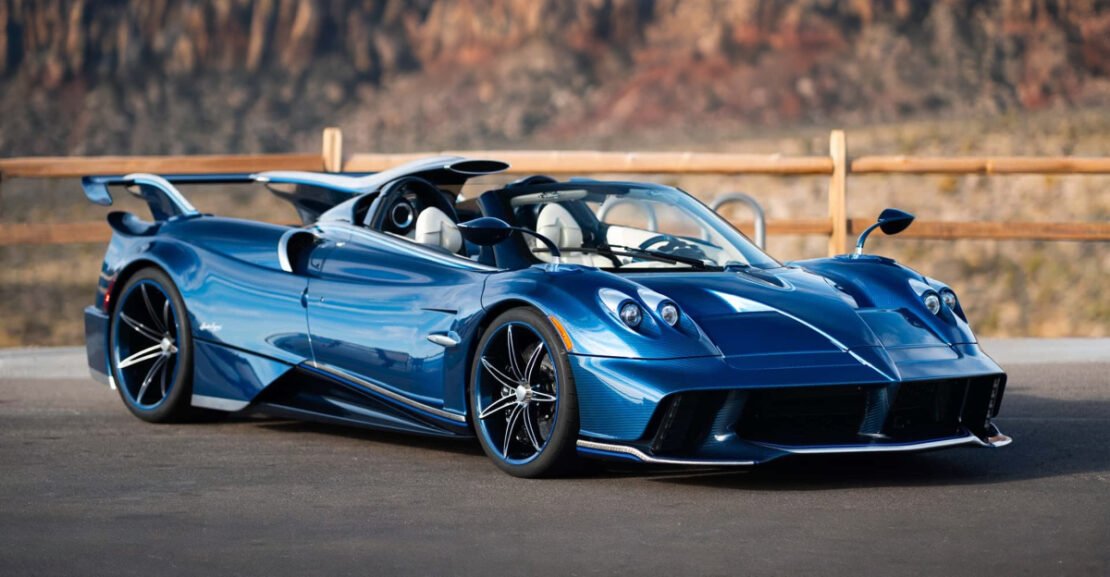
An extraordinary celebration of Horacio Pagani’s 70th birthday reaches its conclusion with the Huayra 70 Anima, a singular creation where Italian craftsmanship, a manual V12 and precious materials transform automotive engineering into a deeply personal work of art.
Some automobiles are designed to redefine performance. Others exist to challenge convention. And then there are creations that transcend both ambitions, conceived not simply as machines but as expressions of imagination, individuality and artistic vision.
The 2026 Pagani Huayra 70 Anima belongs firmly to the latter category.
Unveiled on October 31, 2026, at the prestigious Concours at Wynn Las Vegas, this remarkable one-off completes a trilogy of individually commissioned Huayra creations celebrating the 70th birthday of Horacio Pagani, founder of one of the world’s most extraordinary automotive marques.
Following the Huayra 70 Trionfo and Huayra 70 Derecho, Anima represents the final chapter of an exclusive three-car project that demonstrates why Pagani continues to occupy a distinctive position at the intersection of engineering, craftsmanship and automotive art.
A Trilogy Celebrating Horacio Pagani
For Horacio Pagani, anniversaries have often provided opportunities to explore new creative possibilities.
His 60th birthday was commemorated through the extraordinary Zonda HP Barchetta, a car that became one of the most recognizable expressions of Pagani’s bespoke philosophy.
A decade later, the Huayra 70 trilogy takes that philosophy into another dimension.
Developed through Pagani’s Grandi Complicazioni division, the three creations reinterpret the celebrated Huayra through individual design languages, unique materials and extensive personalization.
The Huayra 70 Trionfo introduced the series with green exposed carbon fiber, contrasting orange details and a comprehensively reworked exterior.
The Huayra 70 Derecho followed, making its public appearance at the 2026 Goodwood Festival of Speed with a striking combination of Pearl Orange and Inky Blue.
Finally, the Huayra 70 Anima brings the trilogy to its conclusion with an entirely different character: more intricate in its material expression, deeply personal in its inspiration and unmistakably theatrical in its execution.
At Wynn Las Vegas, all three creations appeared together publicly for the first time, offering a rare opportunity to appreciate three interpretations of the same extraordinary philosophy.
Pagani Huayra 70 Derecho: A Personal Tribute to Horacio Pagani’s Vision
Anima: Giving Physical Form to a Dream
The name Anima, meaning “soul” in Italian, is particularly appropriate.
Unlike conventional limited-edition hypercars, which are typically developed around a predefined specification, the Anima was created through an extended dialogue between Pagani’s designers and its individual client.
According to Pagani designer Lorenzo Kerkoc, the development involved more than a year of collaboration, exploring the owner’s personality, memories and long-standing aspirations.
At the heart of the project was a childhood dream: the desire to one day create a special automobile alongside Horacio Pagani himself.
That aspiration ultimately became reality.
This connection between creator and collector gives the Huayra 70 Anima a significance that extends beyond its technical specifications.
It is not merely a rare Pagani configured to an owner’s preferences. It is an automobile conceived around an individual story, translated into carbon fiber, metal, leather and mechanical artistry.
Diamond Dust, Platinum and the Art of Bespoke Design
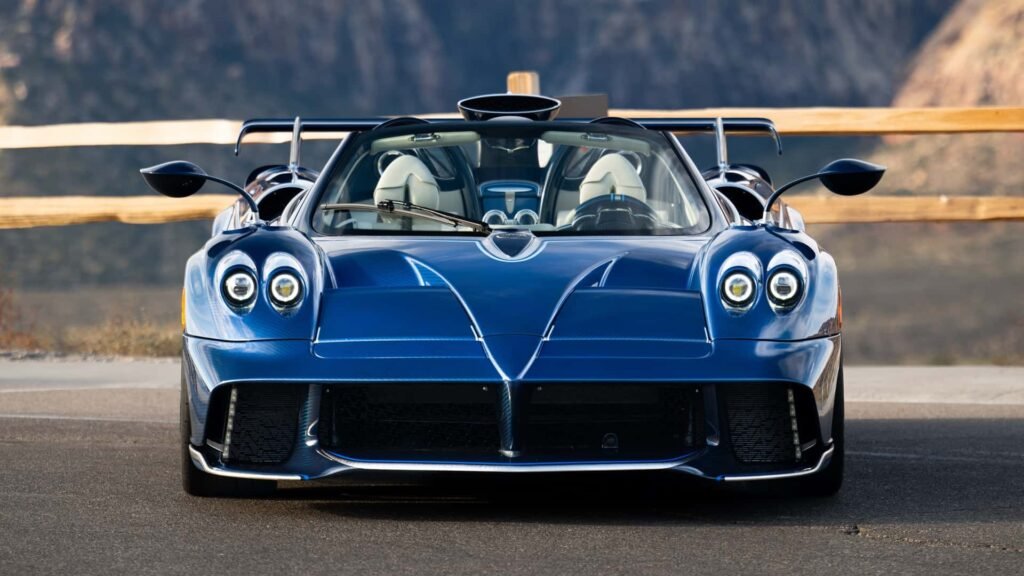
The exterior of the Huayra 70 Anima is perhaps its most immediately captivating feature.
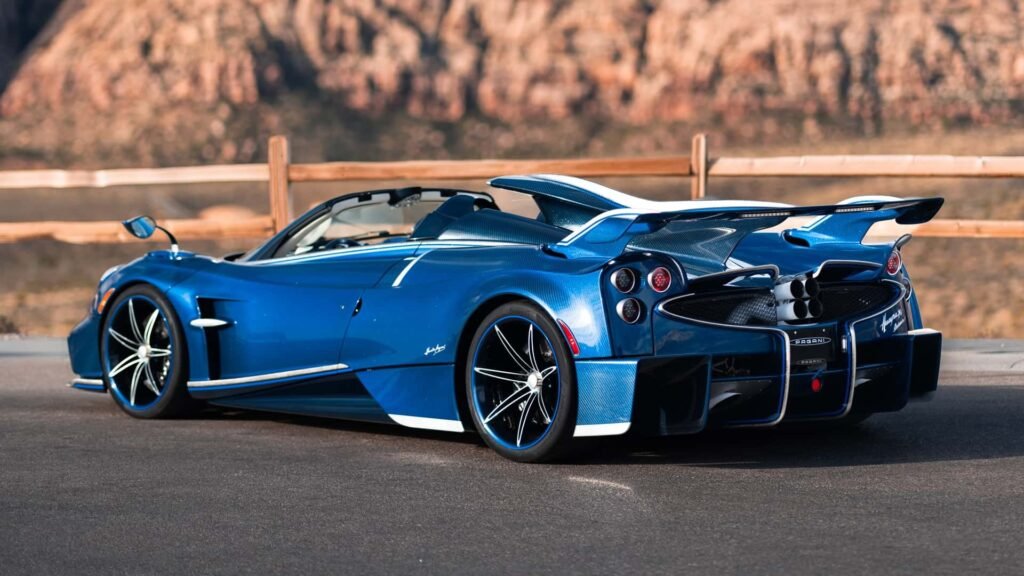
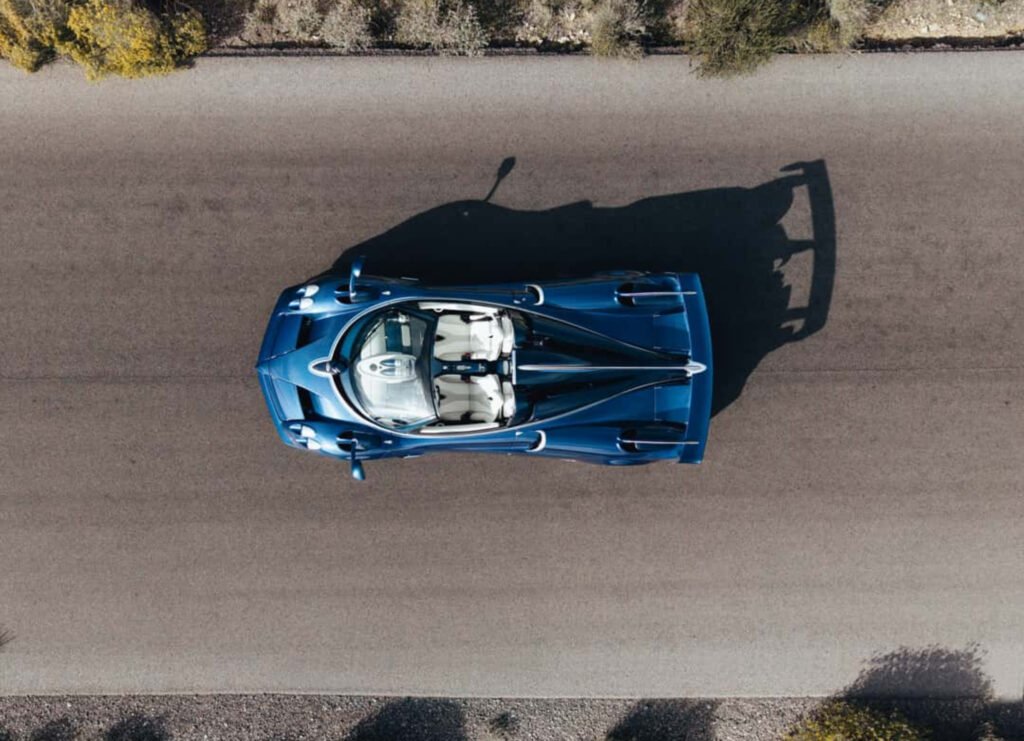
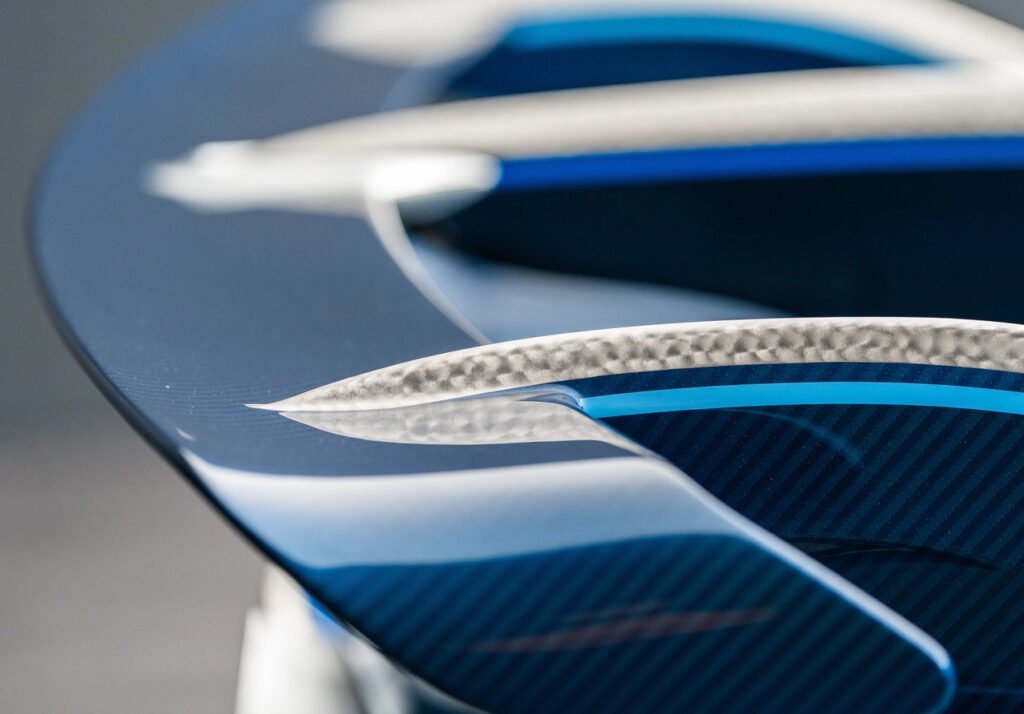
Its exposed carbon-fiber bodywork combines two specially developed finishes: Custom Metallic Light Blue (Azzurro Metallizzato Custom) and Custom Inky Blue (Blu Inchiostrato Custom).
Both incorporate diamond dust, creating an exceptional luminosity that changes with the surrounding light and emphasizes the sculptural complexity of the bodywork.
Rather than relying on conventional painted stripes, Pagani has introduced a remarkable decorative element: a primary stripe formed from hand-applied platinum leaf, individually worked to produce a distinctive pattern.
A secondary stripe alternates between light blue and deeper blue, with the same chromatic treatment extending to the exterior mirrors.
The attention to detail continues throughout the vehicle.
Solid-milled aluminum components receive a silver anodized finish, while diamond-cut wheels feature Inky Blue centers with Las Vegas Blue detailing around their perimeter.
Chrome-finished brake calipers provide an elegant contrast.
Even the less visible mechanical components receive individual consideration. Beneath the bodywork, selected components are anodized in Tricolore Blue, while chassis tie-rods and suspension springs are finished in Argentina Light Blue.
These details are not simply decorative. Together, they demonstrate Pagani’s conviction that every element, visible or concealed, should contribute to the identity of the finished automobile.
A Sculptural Body Designed for Performance
The Anima retains the unmistakable proportions of the Huayra while embracing a much more dramatic aerodynamic character.
A prominent central air intake rises behind the cockpit, accompanied by a longitudinal fin that extends toward the rear.
Individual roll hoops reinforce its open-cockpit architecture, while an imposing fixed rear wing and substantial diffuser emphasize the car’s performance-oriented design.
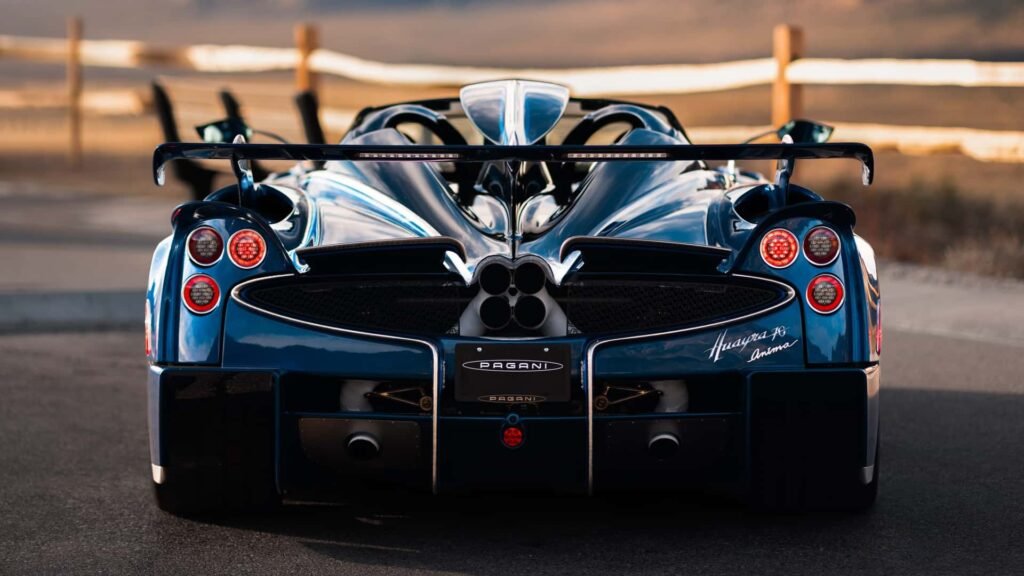
Ventilation openings, sculpted surfaces and exposed carbon-fiber elements contribute to an exterior that appears simultaneously mechanical and organic.
At the rear, the bespoke six-pipe exhaust system, finished with a white ceramic coating, provides another extraordinary visual signature.
It is a design that could easily become excessive in less accomplished hands.
Yet the Anima’s appeal lies in the way its numerous details are integrated into a coherent artistic composition.
For Pagani, aerodynamics and aesthetics are not opposing disciplines. They are different expressions of the same ambition: achieving harmony between form and function.
From Zonda to Utopia: The Complete Evolution of Pagani
A Twin-Turbo V12 With a Seven-Speed Manual Gearbox
Beneath its elaborate bodywork, the Huayra 70 Anima continues Pagani’s longstanding relationship with twelve-cylinder performance.
The car uses the familiar 6.0-liter twin-turbocharged V12 architecture developed by Mercedes-AMG, paired with a seven-speed manual transmission.
The gearbox is particularly significant.
In an era when most contemporary hypercars rely almost exclusively on sophisticated automated transmissions, Pagani has deliberately preserved the engagement of a traditional manual gearbox.
An exposed mechanical shift linkage and three-pedal arrangement place the driver directly at the center of the experience.

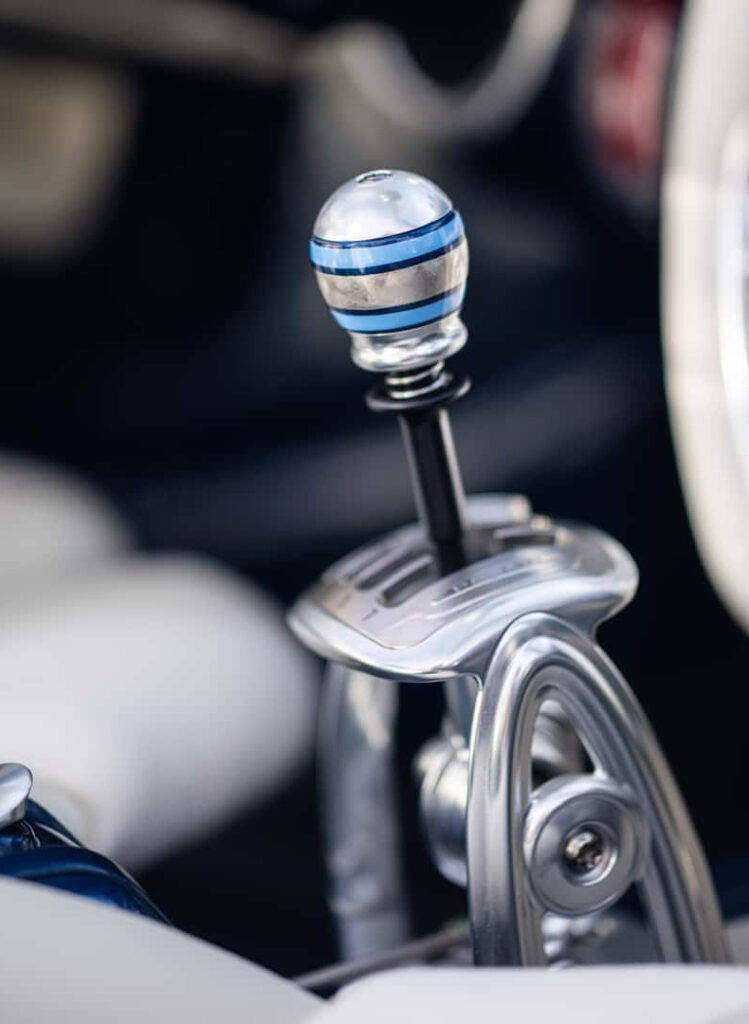
This philosophy was previously demonstrated by the one-off Huayra Epitome, which introduced a manual transmission to the Huayra family.
The Anima continues that tradition, prioritizing mechanical involvement alongside extraordinary performance.
Although related Huayra special editions have produced more than 800 horsepower, Pagani has not disclosed an official power or torque figure specifically for the Anima.
Its acceleration, top speed and detailed performance figures also remain unconfirmed.
Nevertheless, the attraction of this creation extends well beyond numerical comparisons.
The combination of a formidable V12, a physical manual gearbox and highly individualized craftsmanship offers something increasingly unusual in modern hypercars: an experience shaped as much by human interaction as by technological sophistication.
Inside the Anima: Italian Craftsmanship at Its Finest
The interior continues the exterior’s meticulous exploration of texture, color and material.
Soft beige and milk-colored leather are combined with exclusive Loro Piana fabric, creating an atmosphere that is both luxurious and deliberately unconventional.
Exposed carbon fiber, finished predominantly in Inky Blue, contrasts with intricately machined aluminum components and the elaborate mechanical controls for which Pagani interiors have become renowned.
Custom Metallic Light Blue appears on selected touchpoints, including the steering wheel and manual gear knob, both enhanced by the distinctive diamond-dust treatment.

Subtle graphic elements reference the flags of Argentina and Las Vegas, adding another personal dimension to the cabin.
The resulting environment feels less like the interior of a conventional supercar and more like a carefully curated collection of bespoke objects.
Every switch, surface and mechanical component contributes to the overall composition.
It is an interior intended not only to be admired, but to be experienced through touch, movement and interaction.
Gordon Murray S1: The V12 Manual Supercar Built for the Open Road
The Huayra 70 Anima and the World of Automotive Collecting
With only three individually created Huayra 70 automobiles in existence, the trilogy occupies a particularly exclusive position within the modern hypercar landscape.
The Anima itself is a genuine one-off, developed for a single client rather than offered as part of a conventional production series.
Its significance for collectors lies in several overlapping qualities.
There is the association with Horacio Pagani’s personal milestone, the extraordinary level of customization, the craftsmanship of Grandi Complicazioni and the combination of a V12 engine with a manual transmission.


There is also the wider historical context.
Although the Pagani Utopia succeeded the Huayra as the marque’s principal production model, the Huayra continues to inspire exceptional bespoke projects.
This reflects a characteristic of Pagani’s history: the company’s most celebrated designs do not necessarily disappear when their conventional production cycles conclude.
Instead, they can evolve into increasingly individualized creations.
The Zonda established that tradition, and the Huayra now appears to be following a similar path.
What Is the Pagani Huayra 70 Anima Worth?
Pagani has not publicly disclosed the Anima’s original commission price.
Its individual configuration, unique materials and extensive development make direct comparisons with standard-production Huayra models difficult.
From a collector’s perspective, its one-off status and connection to Horacio Pagani’s anniversary may contribute to its long-term desirability.
However, without a disclosed transaction price or a secondary-market sale, any precise valuation would remain speculative.
For an automobile of this nature, exclusivity and provenance are central to its appeal, but they do not guarantee future appreciation.
The Last Chapter of an Extraordinary Trilogy
The Pagani Huayra 70 Anima is more than a celebration of a birthday.
It represents an approach to automotive creation in which technological sophistication exists alongside the traditions of fine craftsmanship, personal expression and artistic experimentation.
Its diamond-infused finish, hand-applied platinum detailing, exquisite interior and engaging manual V12 powertrain demonstrate just how far an already exceptional automobile can be transformed when conventional production constraints are removed.

As the third and final creation in the Huayra 70 trilogy, Anima brings this particular project to a fitting conclusion.
But it would be premature to describe it as the final Huayra ever built. Pagani’s history has repeatedly shown that exceptional commissions can extend the creative life of an iconic model far beyond its original production era.
Ultimately, the Huayra 70 Anima reminds us that the rarest automobiles are not necessarily defined by the numbers they achieve, but by the stories they preserve.
For Pagani, that distinction has always been essential.