
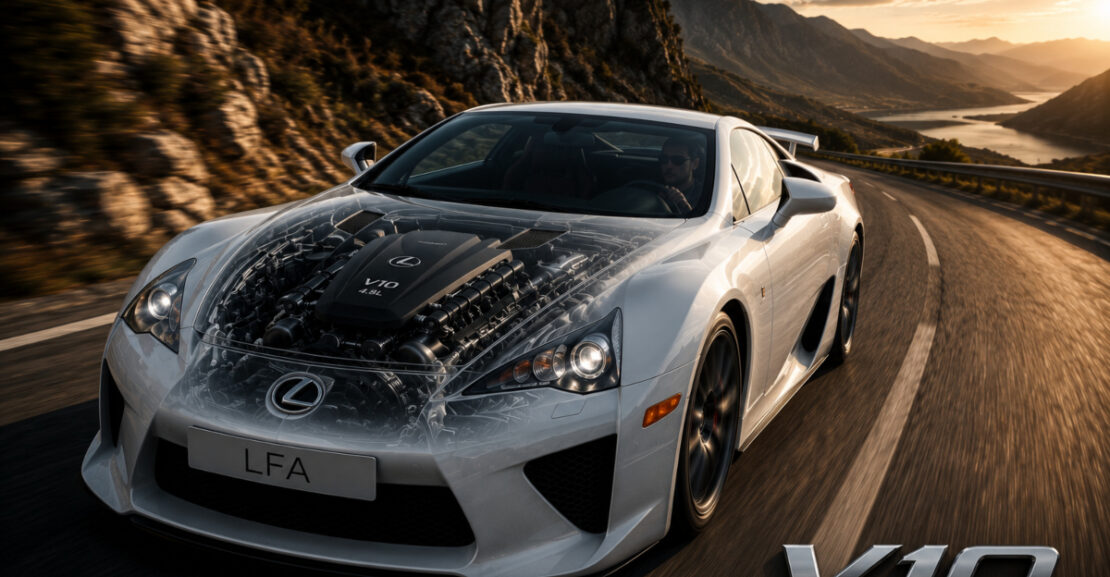
For a relatively brief period in automotive history, the V10 engine appeared to offer almost everything an enthusiast could desire.
It could deliver the deep mechanical force associated with a large V8 while approaching the speed, smoothness and exotic soundtrack of a V12. It was powerful without being predictable, sophisticated without losing its aggression and sufficiently unusual to give almost every car fitted with one a distinctive identity.
The V10 was never the most logical engine configuration. It was more complex than a V8, less naturally prestigious than a V12 and rarely an obvious answer to questions of cost, packaging or efficiency. That may be precisely why it became so special.
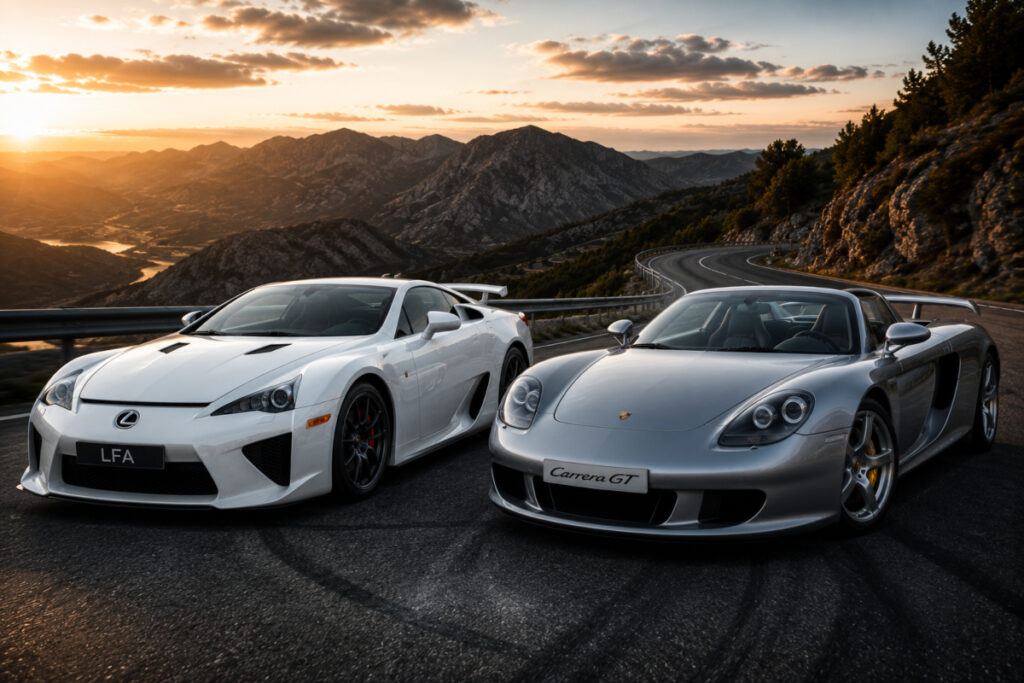
During its golden age, ten-cylinder engines appeared in extraordinarily different machines. They powered Lamborghini supercars, an Audi executive saloon, a BMW estate, a Volkswagen luxury SUV, an American pick-up, a Japanese technological masterpiece and a Porsche whose engine had originally been conceived for endurance racing.
At the furthest end of the spectrum, V10 power also reached cars produced in tiny numbers, including the Lamborghini Sesto Elemento, Italdesign Zerouno, GTA Spano and McLaren Solus GT.
These vehicles were not united by one technical philosophy. Some used naturally aspirated engines capable of soaring beyond 8,000 or even 10,000 rpm. Others relied on turbocharging to generate immense torque. One of the most remarkable was a five-litre twin-turbo diesel.
What connected them was character.
This is the story of the V10 engine and the extraordinary road, track and collector cars that made ten cylinders one of the most memorable formulas in automotive history.
Why Did Manufacturers Build V10 Engines?
A V10 sits in an unusual position between more familiar engine layouts.
Compared with a V8, the additional cylinders can allow smaller individual combustion chambers, a smoother delivery and a greater appetite for high engine speeds. Compared with a V12, a V10 can be shorter, lighter and easier to install, although it does not possess the same inherent smoothness or traditional association with luxury grand tourers.
Its imperfections became part of its appeal.
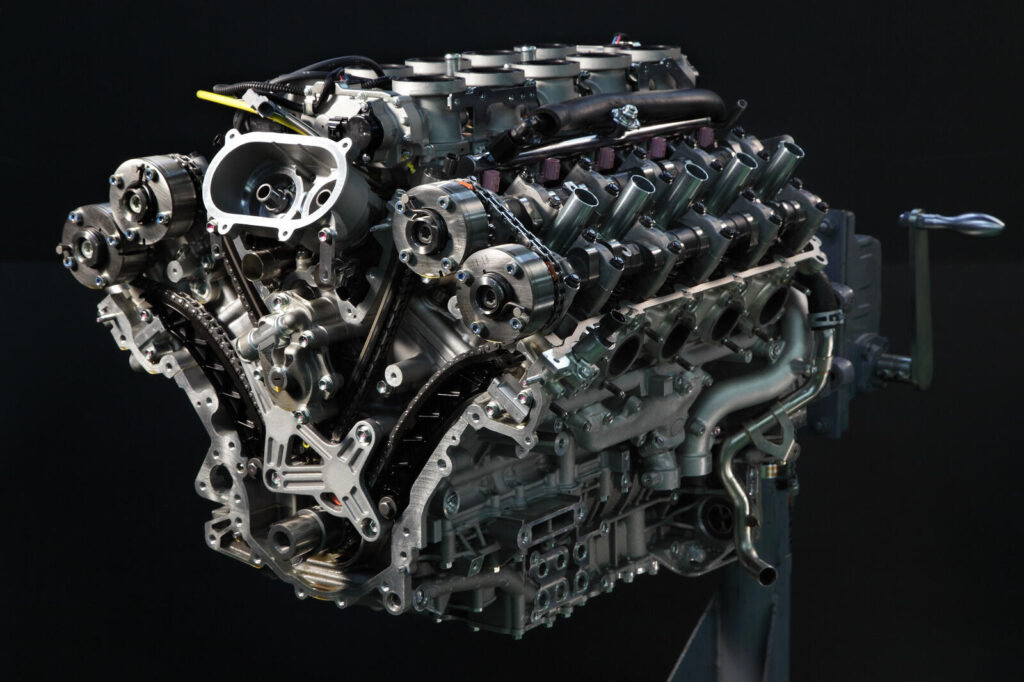
A V10 can sound harder-edged and more urgent than a V12. At low engine speeds, it may have a muscular and slightly uneven pulse. As the revs rise, that mechanical rhythm can transform into the metallic howl that made cars such as the Lexus LFA, Porsche Carrera GT and Lamborghini Huracán instantly recognisable.
The configuration also offered enormous freedom to engineers. Dodge used displacement and torque. BMW pursued engine speed and immediate response. Volkswagen demonstrated what ten diesel cylinders and two turbochargers could achieve. Audi employed V10 engines in everything from luxury saloons to supercars, while Lamborghini made the naturally aspirated V10 central to its identity for more than two decades.
The result was not one V10 era, but several overlapping interpretations of the same idea.
The Lamborghini V10: From the Gallardo to the End of an Era
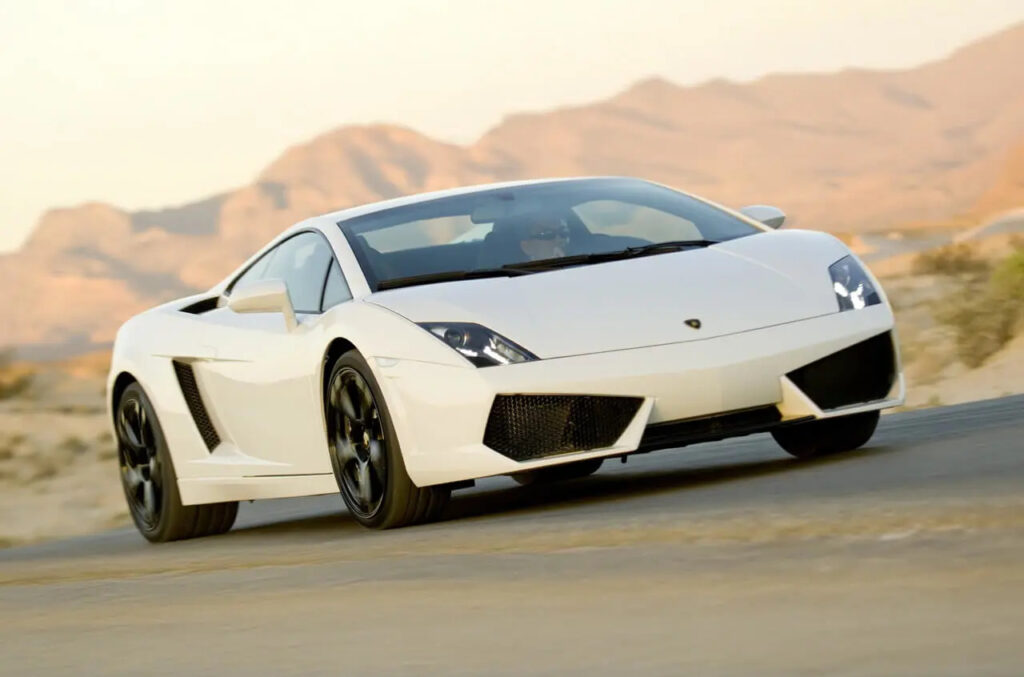
When Lamborghini introduced the Gallardo in 2003, it was entering territory that would fundamentally change the company.
The new model sat below the V12-powered Murciélago, but it could not feel like a lesser Lamborghini. It needed its own voice, mechanical identity and sense of occasion. The solution was a naturally aspirated 5.0-litre V10.
The original Gallardo’s engine gave the compact Lamborghini a character distinct from both the company’s V12 flagships and the V8-powered competitors of the period. It combined substantial mid-range force with the sharp upper-register sound that would become synonymous with modern Lamborghini.
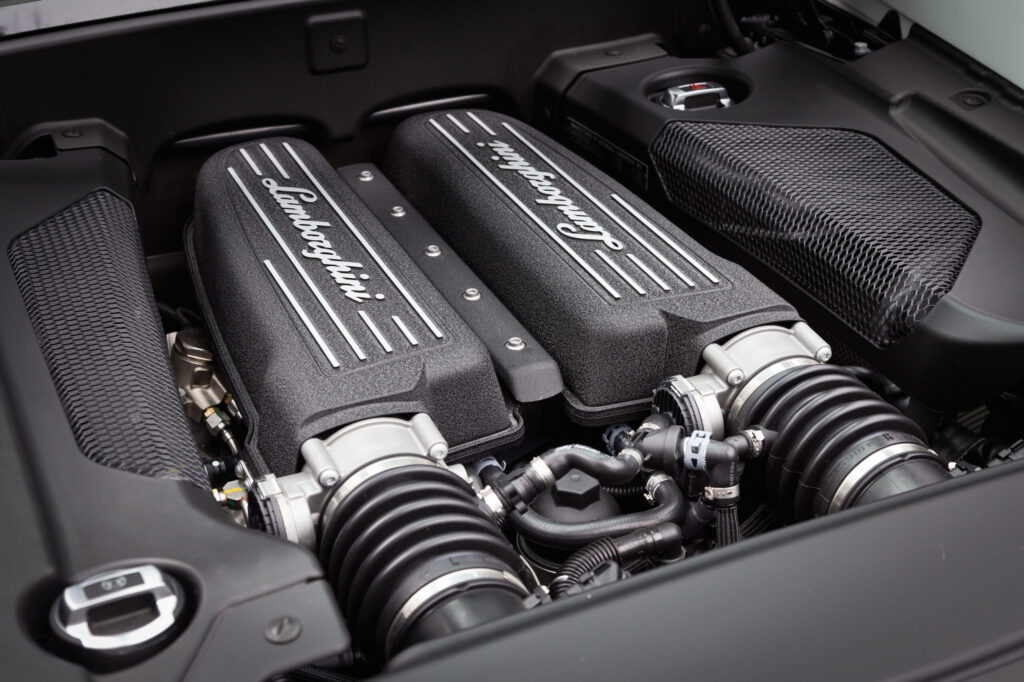
Over the Gallardo’s long life, the V10 evolved alongside the car itself. Early models used the original five-litre unit, while the later LP560-4 introduced a 5.2-litre engine with direct injection and substantially greater performance.
That transition was more than an increase in displacement. It established the mechanical foundation for a family of supercars and limited-production models that would continue long after the Gallardo disappeared.
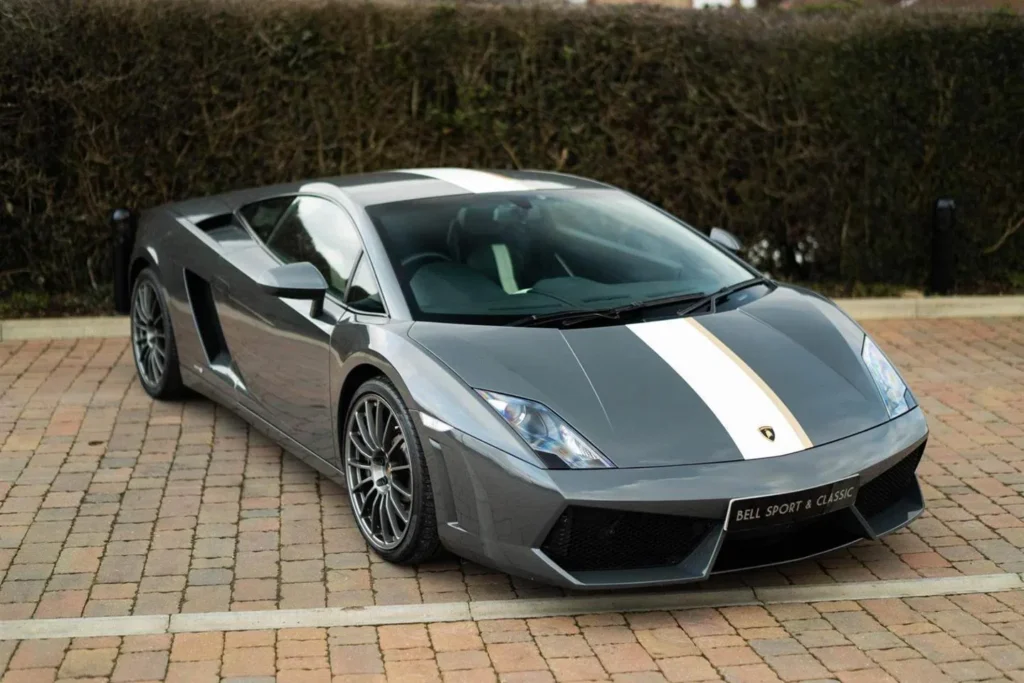
The Gallardo also became a platform for numerous interpretations of the V10 formula. The Superleggera reduced weight and sharpened the chassis. The LP550-2 Valentino Balboni replaced the familiar all-wheel-drive layout with rear-wheel drive, creating one of the most engaging and collectable versions. Later cars such as the LP570-4 Superleggera and Super Trofeo Stradale pushed the model closer to Lamborghini’s one-make racing machinery.
Yet the most radical Gallardo-based creation was not officially a Gallardo at all.
Lamborghini Sesto Elemento: Carbon Fibre and Ten Cylinders
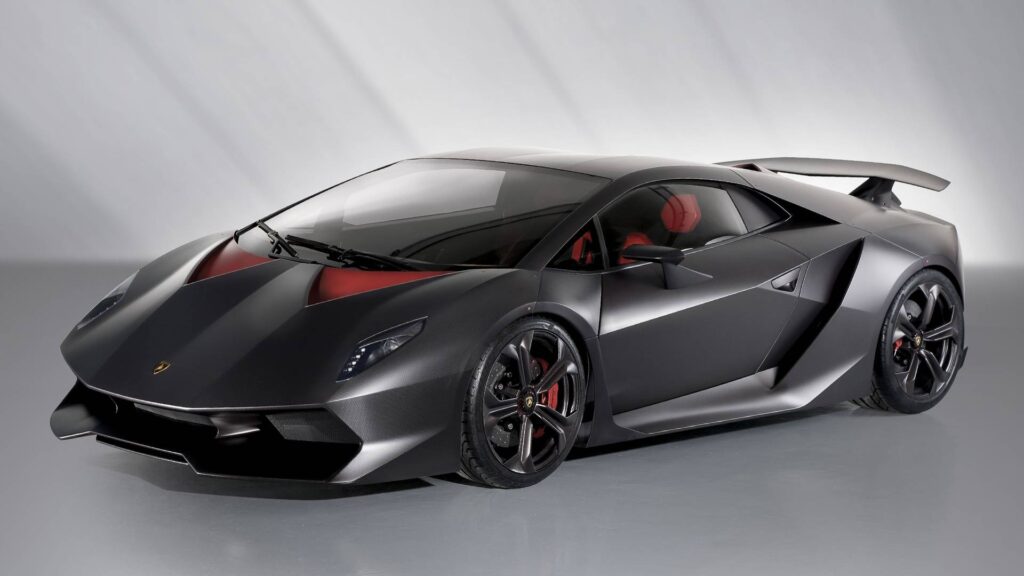
Presented as a concept in 2010 and subsequently produced in an extremely limited series, the Lamborghini Sesto Elemento explored what could happen when the Gallardo’s V10 and all-wheel-drive system were surrounded by an uncompromising programme of weight reduction.
Its name referred to carbon, the sixth element of the periodic table. Carbon-fibre technology was used throughout the vehicle, contributing to a quoted weight below 1,000 kilograms.
The Sesto Elemento did not require hybrid assistance, turbocharging or four-figure power to deliver extreme performance. Its naturally aspirated 5.2-litre V10 produced approximately 570 hp, but the lack of mass transformed the way that power could be deployed.
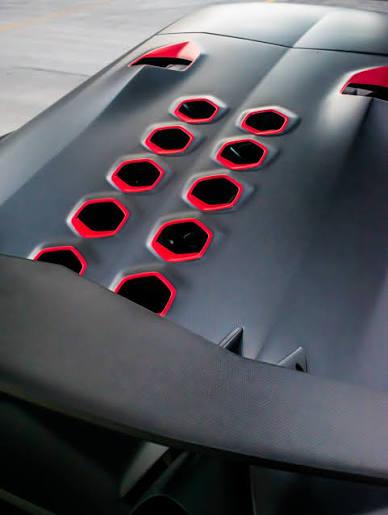
It represented one of the purest expressions of Lamborghini’s V10: an engine already known from a relatively accessible production supercar placed inside a machine closer in philosophy to an experimental racing prototype.
The Complete Lamborghini V12 Legacy: From Miura to Revuelto
Engineering Insight
The Sesto Elemento demonstrated that the potential of a high-performance engine cannot be judged by output alone. By reducing mass rather than dramatically increasing power, Lamborghini created performance comparable with significantly more powerful hypercars.
The Huracán and the Final Evolution of Lamborghini’s Naturally Aspirated V10
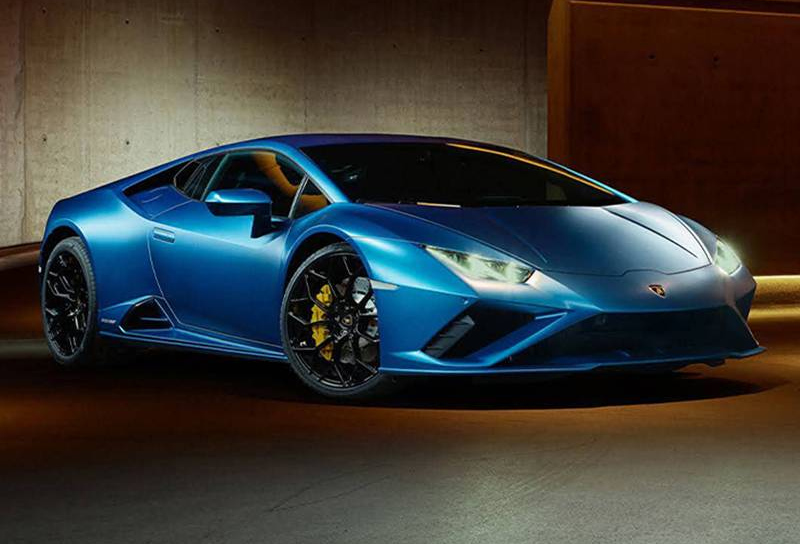
The Lamborghini Huracán arrived in 2014 as the Gallardo’s replacement, but its significance ultimately extended beyond succeeding Lamborghini’s best-selling model.
Its 5.2-litre naturally aspirated V10 became one of the last major supercar engines to resist turbocharging. While competitors increasingly turned to smaller forced-induction engines, Lamborghini continued developing throttle response, sound and high-revving character.
The original Huracán LP610-4 combined the V10 with all-wheel drive and a dual-clutch transmission, creating a faster, more refined and more accessible Lamborghini. Later rear-wheel-drive versions altered the balance, while the Huracán EVO introduced further aerodynamic and dynamic development.
The engine reached some of its most memorable applications in the specialised variants.
The Huracán Performante used active aerodynamics, reduced weight and a more powerful evolution of the 5.2-litre V10 to create one of the defining track-focused supercars of its generation. The STO went further, drawing inspiration from Lamborghini’s Super Trofeo and GT3 competition programmes to produce a road-legal car centred on aerodynamic efficiency, braking performance and circuit use.
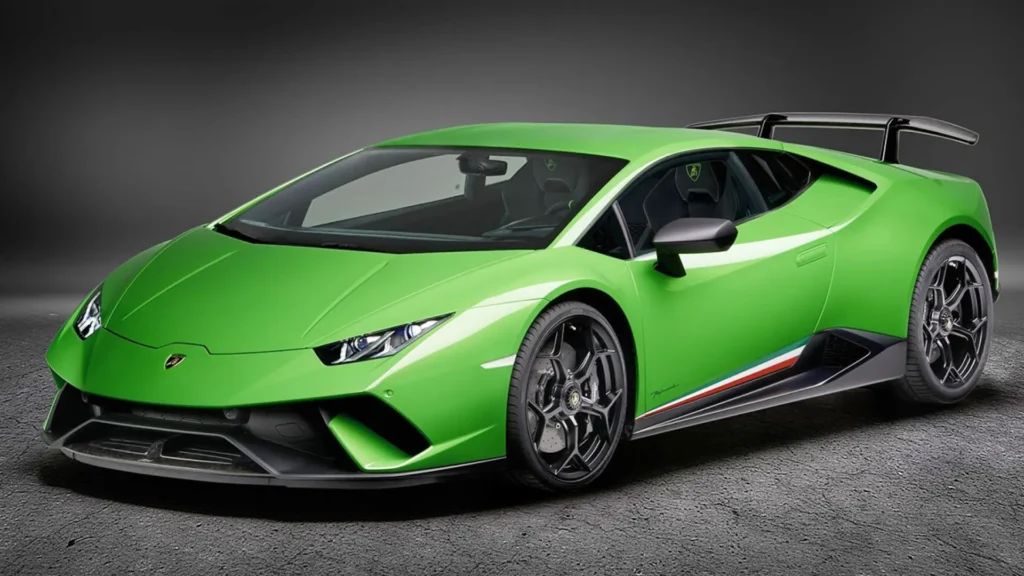
The Huracán Tecnica offered a more road-oriented interpretation of much of the STO’s performance, while the Huracán Sterrato sent the same essential V10 formula in an almost opposite direction. With increased ride height, underbody protection and an all-terrain character, the Sterrato proved that the engine could remain compelling even when removed from the smooth asphalt environment normally associated with an Italian supercar.
Across the Gallardo and Huracán generations, Lamborghini’s V10 progressed from five litres to 5.2, from automated manuals to dual-clutch transmissions and from conventional supercars to machines as different as the Sesto Elemento, STO and Sterrato.
Few engines have served as the foundation for such a varied collection of vehicles.
Audi and the Many Personalities of the V10
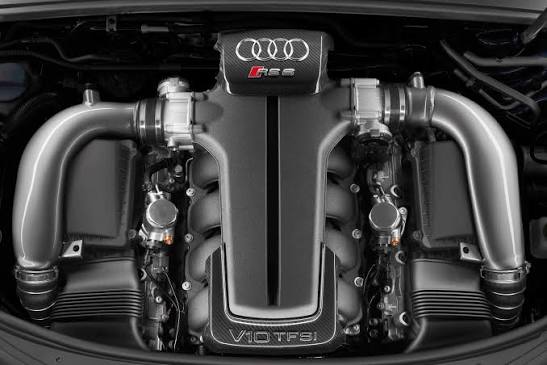
Audi’s V10 history is more complicated than the idea that one Lamborghini engine was simply installed throughout the company’s range.
During the 2000s and 2010s, Audi used several related but technically distinct ten-cylinder engines. They appeared in executive saloons, high-performance estates and two generations of the R8, ranging from naturally aspirated 5.2-litre units to the formidable five-litre twin-turbo engine of the C6-generation RS6.
Together, they demonstrated the extraordinary versatility of the V10 configuration.
Audi S6 and S8: Ten Cylinders in Understated Luxury Cars
The C6-generation Audi S6 and D3-generation S8 brought naturally aspirated V10 power into cars that could still pass, at least visually, as restrained executive transport.
The S6 used a 5.2-litre V10 within a discreet saloon or Avant body. It was not intended to be as extreme as the later RS6, but it offered the unusual combination of ten-cylinder character, all-wheel drive and everyday practicality.
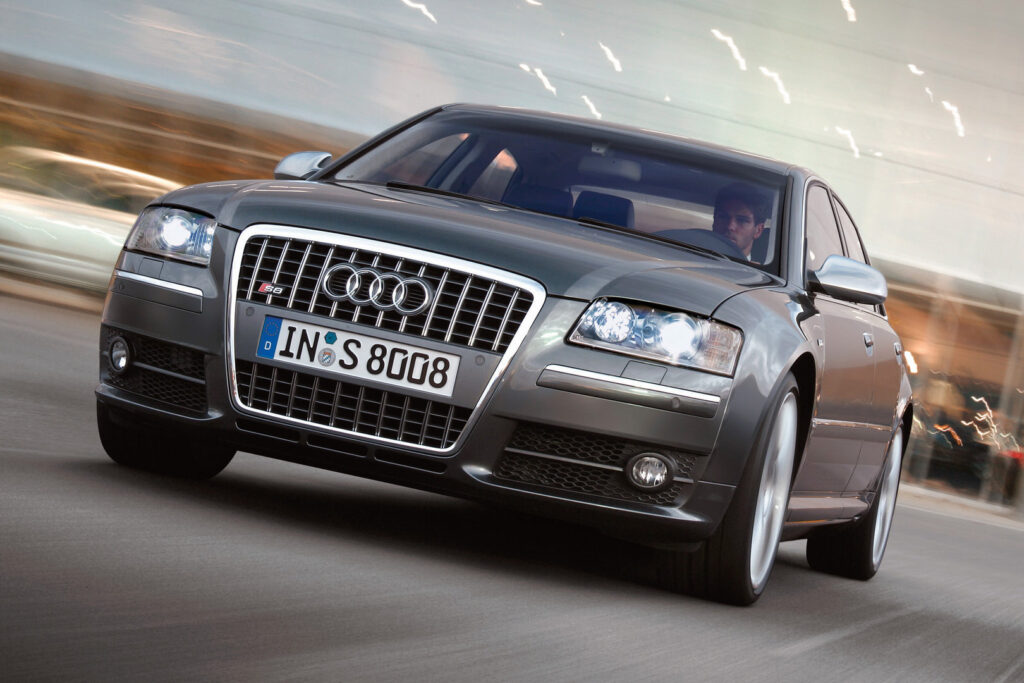
The larger S8 applied a similar philosophy to Audi’s flagship luxury saloon. Its appeal came not from visual aggression, but from the contrast between its understated appearance and an engine configuration more commonly associated with an exotic supercar.
These cars represented a period when manufacturers were willing to solve the demand for greater performance by adding displacement and cylinders rather than reducing engine capacity and increasing boost pressure.
They were expensive and complex, but they were also profoundly distinctive.
Audi RS6 C6: The Five-Litre Twin-Turbo V10
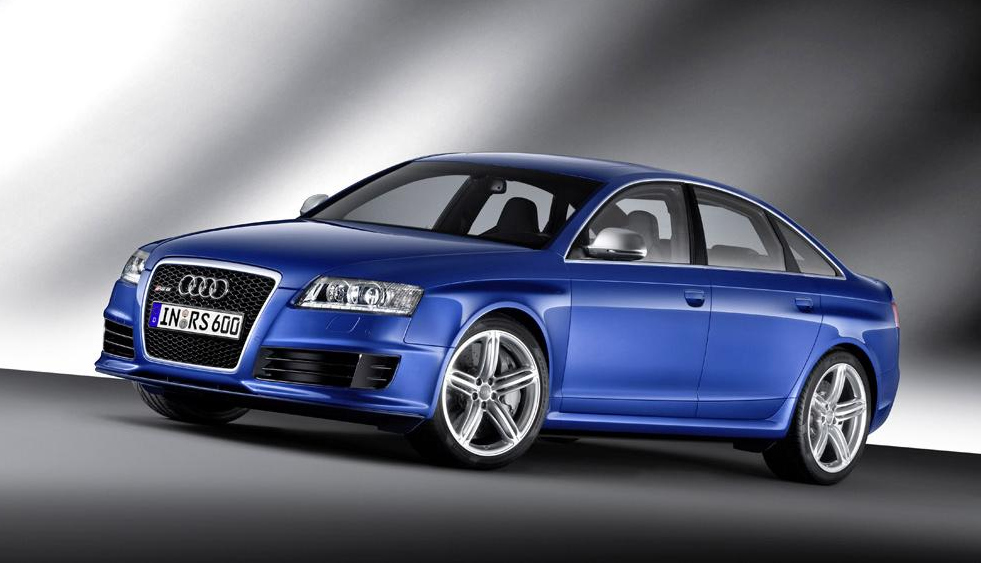
The C6 Audi RS6 took a very different approach.
Its 5.0-litre V10 used twin turbochargers to produce 580 PS and enormous torque, making the RS6 one of the most powerful production saloons and estates of its time.
Although it is frequently grouped with the naturally aspirated Lamborghini and R8 engines, the RS6’s powerplant should be understood as a distinct engineering application. Its purpose was not to imitate the high-revving response of a Gallardo. It was designed to propel a large, luxurious and practical Audi with relentless force.
The result was one of the great sleeper cars of the modern era. In Avant form, it combined a large luggage compartment, all-wheel drive and the appearance of an executive estate with performance that could challenge contemporary supercars.
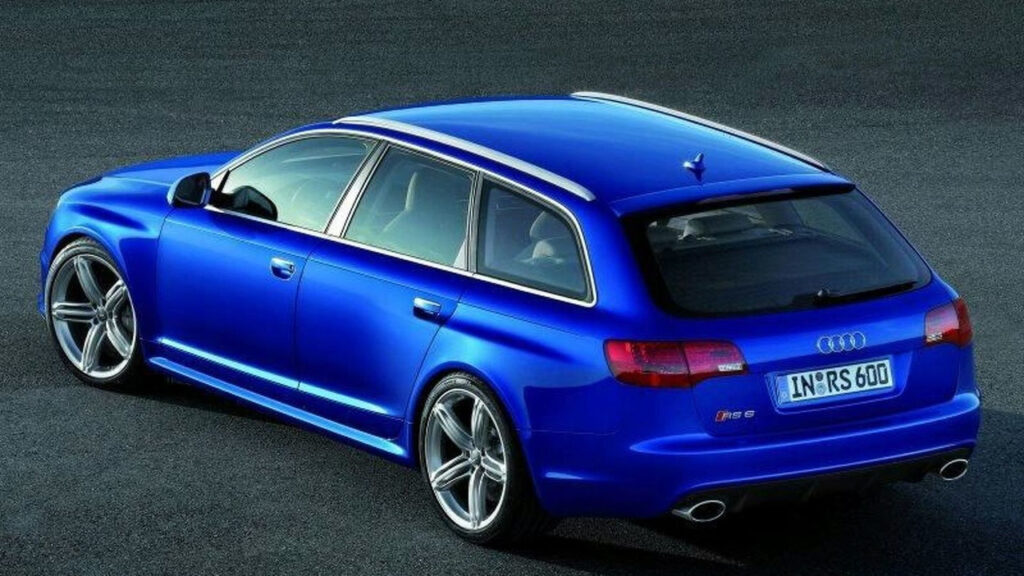
The RS6 showed the V10 at its most forceful rather than its most delicate. Where the LFA and Carrera GT celebrated rising engine speed, the twin-turbo Audi delivered a sustained surge of torque that seemed almost excessive for a family car.
That excess is now central to its appeal.
Did You Know?
The C6 RS6 was available as both a saloon and an Avant. The estate has become particularly emblematic of Audi’s ability to combine exceptional performance with genuine everyday usefulness.
Audi R8: Making the V10 Supercar Usable Every Day
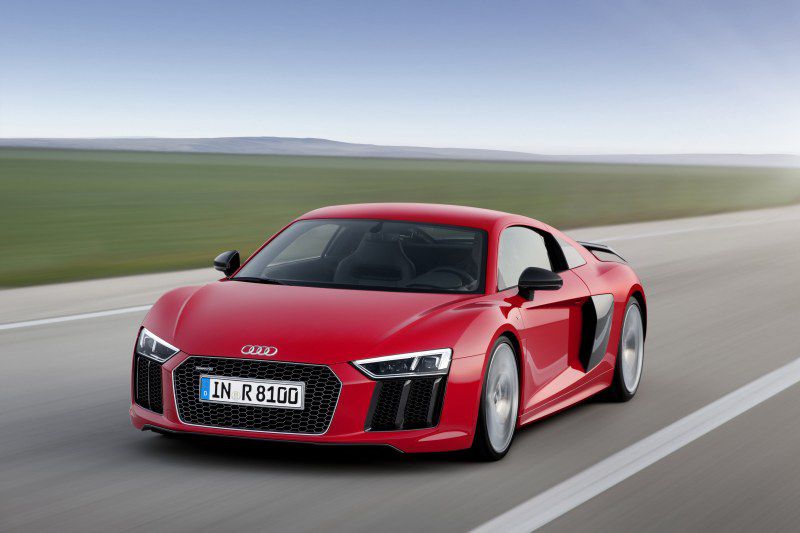
The first Audi R8 initially appeared with a V8, but the arrival of the 5.2 FSI V10 transformed it.
Here was an engine with genuine exotic-car character placed inside a supercar renowned for visibility, build quality, all-weather security and relative ease of use. The R8 V10 could provide the sound and performance expected from an Italian supercar without demanding the same degree of compromise from its owner.
The first-generation R8 V10 was offered as both a Coupé and Spyder, with early examples available with Audi’s R tronic automated manual transmission and later versions gaining the far more accomplished S tronic dual-clutch gearbox.
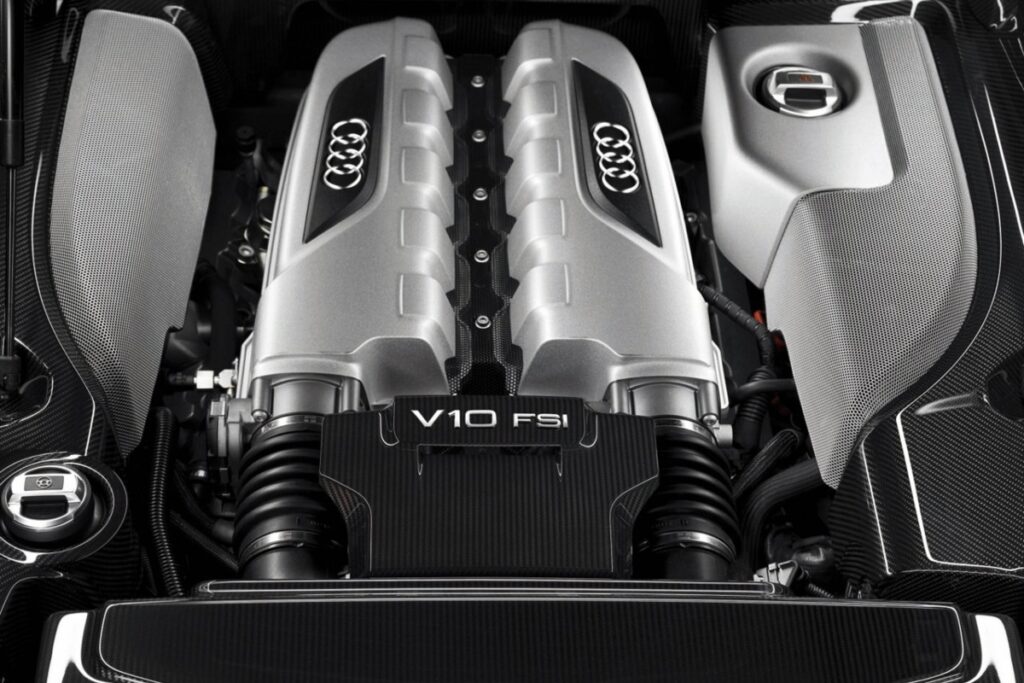
Manual R8 V10 models, recognisable by their exposed metal gear gates, became particularly desirable as the traditional manual supercar began to disappear.
The first Audi R8 GT made the formula more focused. Weight was reduced, power increased and production limited, creating a sharper version of the original V10 R8.
The second-generation R8 moved closer still to its Lamborghini relative. It continued using the naturally aspirated 5.2-litre engine as turbocharging spread across the performance-car market, eventually reaching 620 PS in the R8 V10 Performance quattro.
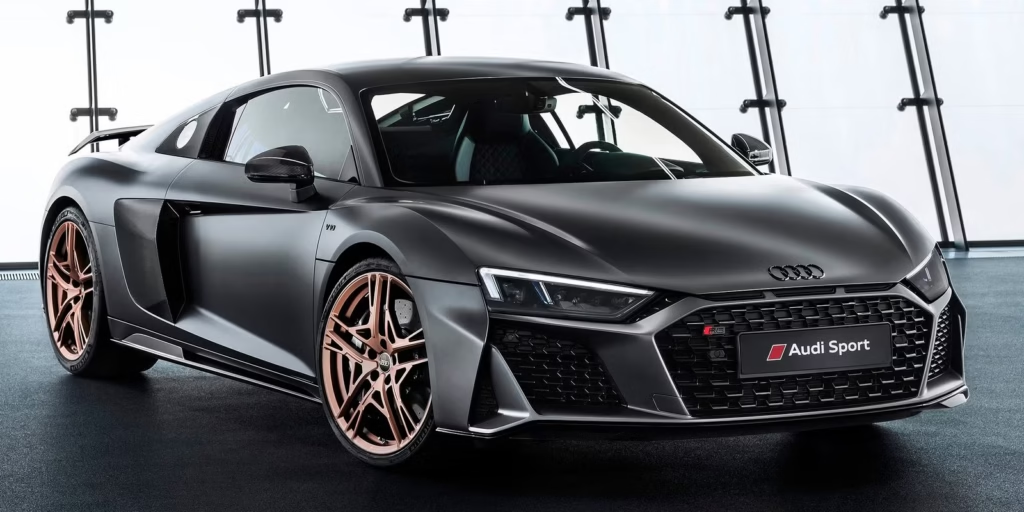
Audi returned to the GT name for the R8 Coupé V10 GT RWD, the final and most powerful rear-wheel-drive version of the model. Limited to 333 examples, it served as a farewell to the R8’s naturally aspirated era.
The R8’s achievement was not simply that it used a Lamborghini-related V10. It proved that one of the world’s most emotive engines could coexist with everyday usability.
That combination made the R8 less intimidating than some rivals, but no less important.
Beyond Lamborghini and Audi: The Italdesign Zerouno
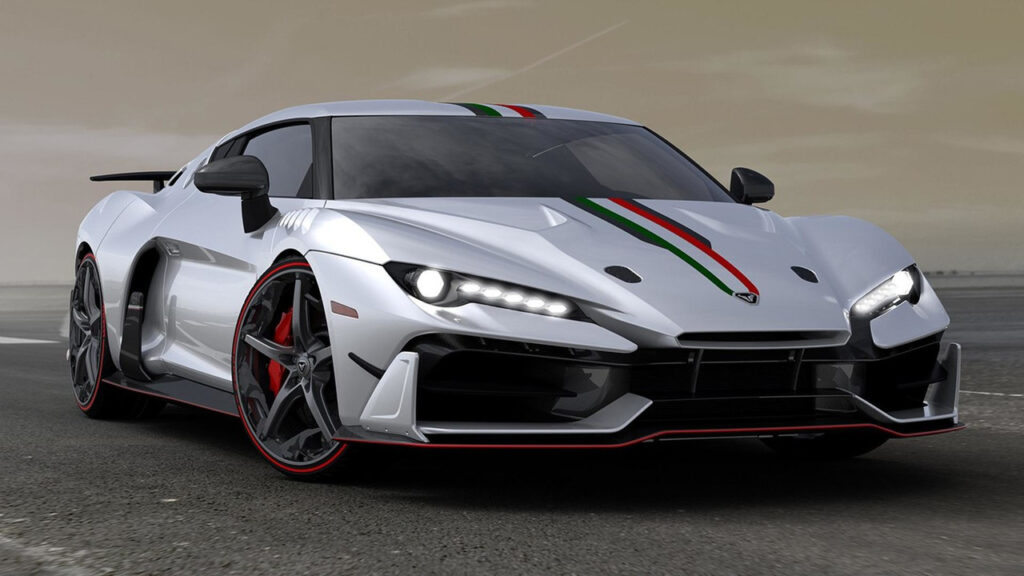
The reach of the Audi Sport 5.2-litre V10 extended beyond the two brands most closely associated with it.
In 2017, Italdesign introduced the Zerouno through its Automobili Speciali division. Based around a carbon-aluminium structure and clothed in a carbon-fibre body, the Zerouno used a naturally aspirated Audi Sport V10, all-wheel drive and a seven-speed dual-clutch transmission.
Only five coupés were planned, placing the Zerouno in an entirely different category of rarity from the R8 and Huracán. Italdesign later created the Zerouno Duerta, a removable-roof interpretation also intended for a production run of five cars.
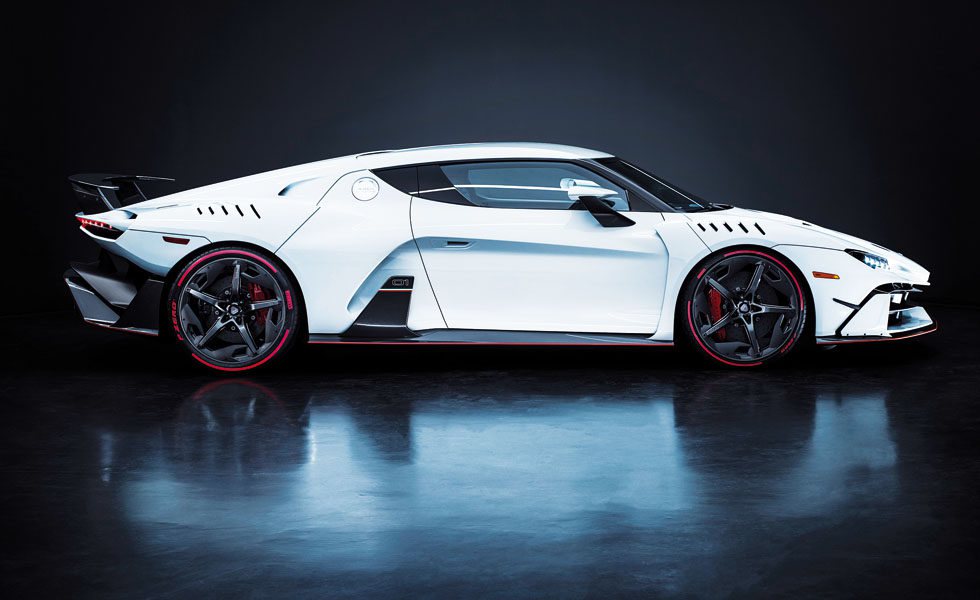
The Zerouno did not reinvent the V10 mechanically. Its significance lay in demonstrating how a familiar and proven engine could provide the foundation for an ultra-limited collector car.
It delivered the reliability and performance of established Audi Sport engineering while allowing Italdesign to concentrate on aerodynamics, carbon-fibre construction, design and personalisation. The coupé’s 5.2-litre engine produced 610 hp and contributed to a claimed 330 km/h maximum speed.
BMW’s Formula One-Era V10 for the Road
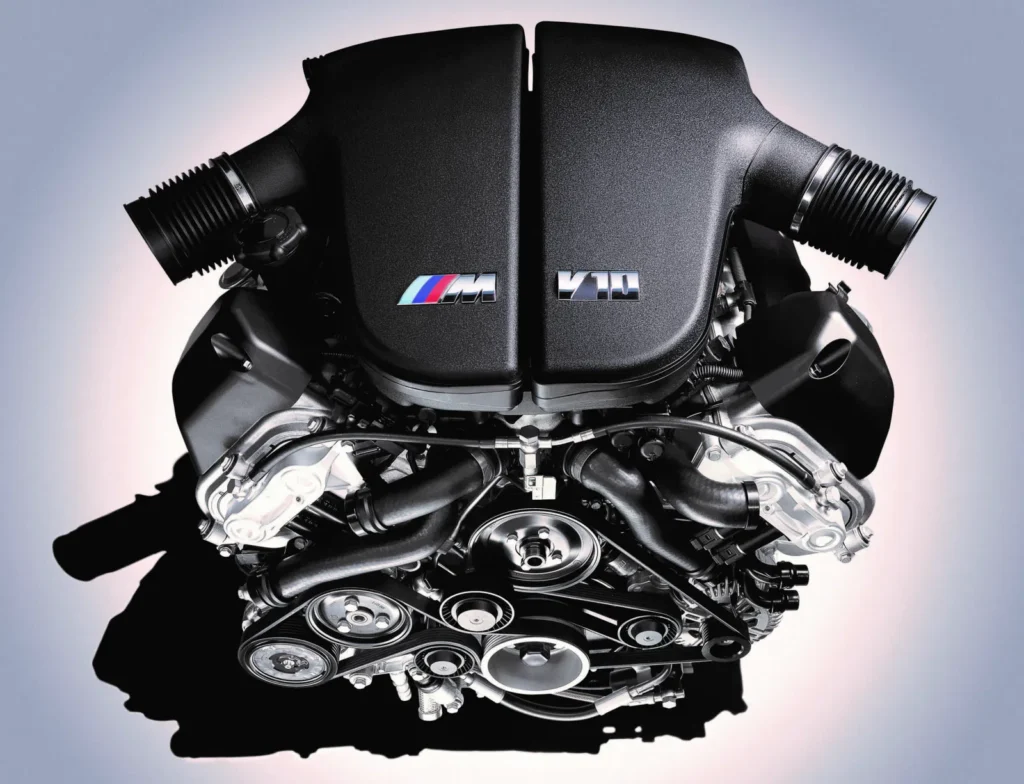
Few engines illustrate the ambition of the early 2000s more clearly than BMW’s S85.
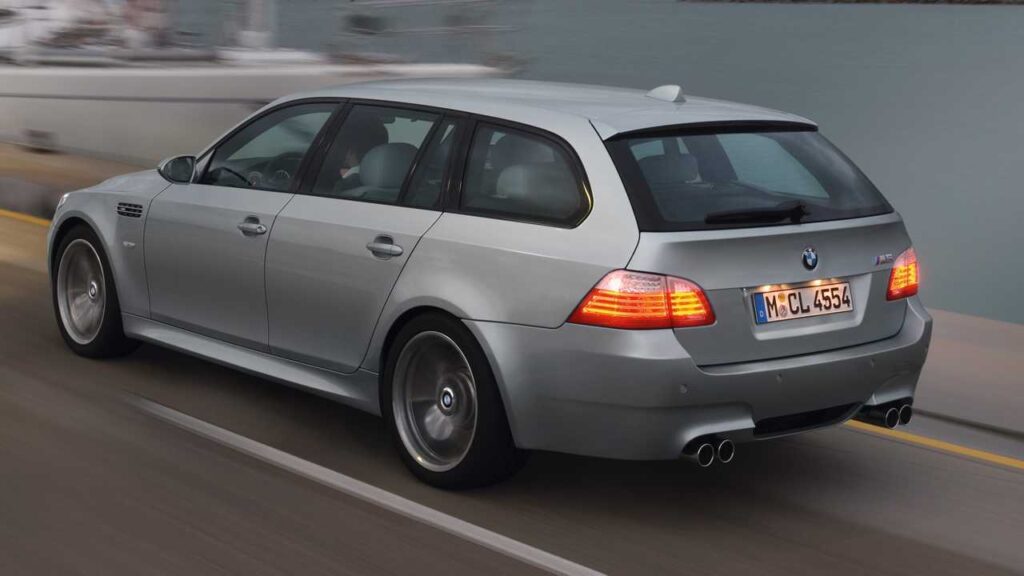
Introduced in the E60-generation M5, the five-litre naturally aspirated V10 represented a dramatic departure from the six-cylinder and V8 engines previously associated with BMW M saloons.
From Zonda to Utopia: The Complete Evolution of Pagani
Its arrival coincided with BMW’s involvement in Formula One, and the connection was central to the engine’s image. The S85 was not simply a detuned Formula One engine installed in a road car, but its philosophy reflected the period: individual throttle bodies, rapid response, a high compression ratio and an 8,250 rpm redline.
In the M5, it produced 507 PS and transformed a large executive saloon into something that felt mechanically closer to an exotic car. Its seven-speed SMG transmission could be difficult at low speeds, but under full acceleration it reinforced the car’s sense of drama.
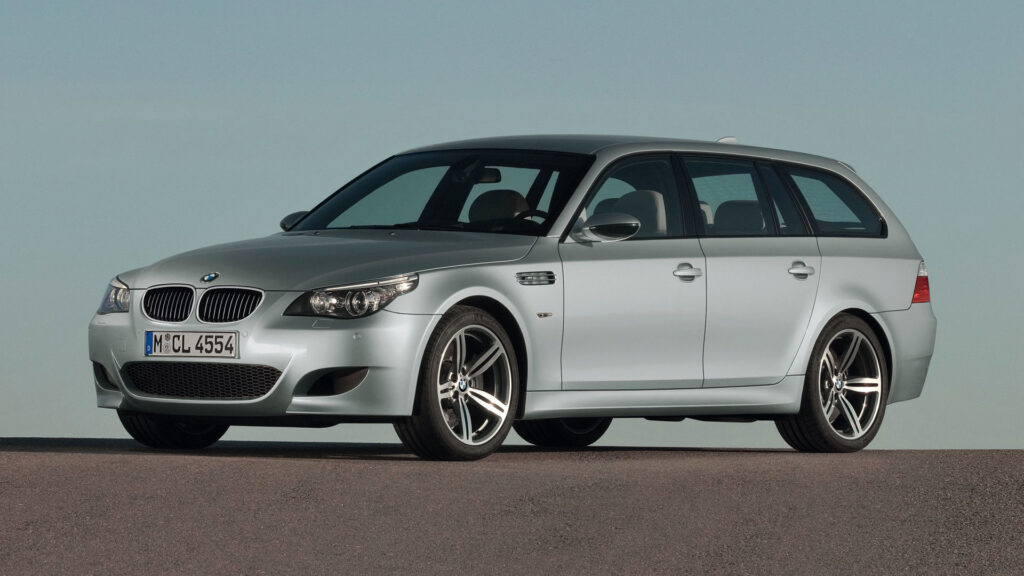
The E60 M5 was also offered in Touring form as the E61, creating one of the rarest and most remarkable performance estates ever built. A family wagon with a naturally aspirated V10 was unusual even during the engine’s golden age; today, it appears almost unimaginable.
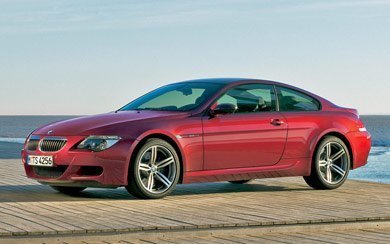
BMW installed the S85 in the E63 and E64 M6 as well. The coupé and convertible offered the same engine in more overtly sporting grand-touring bodies, with the carbon-fibre roof of the M6 Coupé helping reduce weight high in the structure.
The S85 was used for only one generation of M5 and M6. Its production life was relatively brief, and it developed a reputation for demanding maintenance, but neither factor has diminished its historical importance.
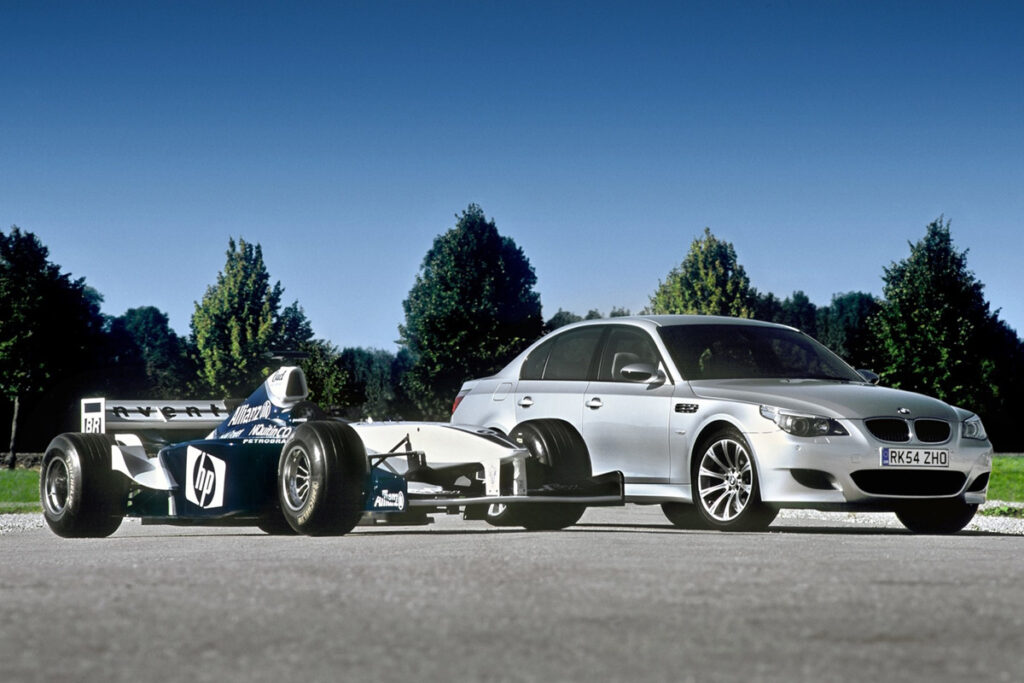
The engine captured a moment when BMW M was prepared to place an 8,250 rpm V10 inside an executive saloon simply because it could.
Engineering Insight
The S85’s character came from more than its cylinder count. Its individual throttle bodies and high operating speed gave it exceptionally immediate response for an engine installed in a large luxury car.
Lexus LFA: The V10 as a Musical Instrument
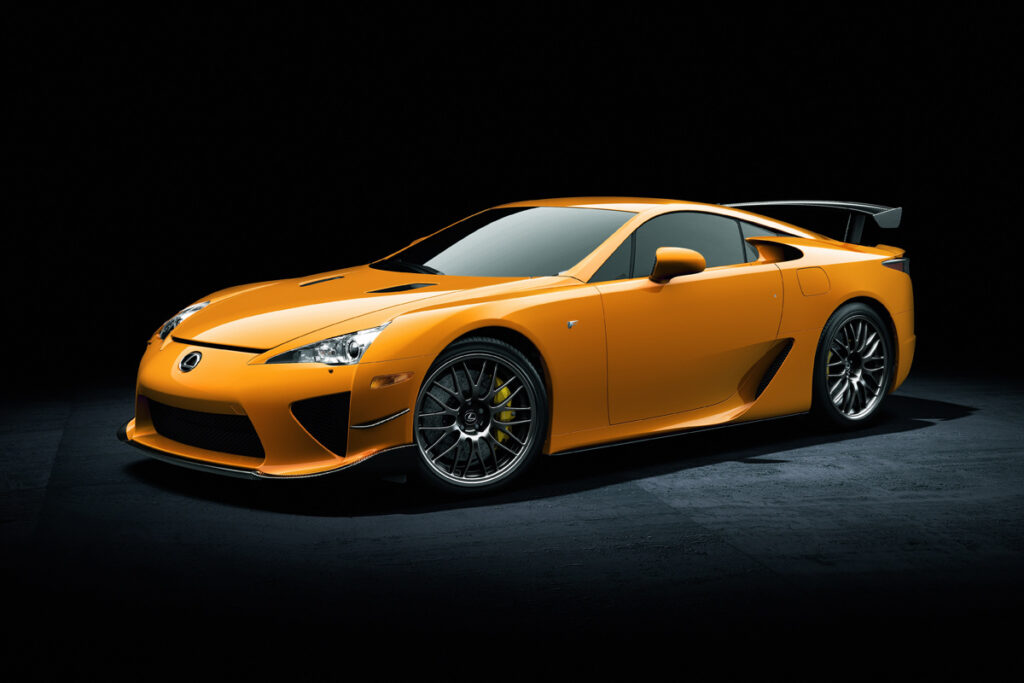
The Lexus LFA took approximately a decade to develop and arrived as a declaration of what Toyota’s luxury division could achieve without being constrained by convention.
Its 4.8-litre naturally aspirated V10 was co-developed with Yamaha Motor and constructed using lightweight materials including aluminium, magnesium and titanium. Lexus stated that the engine was physically smaller than a conventional V8, helping the company achieve the desired weight distribution within the LFA’s front-mid-engine layout.
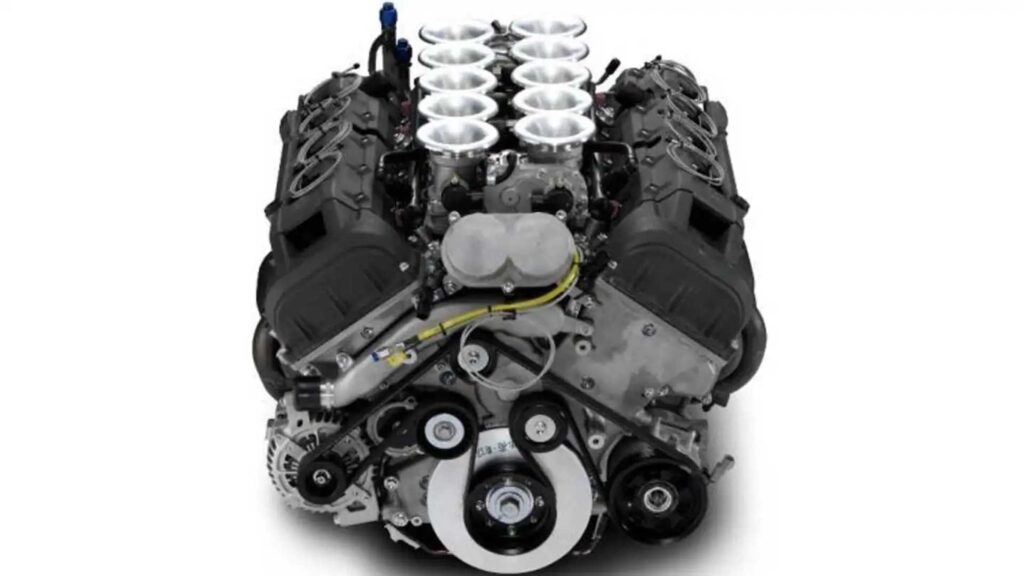
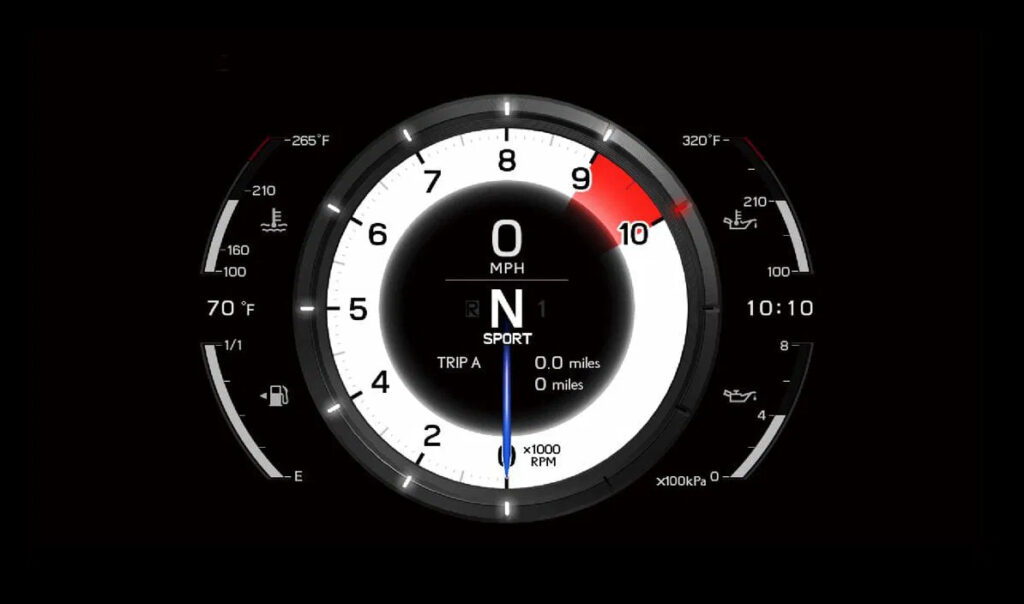
The engine produced 560 PS and reached a 9,000 rpm redline. More important than the numbers was the way it responded and sounded.
Yamaha’s involvement extended to the acoustic character of the car. The intake and exhaust systems were developed so that the engine’s sound became a fundamental element of the driving experience rather than an incidental by-product of combustion.
The LFA’s digital tachometer became part of its mythology. Lexus explained that the V10 could change engine speed so rapidly that a conventional analogue display would not provide the required response, making a digital instrument necessary.
Only 500 examples of the LFA were produced between December 2010 and December 2012. A small number were completed with the Nürburgring Package, which added aerodynamic changes, revised suspension and additional power for a more circuit-focused character.
The LFA was criticised when new for its price and the speed of its automated manual transmission relative to emerging dual-clutch systems. Time has changed that perspective.
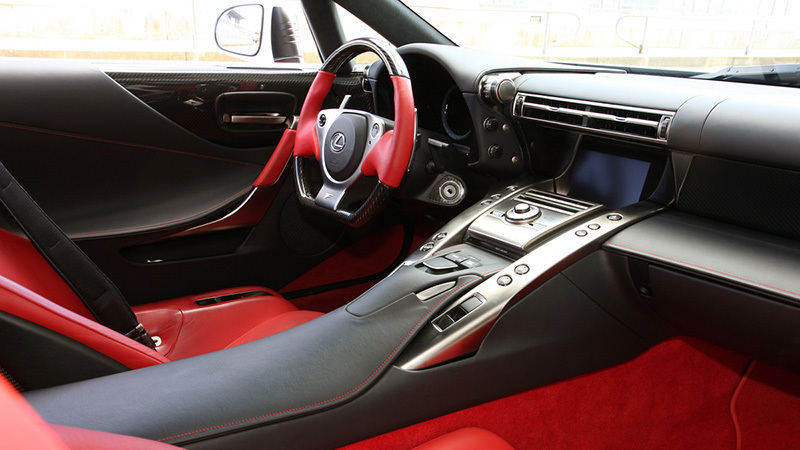
What once appeared expensive now seems like an extraordinary engineering project that may never be repeated. The LFA was not designed around the most commercially sensible engine or the easiest route to performance. It was designed around response, balance, sound and emotional impact.
Among all road-going V10s, it may be the one that treated the engine most deliberately as a musical instrument.
Did You Know?
The LFA’s engine delivered 90 percent of its peak torque across a range extending from 3,700 to 9,000 rpm, giving it both flexibility and exceptional high-revving performance.
Porsche Carrera GT: Born for Le Mans, Destined for the Road
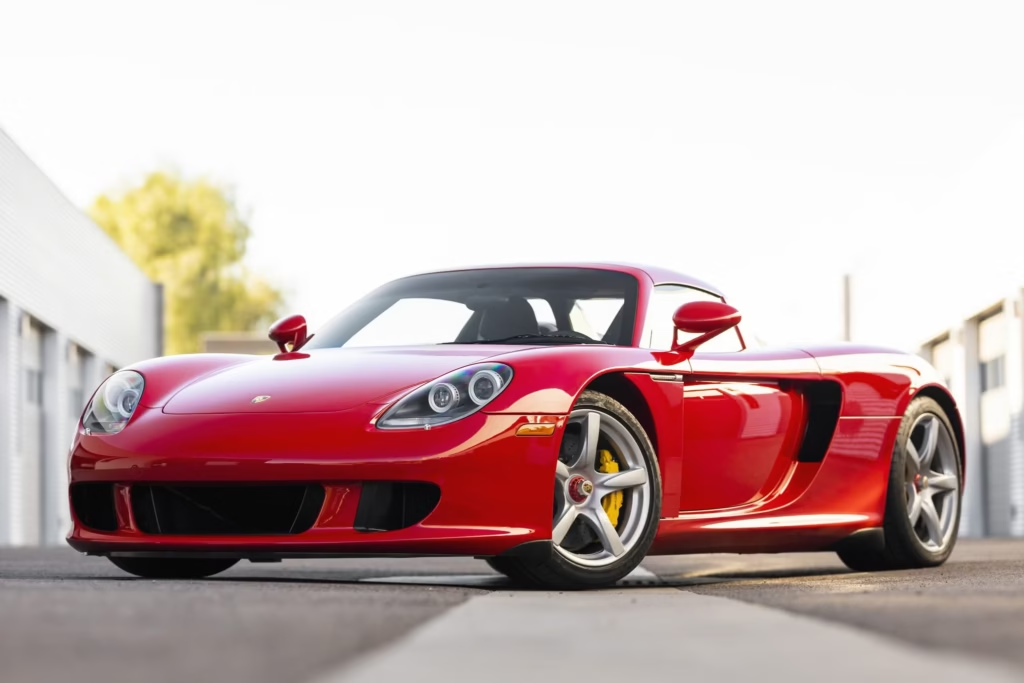
The Porsche Carrera GT occupies a special position even among V10 supercars.
Its engine did not begin as a powerplant for a luxury saloon or a smaller production sports car. Porsche developed the original V10 for the LMP 2000, an endurance-racing prototype intended to continue the company’s Le Mans tradition.
The racing project was cancelled before the car competed, but its engine and lightweight engineering were given a second life.
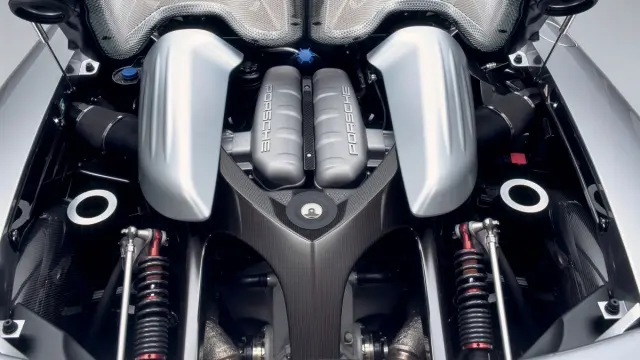
Porsche presented the Carrera GT concept in Paris in 2000 and unveiled the production version at the Geneva Motor Show in 2003. For the road car, the V10 grew from 5.5 to 5.7 litres and produced 612 PS in European specification.
It was paired with a six-speed manual gearbox and Porsche’s compact ceramic composite clutch. A carbon-fibre monocoque and carbon-fibre engine carrier contributed to a quoted weight of approximately 1,380 kilograms. Porsche eventually built 1,270 examples.
The Carrera GT was never designed to make its performance effortless. Its controls, clutch, steering and lack of modern electronic intervention demanded concentration and mechanical sympathy.
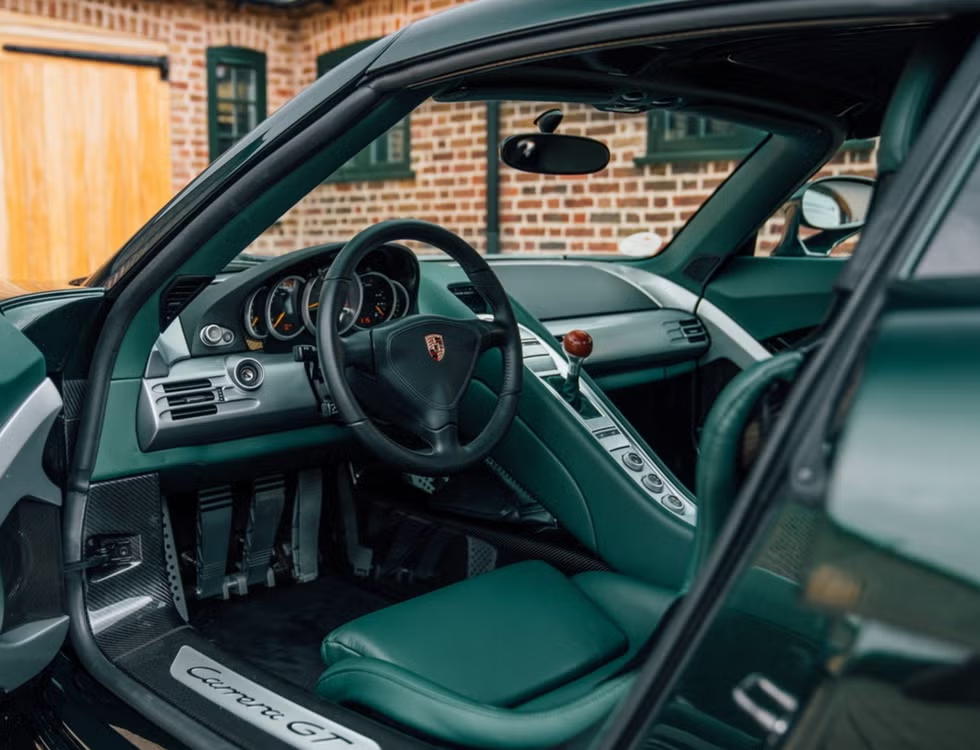
That requirement became part of the car’s legend.
The 5.7-litre V10 does not possess the theatrical polish of the LFA or the low-speed accessibility of the R8. It sounds rawer and more mechanical, as though the cancelled racing programme remained present within the finished road car.
The Carrera GT is therefore more than one of the greatest V10-powered cars. It is one of the clearest examples of competition engineering escaping into a road-legal machine with remarkably little dilution.
Dodge Viper: America’s Brutal Interpretation of Ten Cylinders
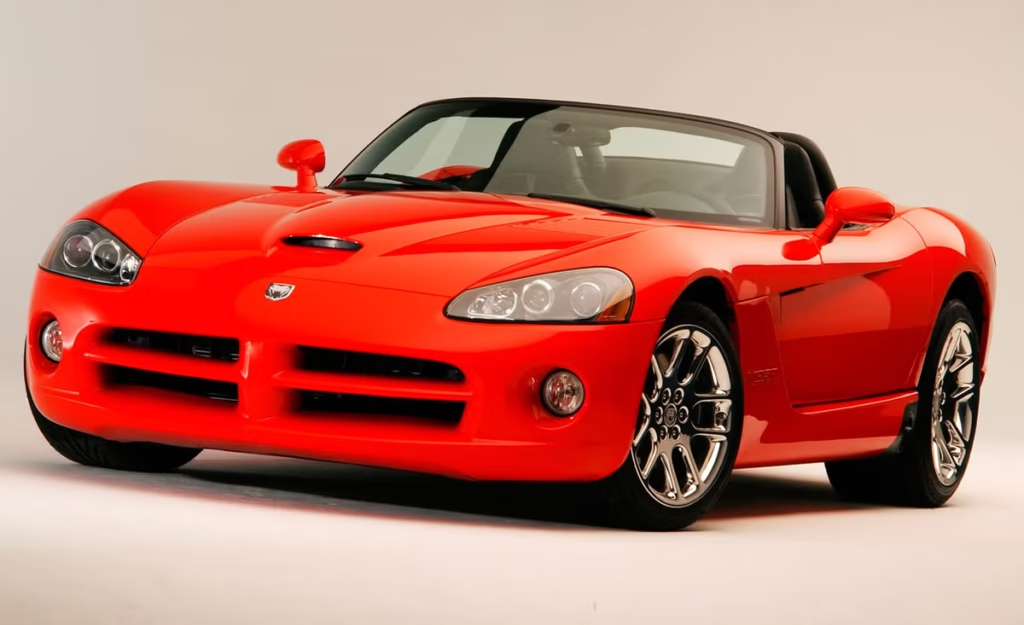
The Dodge Viper approached the V10 from the opposite direction.
Where Porsche, Lexus and BMW pursued high engine speeds, advanced materials and precise response, the Viper relied on displacement, torque and physical presence.
Ferrari One-Off Masterpieces: The Art of Absolute Exclusivity
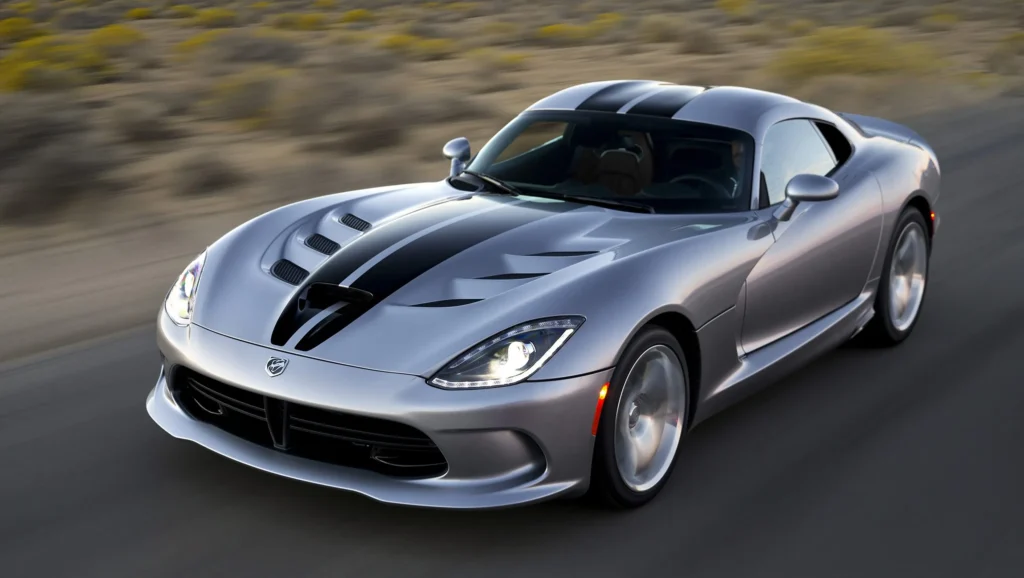
The original Viper RT/10 arrived in the early 1990s with an eight-litre naturally aspirated V10, minimal driver assistance and bodywork that made no attempt to disguise the car’s intentions. It was conceived as a modern American roadster in the spirit of the Shelby Cobra: simple, powerful and intimidating.
Across five generations, the Viper became more sophisticated without losing its essential character.
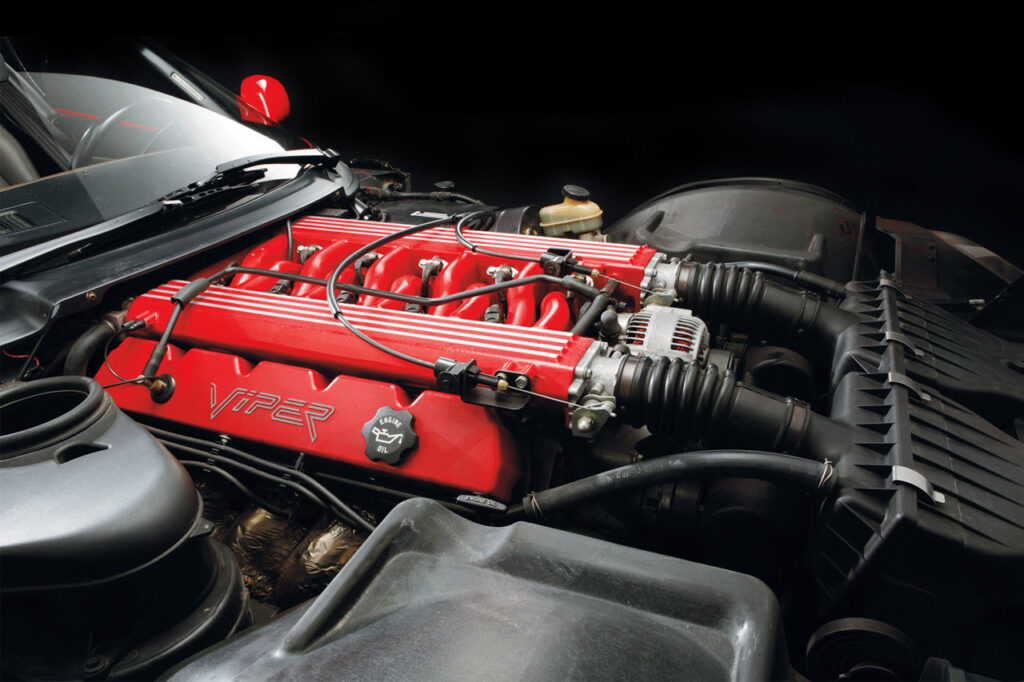
The early RT/10 established the formula. The GTS added a dramatic double-bubble coupé body and increased the car’s appeal beyond the raw roadster. Later generations introduced more power, improved chassis control and increasingly serious track capability.
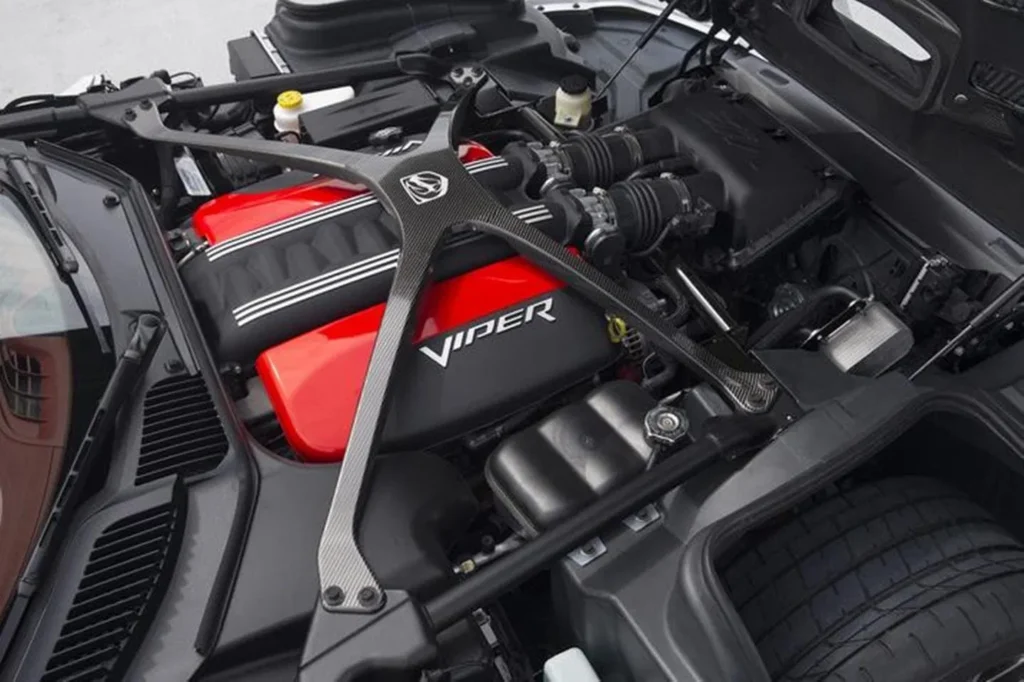
By the final generation, displacement had grown to 8.4 litres and output had reached 645 hp. The Viper ACR transformed the car into one of the most formidable road-legal track machines of its period through extreme aerodynamics, suspension development and tyres capable of exploiting the enormous naturally aspirated engine.
Unlike most European V10s, the Viper did not attempt to sound like a racing engine at 9,000 rpm. Its character came from the heavy, irregular force of a very large engine operating at lower speeds.
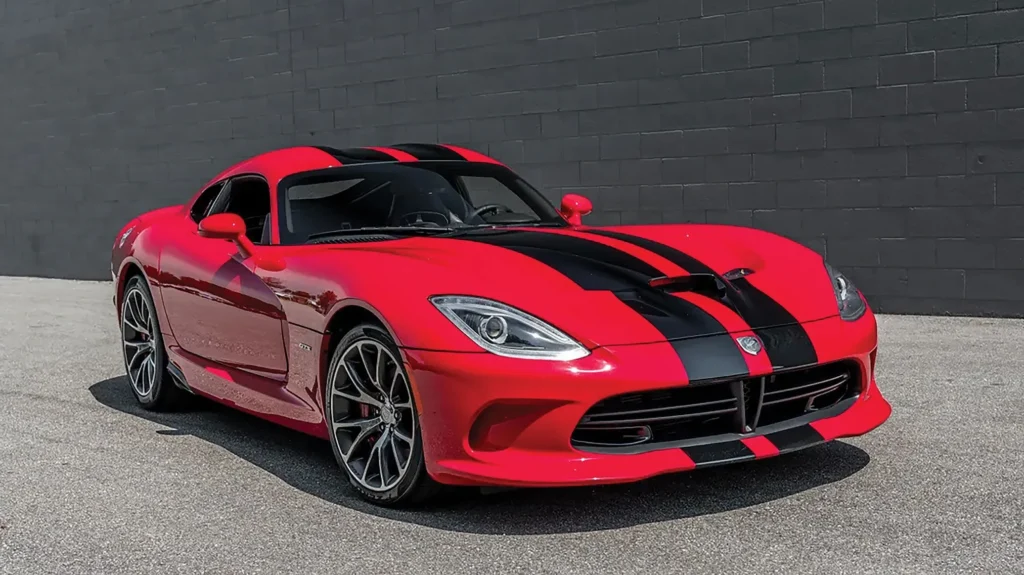
It was less operatic, but no less distinctive.
The Viper demonstrated that a V10 did not need to imitate a V12 or Formula One car. It could instead magnify the traditional values of an American performance engine until they became almost absurd.
Dodge Ram SRT-10: When the Viper Engine Entered a Pick-Up
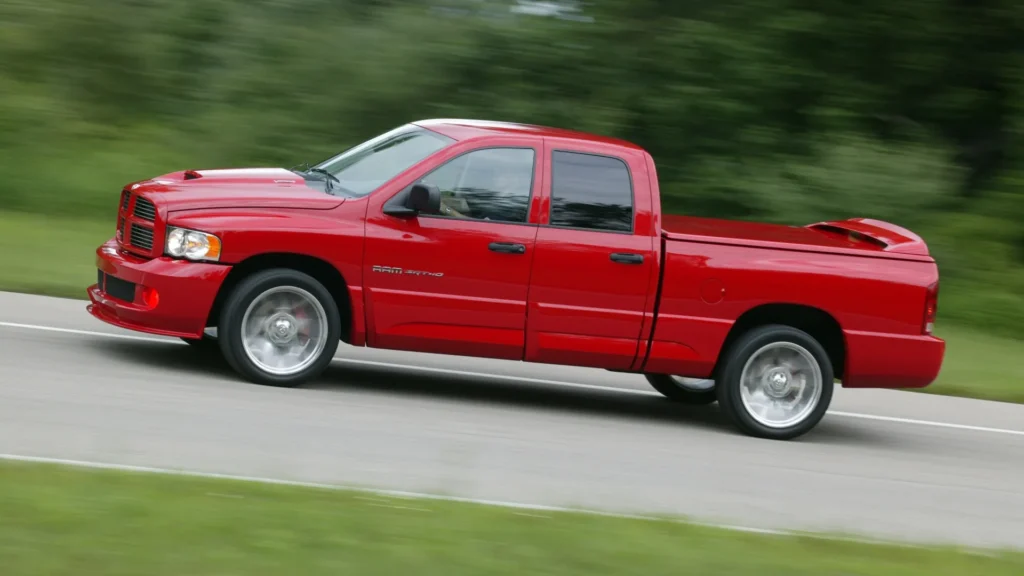
Few production vehicles illustrate the excess of the V10 era better than the Dodge Ram SRT-10.
Dodge took the 8.3-litre engine from the contemporary Viper and installed it in a full-size pick-up. The result was offered as a Regular Cab with a manual gearbox and as a more practical Quad Cab with an automatic transmission.
The idea was gloriously unnecessary.
The Ram SRT-10 had the size, seating position and utility of a truck, but its bonnet concealed the engine of an American supercar. It became famous not merely because it was fast for a pick-up, but because it represented a kind of product planning that is difficult to imagine under modern emissions and efficiency requirements.
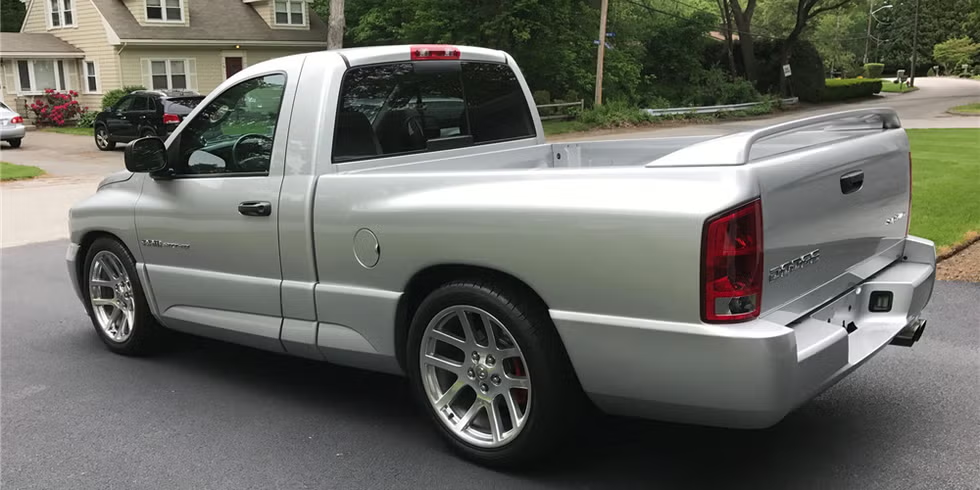
Its existence also revealed the adaptability of the Viper engine. The same essential powerplant could support a two-seat sports car, a circuit-focused ACR and a vehicle capable of carrying cargo in an open bed.
The Ram SRT-10 was not elegant or subtle, but no history of road-going V10s would be complete without it.
Volkswagen V10 TDI: Ten Cylinders, Two Turbos and Diesel Torque
At the beginning of the 2000s, Volkswagen pursued engineering ambition with unusual determination.
The company developed the Phaeton luxury saloon, expanded into the premium SUV market with the Touareg and produced engines in configurations ranging from narrow-angle VR units to the W12.
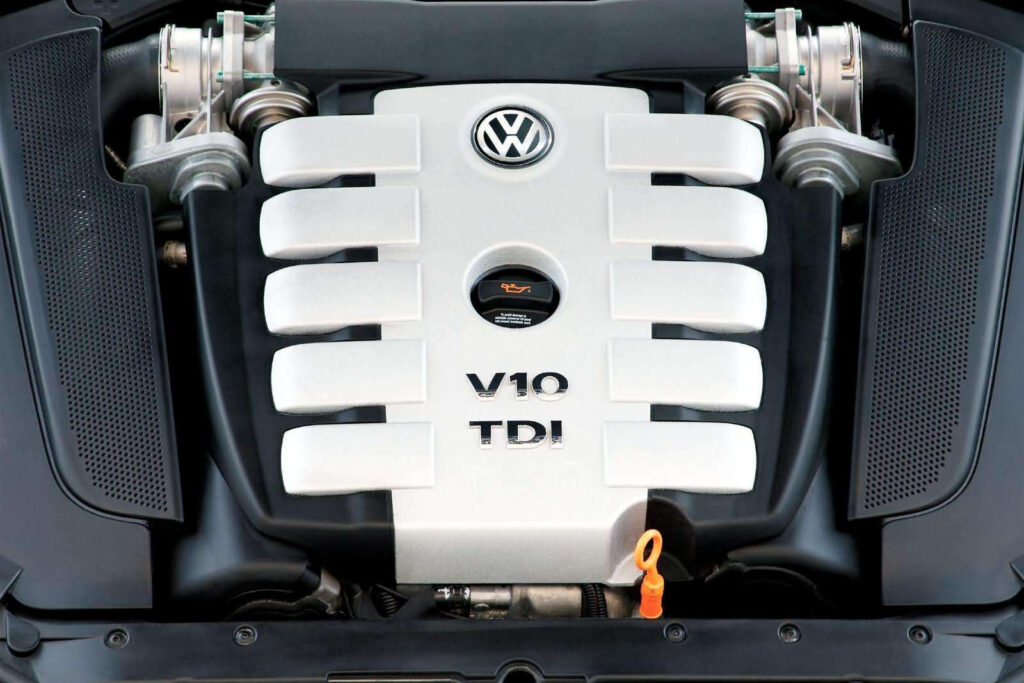
Among the most remarkable was the five-litre V10 TDI.
This engine used two turbochargers and produced 313 PS together with 750 Nm of torque. In the Phaeton, it created what Volkswagen described as the most powerful diesel saloon in the world at the time. In the Touareg, it gave a vehicle weighing approximately 2.5 tonnes the ability to reach 100 km/h in 7.8 seconds.
The Phaeton V10 TDI was perhaps the more surprising application. Volkswagen combined a technically complex ten-cylinder diesel with all-wheel drive, air suspension and a luxury car developed to compete far above the brand’s traditional position.
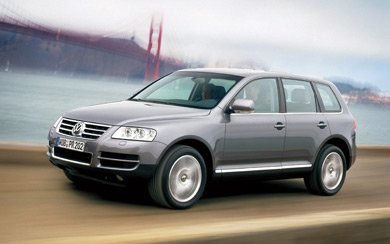
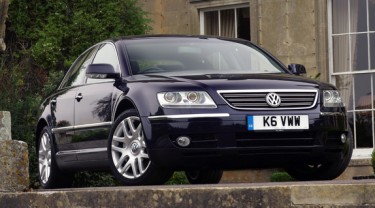
The Touareg V10 TDI became better known. Its enormous torque suited towing and off-road use, while its performance turned the first-generation Touareg into one of the most technically extravagant SUVs of its era.
Volkswagen later created the Touareg R50, increasing output to 350 PS and torque to 850 Nm. With larger wheels, sports suspension and more assertive styling, it became the ultimate factory development of the V10 diesel SUV.
The V10 TDI was not celebrated for its soundtrack or high-revving character. Its fascination came from the scale of the engineering.
It was a large, tightly packaged, twin-turbocharged ten-cylinder diesel installed in vehicles already renowned for complexity. Ownership could be demanding, but the V10 TDI remains one of the clearest symbols of a period when Volkswagen appeared determined to prove that almost any technical challenge could be overcome.
The V10 That Conquered Le Mans
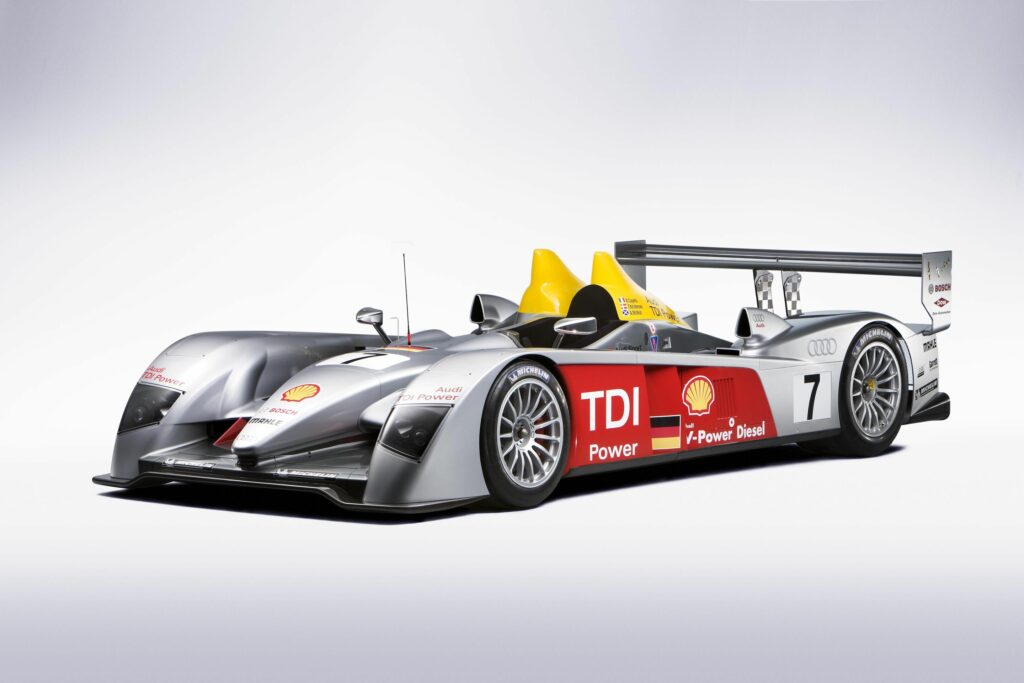
While Audi became renowned for its naturally aspirated V10 road cars, the company’s success with ten-cylinder engines also extended to endurance racing. In 2006, the Audi R10 TDI made history by becoming the first diesel-powered car to win the 24 Hours of Le Mans, introducing a twin-turbocharged 5.5-litre V10 TDI that combined exceptional power with immense torque and remarkable fuel efficiency. The R10 claimed victory at Le Mans in 2006, 2007 and 2008, proving that diesel technology could compete — and win — at the highest level of motorsport. Although unrelated to Audi’s naturally aspirated road-going V10s, the R10 TDI remains one of the most significant ten-cylinder engines ever developed, demonstrating the extraordinary versatility of the V10 architecture both on the road and on the world’s greatest endurance circuits.
GTA Spano: The Spanish Twin-Turbo V10
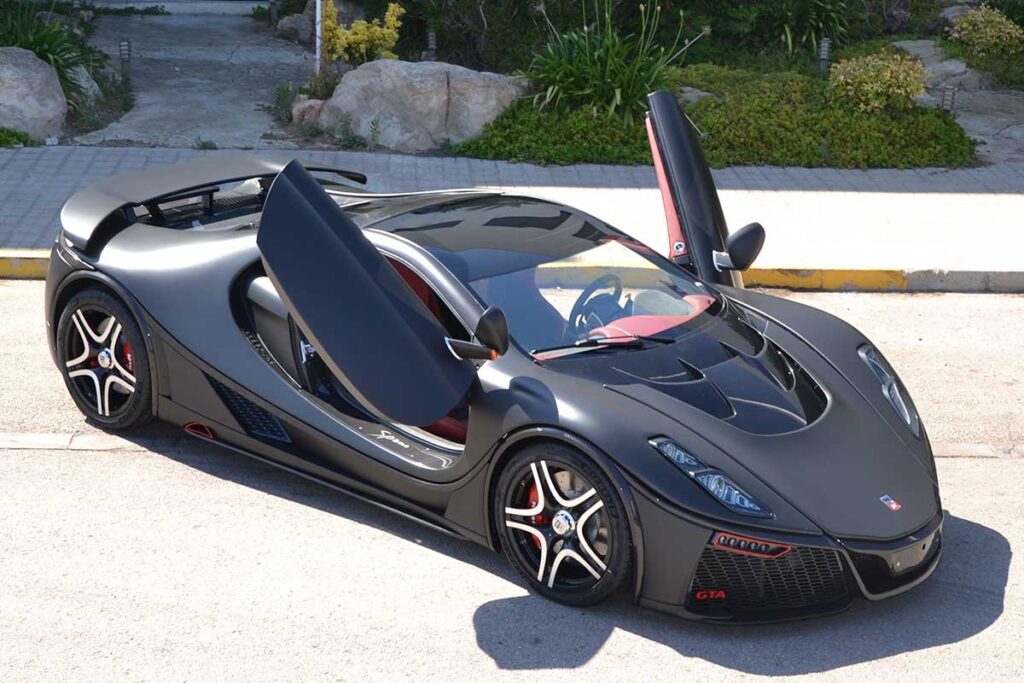
The GTA Spano added another interpretation to the V10 story.
Developed by Spanish manufacturer Spania GTA, the Spano used a large-capacity, twin-turbocharged V10 related to the Dodge Viper tradition but substantially reworked for hypercar levels of performance.
Different stages of the project have carried different technical claims, reflecting the long development and continuing evolution of the car. The current manufacturer specification describes a V10 producing 925 PS and 1,220 Nm, with a claimed maximum speed of 370 km/h.
The Spano combined this power with a structure using carbon fibre, Kevlar and other advanced materials. Production was always intended to be extremely limited, placing it among the rarest modern European supercars.
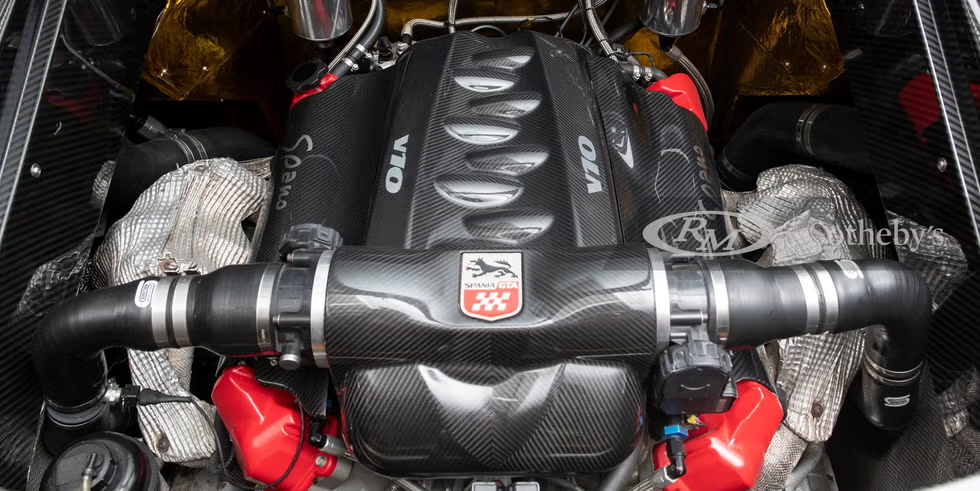
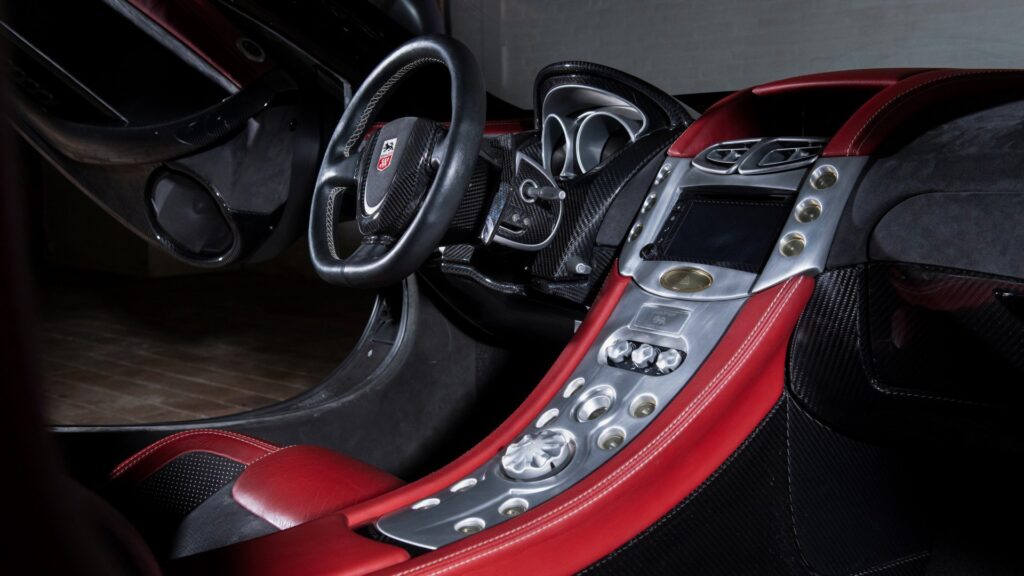
More recent developments have taken the concept further. Spania GTA has announced the Spano R with 1,200 PS and a planned production of 40 cars, while its experimental E&D project uses a 7.9-litre Ilmor twin-turbo V10 and targets speeds beyond 400 km/h.
The GTA Spano occupies an unusual position. It lacks the global recognition of the LFA or Carrera GT, but it demonstrates how the V10 could provide an independent manufacturer with a mechanical identity strong enough to stand apart in the hypercar world.
McLaren Solus GT: A V10 Beyond 10,000 RPM
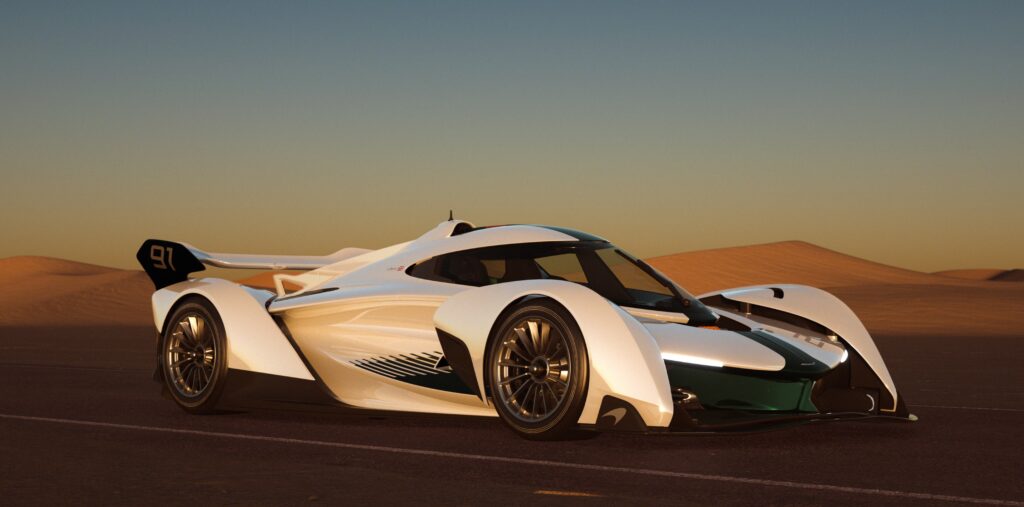
The McLaren Solus GT is not a conventional road car.
Inspired by McLaren’s Vision Gran Turismo concept, it is a single-seat, track-only machine produced for a small group of customers. Its enclosed cockpit, central seating position and extreme aerodynamic package make it closer in spirit to a prototype racing car than a traditional supercar.
At its heart is a naturally aspirated 5.2-litre V10 capable of revving beyond 10,000 rpm and producing more than 840 PS.
Unlike the engines used in the R8, Huracán or LFA, the Solus powerplant is a stressed structural component of the chassis. Its purpose is inseparable from the track car surrounding it. McLaren paired it with a seven-speed sequential transmission and pursued a target weight below 1,000 kilograms.
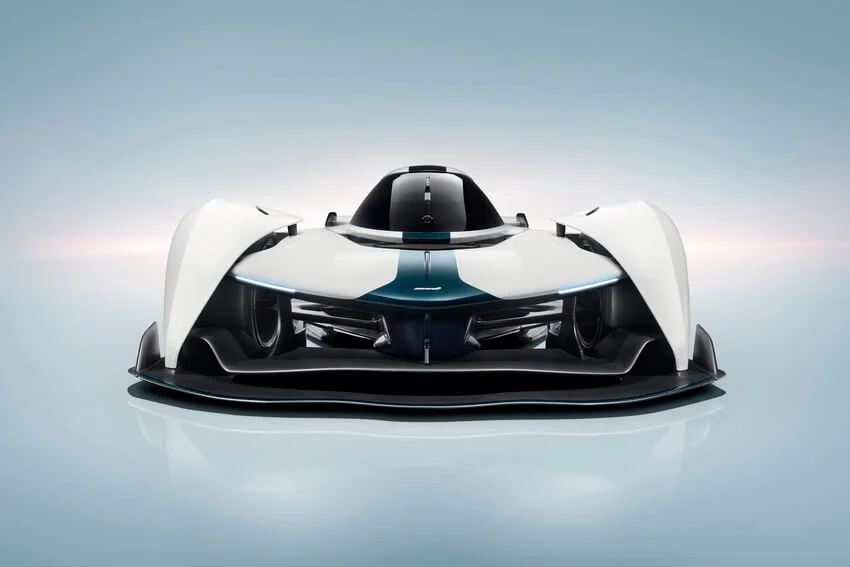
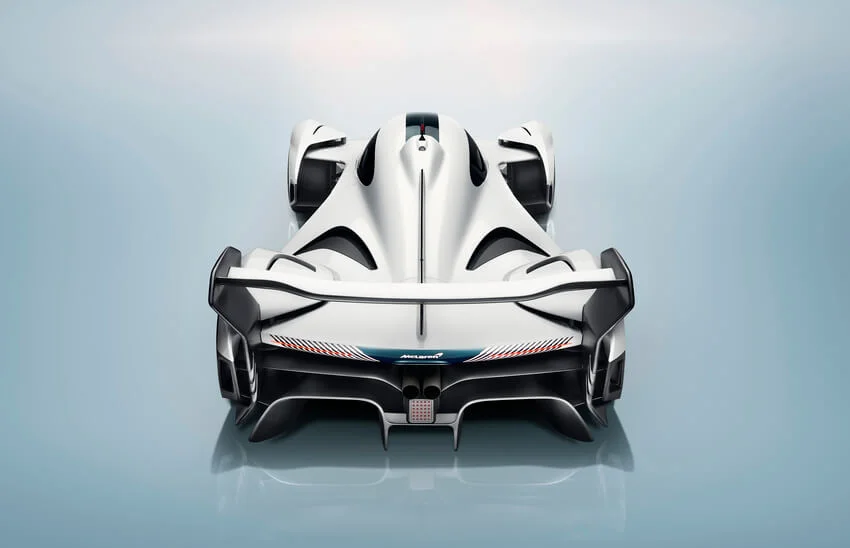
The Solus GT arrived after the mainstream V10 era had already begun to disappear. That timing makes it especially significant.
It did not revive the ten-cylinder engine for mass production or daily use. Instead, it distilled the V10 into an exclusive track experience, free from many of the compromises associated with road homologation.
In doing so, the Solus became one of the most extreme interpretations of the configuration: one seat, no road-going pretence and more than 10,000 rpm.
Which V10 Sounds Best?
No objective answer exists, because the greatest V10s possess fundamentally different voices.
The Lexus LFA is perhaps the most carefully orchestrated. Its sound rises cleanly from a purposeful mechanical note into a high-frequency howl, with Yamaha’s acoustic expertise evident throughout the rev range.
The Porsche Carrera GT sounds less polished and more closely connected to racing machinery. Its V10 has a hard metallic edge that becomes increasingly intense as it approaches the upper range.
Lamborghini’s 5.0- and 5.2-litre engines combine a recognisable ten-cylinder rhythm with the theatrical aggression expected from the brand. Earlier Gallardos sound raw and mechanical, while the Huracán Performante and STO offer a sharper and more controlled interpretation.
The Audi R8 shares some of that exotic character but presents it differently. Its sound is attached to a car that can be driven through traffic or across countries without losing its sense of occasion.
BMW’s S85 produces one of the most surprising soundtracks because it emerges from an executive saloon, coupé or estate. Its transformation beyond 6,000 rpm is central to the M5 and M6 experience.
The Dodge Viper exists at the other end of the spectrum. It does not chase a smooth, high-pitched crescendo. Its vast displacement creates a deeper, rougher pulse that feels inseparable from the physical scale of the car.
The McLaren Solus GT may be the most extreme, revving beyond 10,000 rpm in a machine designed exclusively for the circuit.
Choosing among them says as much about the listener as it does about the engine.
Most Iconic Hypercars of the 21st Century
Why Did the V10 Disappear?
The V10 did not disappear because it lacked performance.
It disappeared because other technologies could produce equal or greater performance while making it easier for manufacturers to meet emissions, fuel-consumption, noise and packaging requirements.
Turbocharged V8s became capable of delivering extraordinary power and torque from smaller external dimensions. Hybrid systems filled gaps in throttle response, supported acceleration and allowed manufacturers to claim forms of efficiency that a large naturally aspirated engine could not match.
Development costs also became harder to justify. A V10 is unlikely to be shared across the same number of models as a four-, six- or eight-cylinder engine. Even during its most successful period, the configuration remained relatively rare.
Audi discontinued the R8. Lamborghini replaced the Huracán with the Temerario, which uses a twin-turbocharged V8 hybrid powertrain rather than a naturally aspirated V10. BMW’s S85 lasted for a single M5 and M6 generation. The Viper ended production without a direct successor.
The V10 has survived only in exceptional projects such as the track-only McLaren Solus GT and ultra-low-volume creations from specialist manufacturers.
Its disappearance therefore reflects a change not only in regulation, but in the way performance cars are engineered.
Modern powertrains are faster, more efficient and often more capable. Yet capability alone cannot replicate the experience of ten individual cylinders, an immediate throttle and an engine building naturally toward its redline.
The Legacy of the Ten-Cylinder Era
No single car defines the V10.
The Lamborghini Gallardo made the configuration the centre of a successful modern supercar family. The Huracán preserved it as turbocharging became the industry standard. The Audi R8 made it usable every day, while the RS6 transformed ten-cylinder power into an executive estate capable of extraordinary speed.
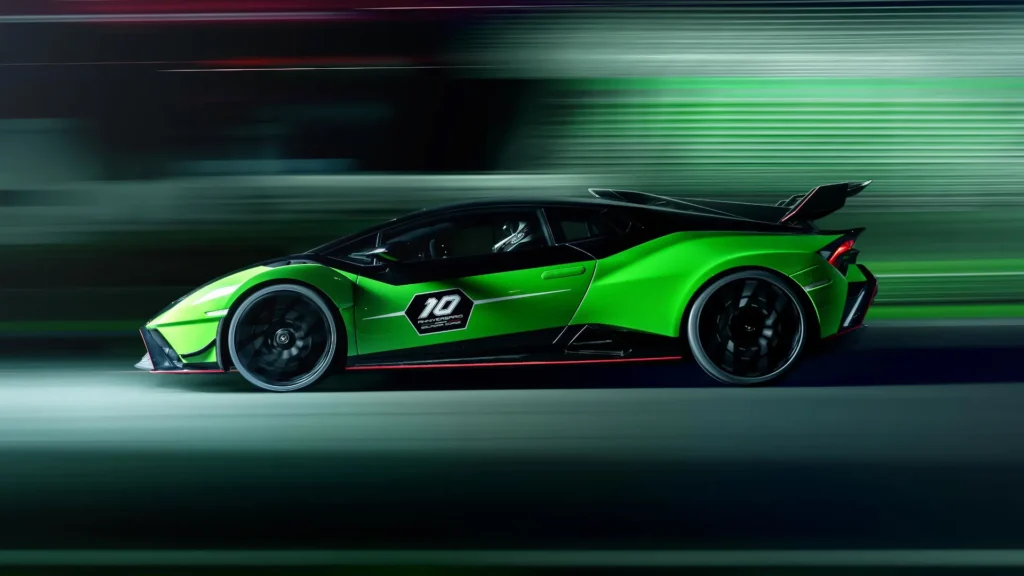
BMW installed a high-revving V10 in the M5, M6 and even an estate. Lexus treated the engine as an acoustic and engineering masterpiece. Porsche rescued a racing project and created the Carrera GT. Dodge built the Viper and then placed its engine in the Ram SRT-10. Volkswagen constructed a twin-turbo diesel V10 for a luxury saloon and a 2.5-tonne SUV.
The Sesto Elemento used carbon fibre to reveal what the Lamborghini engine could achieve without mass. Italdesign turned established Audi Sport engineering into a five-car collector series. GTA Spano used twin turbochargers to pursue hypercar performance, while McLaren created a track machine capable of exceeding 10,000 rpm.
Together, these cars show why the V10 cannot be reduced to a technical specification.
More Than an Engine Configuration
Ten cylinders produced high-revving Japanese precision, German executive-car excess, Italian theatre, American displacement and diesel torque. The same broad configuration supported manual supercars, all-wheel-drive saloons, estates, SUVs, pick-ups and track-only collector machines.
The V10 era was relatively brief because it was never especially rational.
It asked manufacturers to accept greater complexity and cost in exchange for character, sound and mechanical distinction. For several remarkable decades, enough of them decided that the exchange was worthwhile.
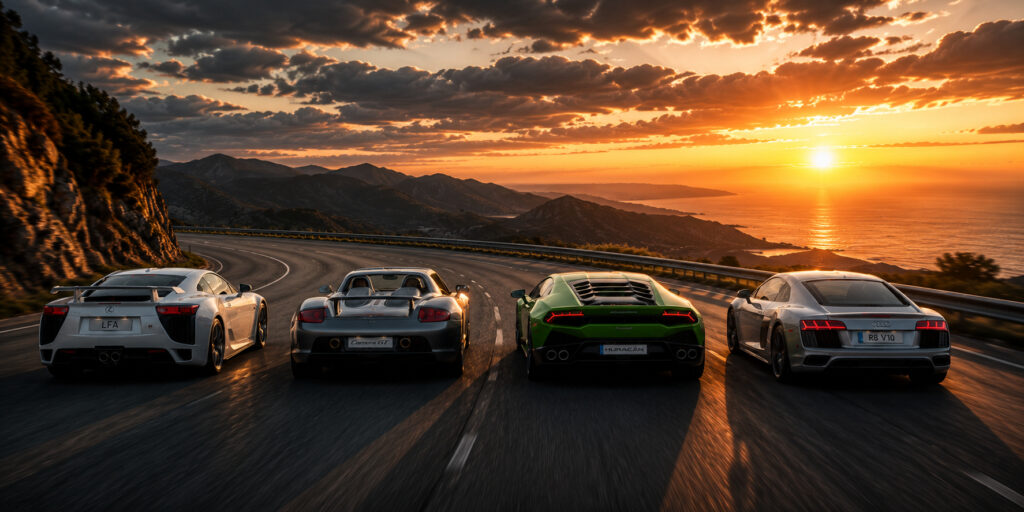
That is why the greatest V10-powered cars remain so compelling.
They represent a period when performance was not measured only by acceleration figures or lap times, but by the way an engine responded, the way it sounded and the personality it gave to the machine built around it.
The V10 may no longer have a meaningful place in mainstream production.
Its place in automotive history is already secure.