

More power is not always the answer.
Gunther Werks knows this particularly well.
The California specialist has already demonstrated what happens when the air-cooled Porsche 911 formula is pushed into four-figure territory. Its extraordinary F-26 produces more than 1,000 horsepower from a twin-turbocharged flat-six.
For its latest creation, however, Gunther Werks has gone in almost the opposite direction.
The new GXR-Evo has no turbochargers.
No hybrid assistance.
No dual-clutch transmission.
Instead, it combines a naturally aspirated 4.0-litre air-cooled flat-six, a six-speed manual gearbox, rear-wheel drive and an extraordinary dry weight of just 2,386 pounds — approximately 1,082 kilograms.
The engine produces 455 horsepower.
In the modern supercar world, that number sounds almost modest.
Everything else about the GXR-Evo suggests otherwise.
Unveiled during Monterey Car Week 2026, the GXR-Evo is Gunther Werks’ most uncompromising naturally aspirated creation yet: a road-legal interpretation of what an air-cooled 993 might have become if its evolution had continued deep into modern GT racing territory.
From the 993 to Something Entirely Different

The Porsche 993 remains fundamental to Gunther Werks.
It was the final air-cooled generation of the Porsche 911 and provides the starting point for the company’s philosophy: preserving the analogue relationship between driver and machine while reconsidering almost everything around it using contemporary engineering and materials.
But calling the GXR-Evo a restored 993 would fundamentally misunderstand the project.
Gunther Werks itself rejects the restoration label for its creations.
Each commission begins with a complete teardown. The original car is stripped back before being comprehensively re-engineered, with extensive carbon-fibre bodywork, new mechanical systems and bespoke interiors transforming the donor into something dramatically different.
With the GXR-Evo, that transformation reaches a new extreme.
This is less a modernised classic than a racing machine built around the DNA of an air-cooled 911.
Singer vs Gunther Werks — Defining the Ultimate Porsche Reimagined
A 4.0-Litre Naturally Aspirated Flat-Six
At its heart sits exactly the kind of engine that increasingly feels endangered.
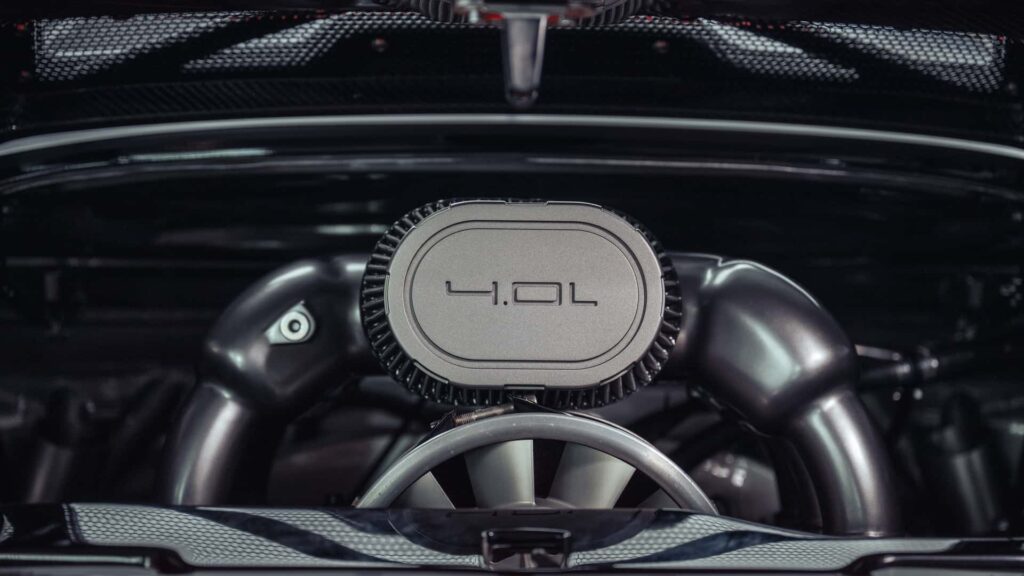
A 4.0-litre naturally aspirated, air-cooled flat-six, developed with Rothsport Racing.
It produces approximately 455 horsepower and revs towards 9,000 rpm.
There is no forced induction masking the relationship between accelerator movement and engine response.
No electric motor filling gaps in the torque curve.
No artificial assistance required to create the headline figure.
Instead, the character comes from displacement, breathing, rotational speed and mechanical response.
For a car created primarily around driver involvement, that matters considerably more than simply chasing another enormous horsepower number.
455 HP Is More Than Enough
Context changes everything.
Four hundred and fifty-five horsepower in a two-tonne luxury performance car would be relatively ordinary.
In a machine weighing approximately 1,082 kg dry, it becomes something entirely different.
The GXR-Evo is around 210 pounds lighter than Gunther Werks’ earlier Coupe, creating a power-to-weight relationship that allows its naturally aspirated output to become genuinely serious.
And weight reduction influences far more than acceleration.
Less mass needs to be stopped.
Less mass needs to be controlled by the suspension.
The tyres have less inertia to overcome.
The entire car can react more immediately.
Gunther Werks has therefore pursued one of the oldest principles in performance engineering.
Rather than asking how much more power the car needs, ask how much less car the engine needs to move.
Six Speeds and Three Pedals
Power reaches the rear wheels through a modified Getrag G50 six-speed manual transmission.
That specification immediately defines the GXR-Evo’s character.
A paddle-shift transmission would almost certainly produce faster lap times.
It would also remove one of the fundamental interactions Gunther Werks wants to preserve.
The driver must operate the clutch.
Select the gear.
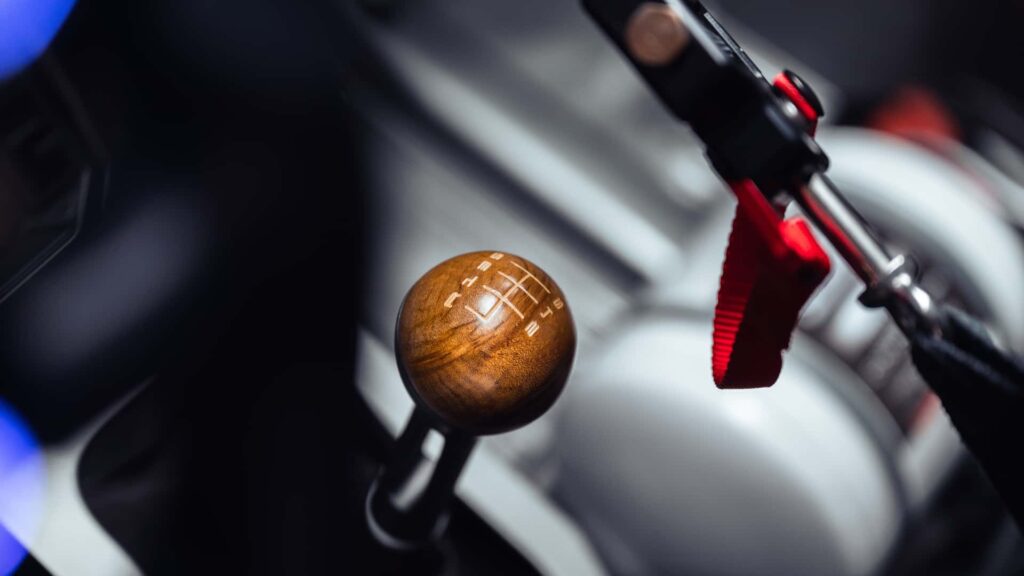
Coordinate the throttle.
And accept that every perfect shift — or imperfect one — belongs to them.
Combined with an engine approaching 9,000 rpm and rear-wheel drive, the result is a driving philosophy increasingly separated from the way contemporary supercars achieve their performance.
The GXR-Evo is technologically sophisticated.
Its controls remain deliberately analogue.
A Body Made Entirely From Carbon Fibre
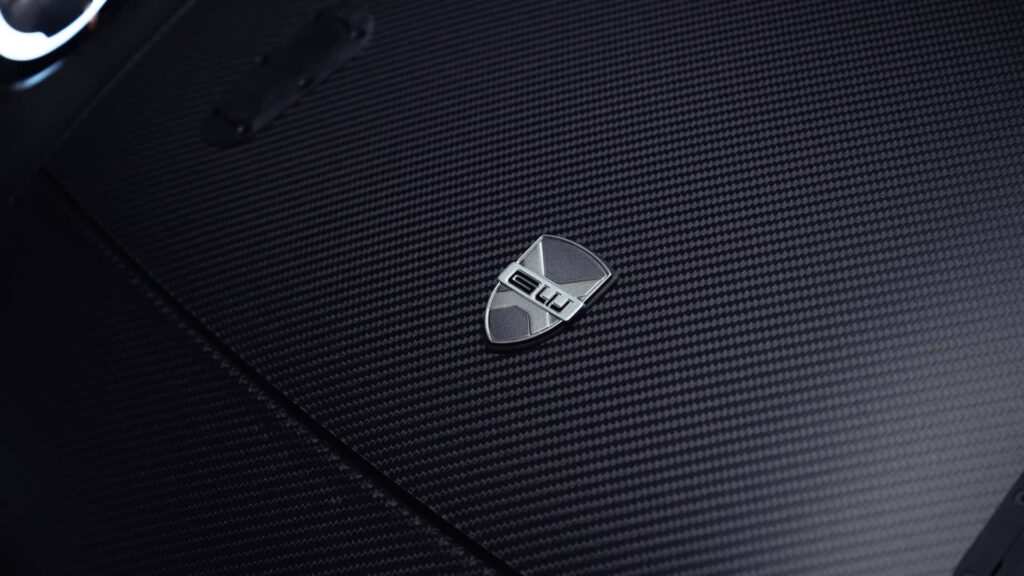
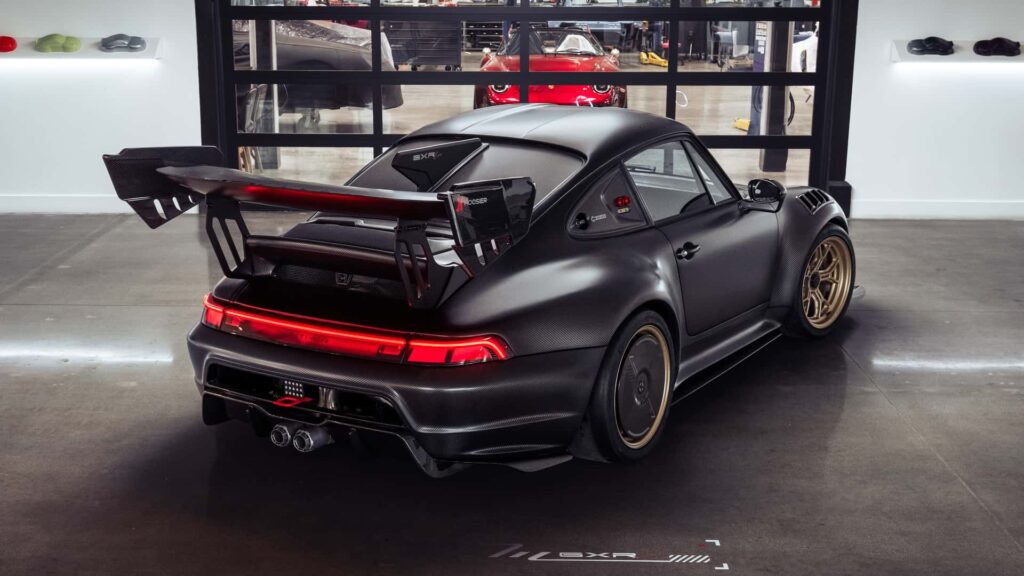
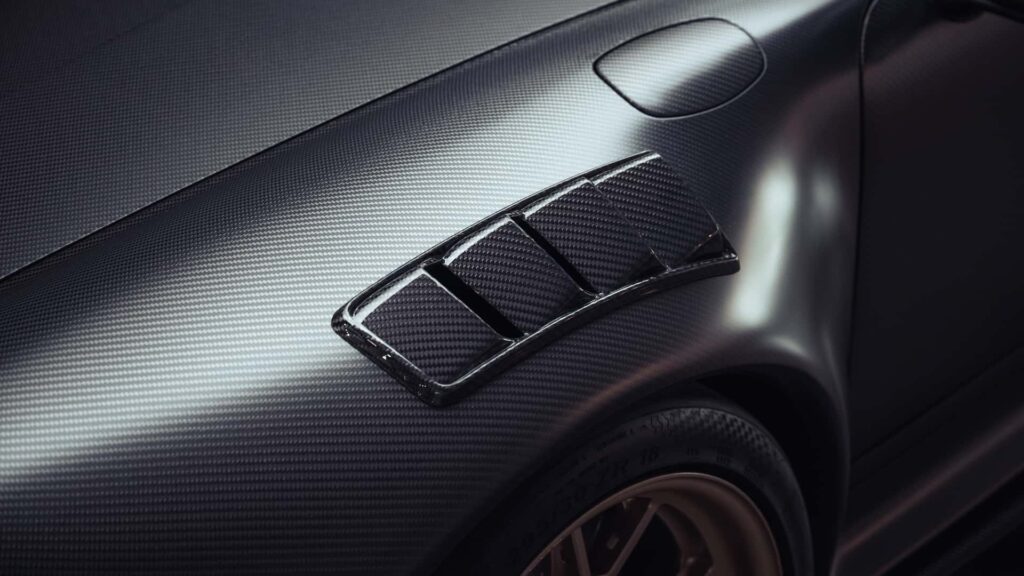
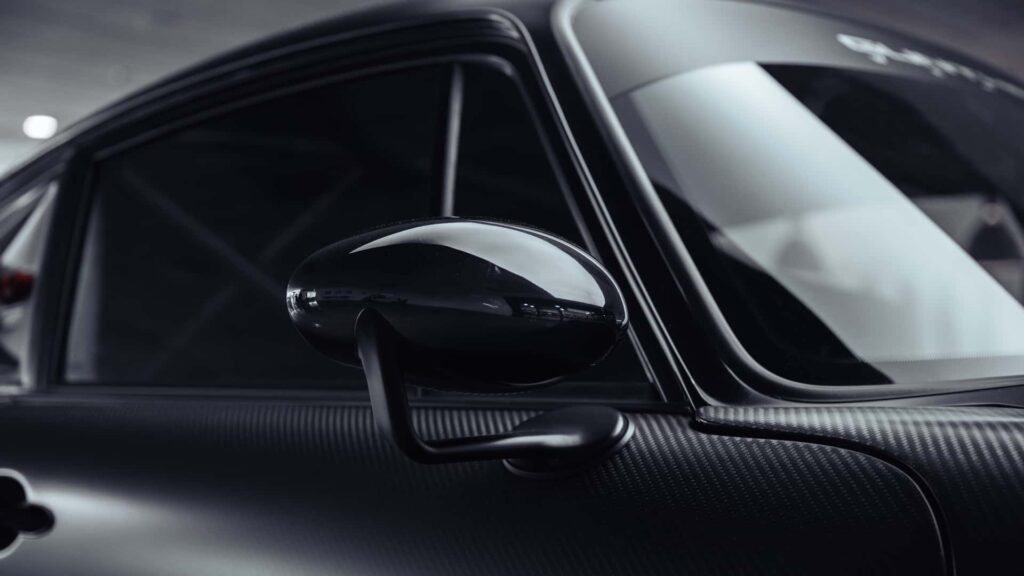
Almost every exterior panel has been recreated in carbon fibre.
This is fundamental to achieving the GXR-Evo’s remarkable weight figure, but Gunther Werks also uses carbon as a means of reshaping the original 993.
The familiar silhouette survives.
Round headlights remain.
The cabin proportions remain unmistakably 911.
The fundamental curvature of the roof still connects the car visually with Porsche’s air-cooled lineage.
Everything surrounding those elements becomes considerably more aggressive.
The GXR-Evo does not disguise its origins.
It weaponises them.
Aerodynamics Become the Dominant Visual Language
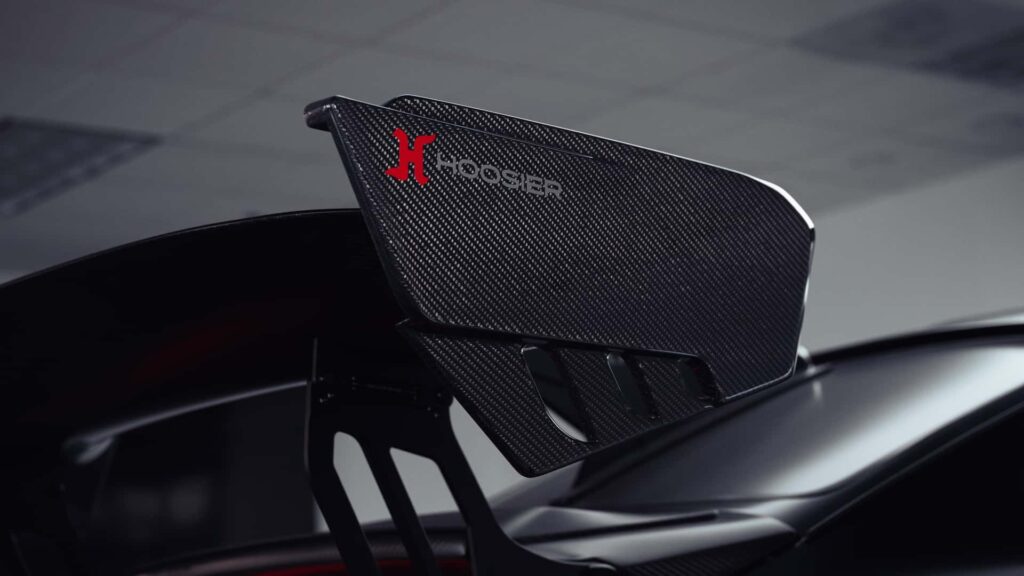
Where earlier Gunther Werks projects maintained a relatively clean relationship with the original 993 shape, the GXR-Evo allows aerodynamics to take considerably greater control.
The front receives an enormous splitter.
Large dive planes appear around the corners.
The widened front fenders incorporate substantial extraction vents.
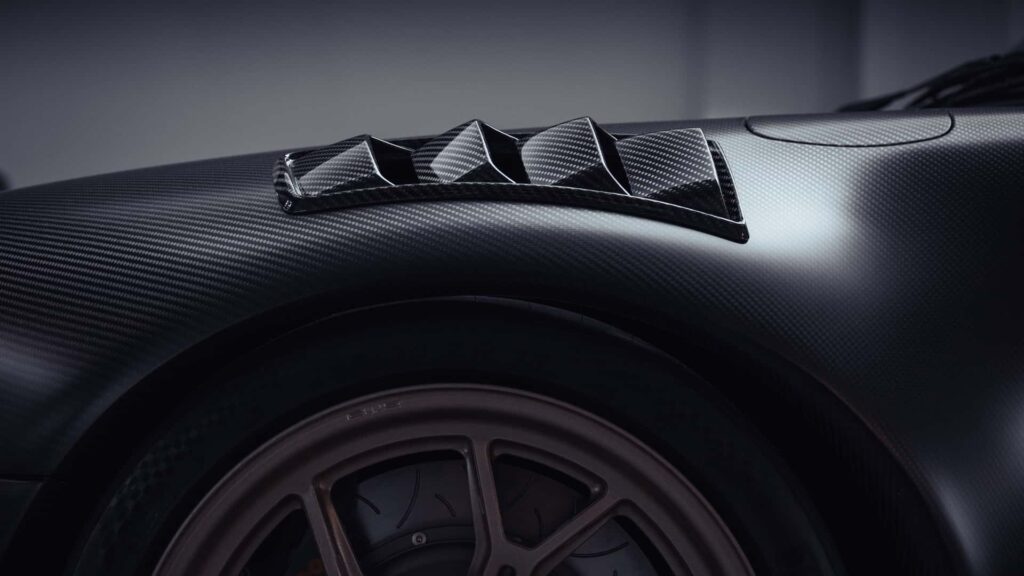
Air is carefully managed around the wheel arches.
The lower body receives new aerodynamic surfaces.
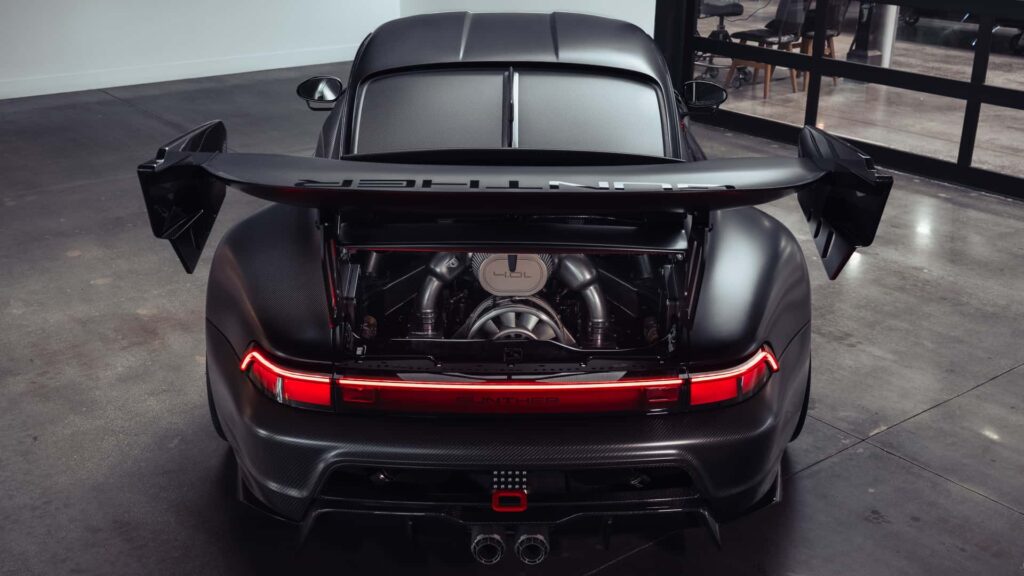
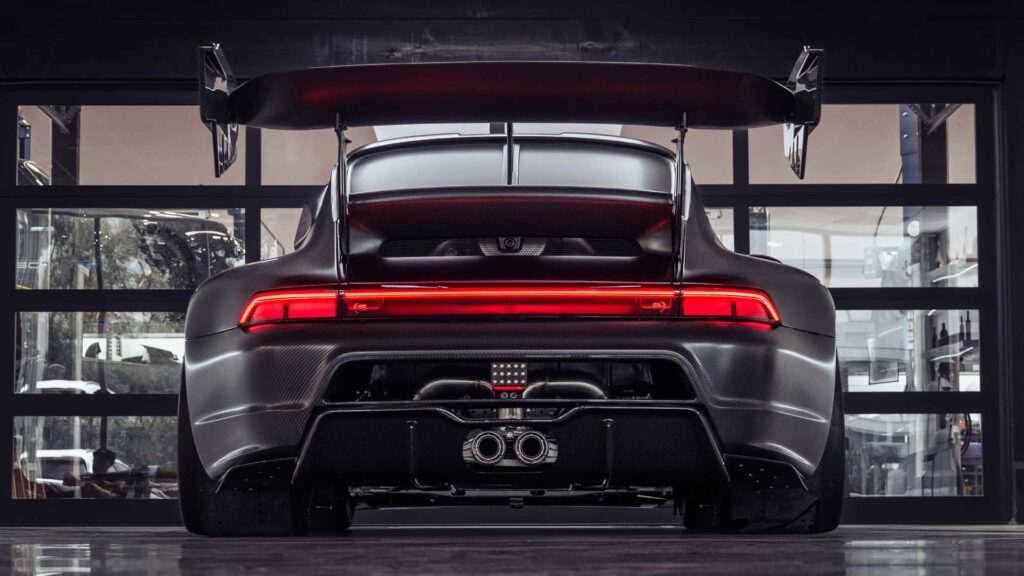
And at the rear sits a vast motorsport-style wing.
There is very little visual subtlety left.
Nor should there be.
This is the closest Gunther Werks has moved towards creating a competition car around its naturally aspirated platform.
The Shark Fin Changes Everything
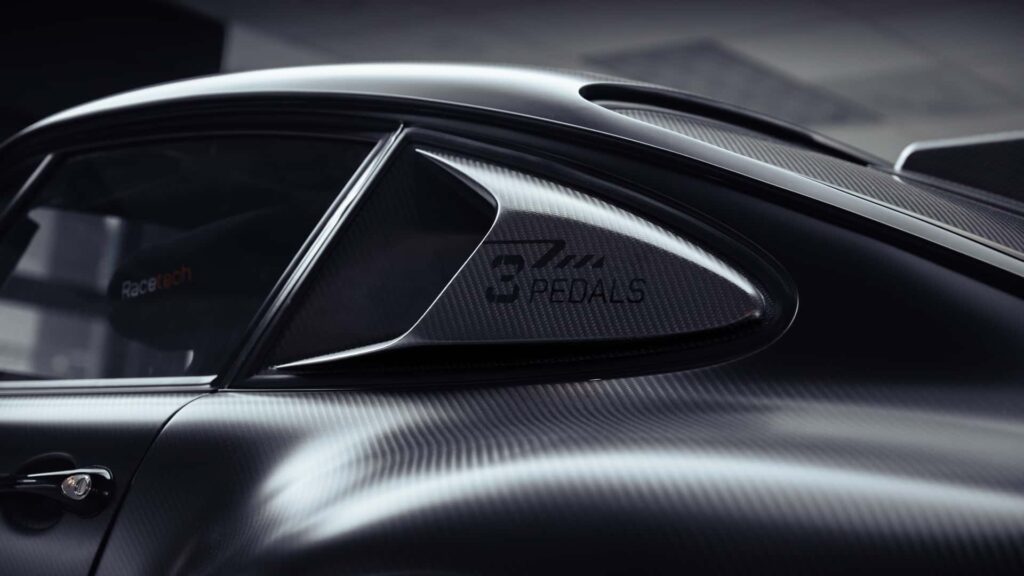
Perhaps the GXR-Evo’s most striking aerodynamic feature is positioned directly behind the cabin.
A large central shark fin connects the roofline visually with the rear wing.
It immediately gives the car the appearance of contemporary endurance racing machinery.
But the feature is not simply theatrical.
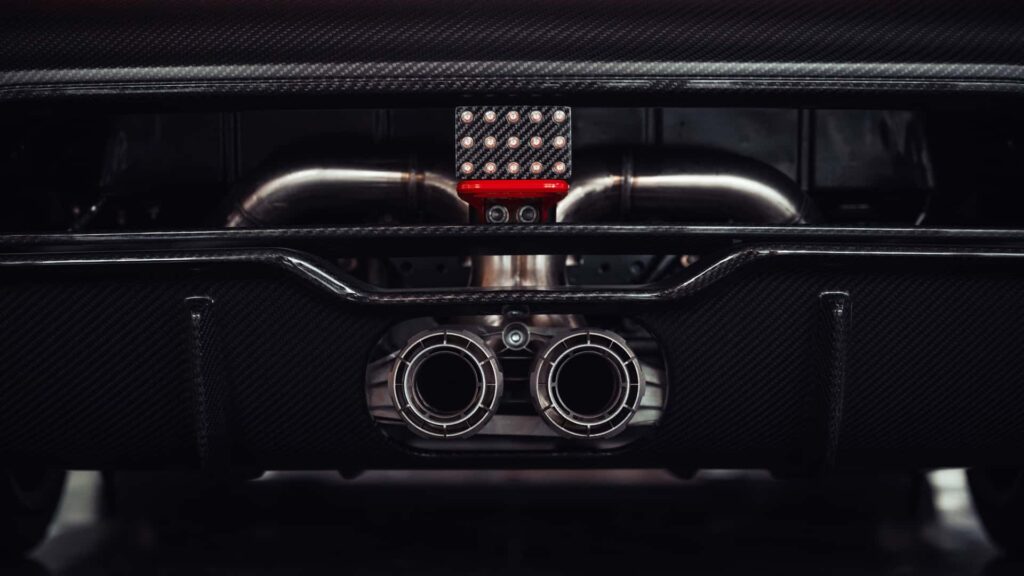
Vertical fins are used in competition cars to improve stability during high-speed yaw conditions, helping control airflow when the vehicle is no longer travelling perfectly parallel to its direction of motion.
On the GXR-Evo, it also transforms the traditional 911 silhouette.
Viewed from the side, there is still an obvious relationship with the 993.
Viewed from above or behind, the car looks increasingly like something designed for Le Mans.
More Downforce, More Stability
The entire aerodynamic package has been designed around genuine high-speed performance rather than simply visual aggression.
Large front extraction areas reduce pressure around the wheel arches.
The splitter manages airflow beneath the nose.
The rear diffuser works with the enormous wing.
And the shark fin contributes additional directional stability.

The objective is balance.
Adding enormous rear downforce without corresponding front aerodynamic performance would simply create understeer.
The GXR-Evo instead treats its body as an interconnected aerodynamic system.
That is one reason the result looks so different from the original 993.
The shape is no longer dictated solely by heritage.
Air has been given a vote.
Double-Wishbone Front Suspension
Beneath the body, Gunther Werks moves even further away from conventional 993 architecture.
The GXR-Evo uses a double-wishbone front suspension arrangement, accompanied by bespoke control arms and highly adjustable dampers.
That is a significant engineering decision.
The double-wishbone layout provides far greater freedom over camber control and suspension geometry than the architecture traditionally associated with the 993.
For a car designed around extreme circuit use, maintaining the tyre’s contact patch as suspension loads increase becomes crucial.
Gunther Werks is therefore not simply refining the old chassis.
It is applying modern race-car thinking to it.


Three-Way Adjustable Dampers
The suspension includes three-way adjustable dampers, allowing individual control over different aspects of compression and rebound behaviour.
For the average road car, this level of adjustment would be unnecessary.
For the GXR-Evo, it makes perfect sense.
Owners can adapt the chassis to different circuits.
Different surfaces and different driving preferences.
The setup can therefore become part of the ownership experience rather than a fixed compromise chosen at the factory.
This is a machine intended to be tuned around the driver.
RUF EHRA: A 650-HP Manual Grand Tourer Inspired by the Yellowbird Legacy
Brembo Pista Brakes
Stopping power comes from a Brembo Pista braking system, another clear indication of the GXR-Evo’s circuit priorities.
Combined with the extremely low vehicle mass, the braking hardware should provide enormous stopping capability while maintaining consistency during repeated high-speed use.
Again, low mass works in the car’s favour.
The brakes do not need to repeatedly decelerate the enormous weight carried by many modern high-performance cars.
Physics becomes an ally rather than an obstacle.
Magnesium Centre-Lock Wheels
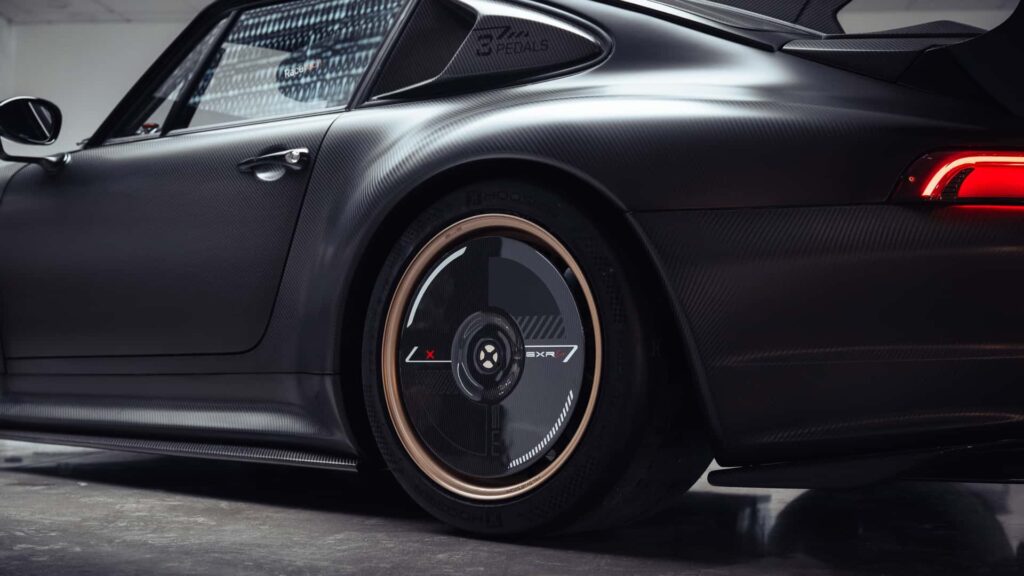
Gunther Werks has fitted the GXR-Evo with centre-lock magnesium wheels, finished in bronze on the Monterey launch car.
Magnesium provides substantial weight advantages over conventional aluminium construction.
More importantly, this is unsprung and rotational mass.
Reducing it improves suspension response.
Steering.
Acceleration.
Braking.
And the speed with which the wheel can react to imperfections in the road surface.
Centre-lock mounting adds another clear motorsport reference while keeping the design visually clean.
These are not simply attractive wheels.
They are part of the weight-reduction programme.
The Interior Has Almost Forgotten About the Road
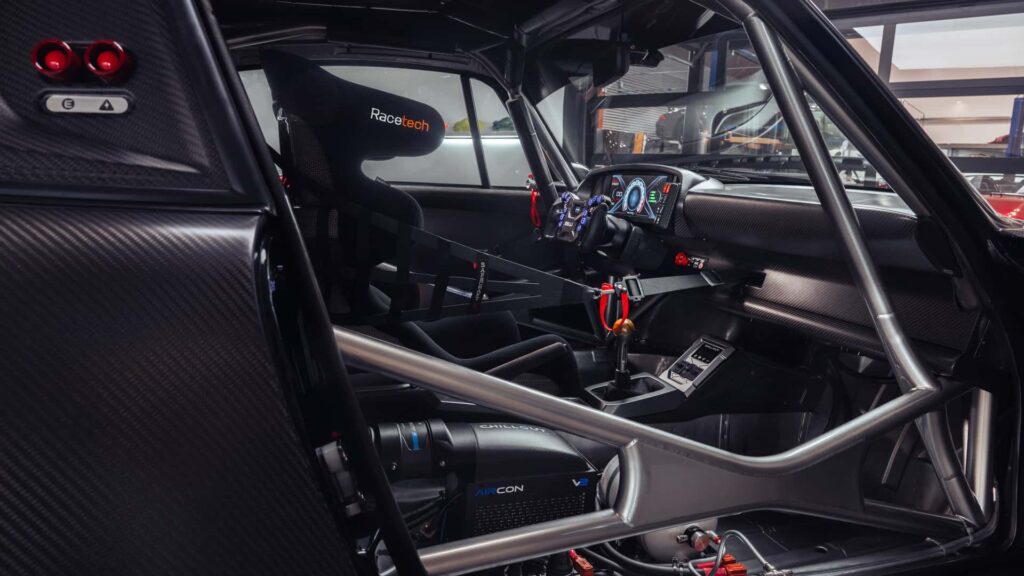
Open the door and the distinction between restomod and race car becomes even less clear.
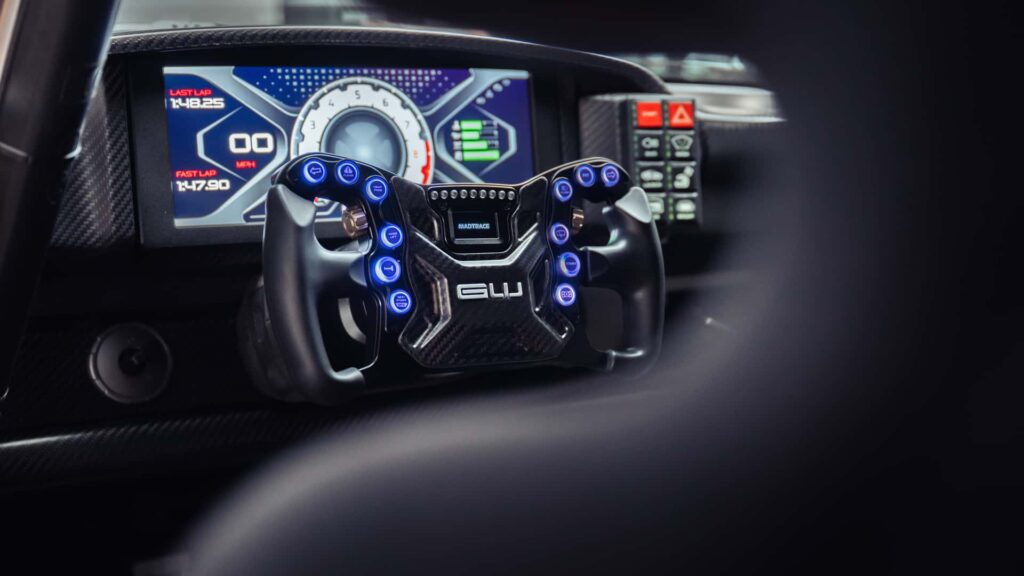
The GXR-Evo uses a carbon-Kevlar racing seat, complete with competition harnesses.
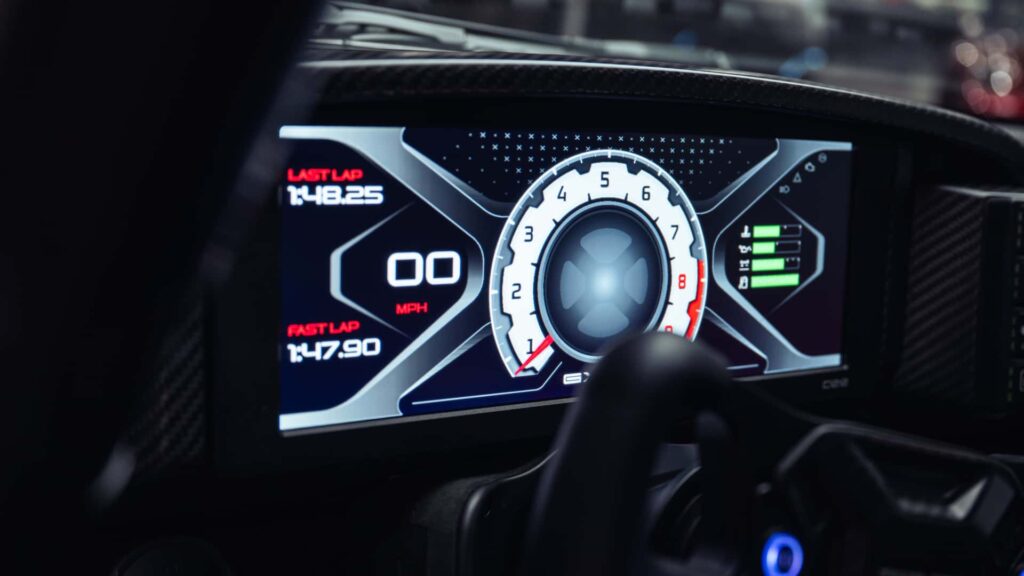
There is a Motec digital display rather than a conventionally luxurious instrument cluster.
The steering wheel is quick-release.
A digital rear-view mirror replaces a traditional solution.
A roll structure surrounds the occupants.
There is an integrated fire-suppression system.
This is not an interior designed around long-distance comfort.
It is designed around lap times and concentration.
It Even Cools the Driver’s Helmet
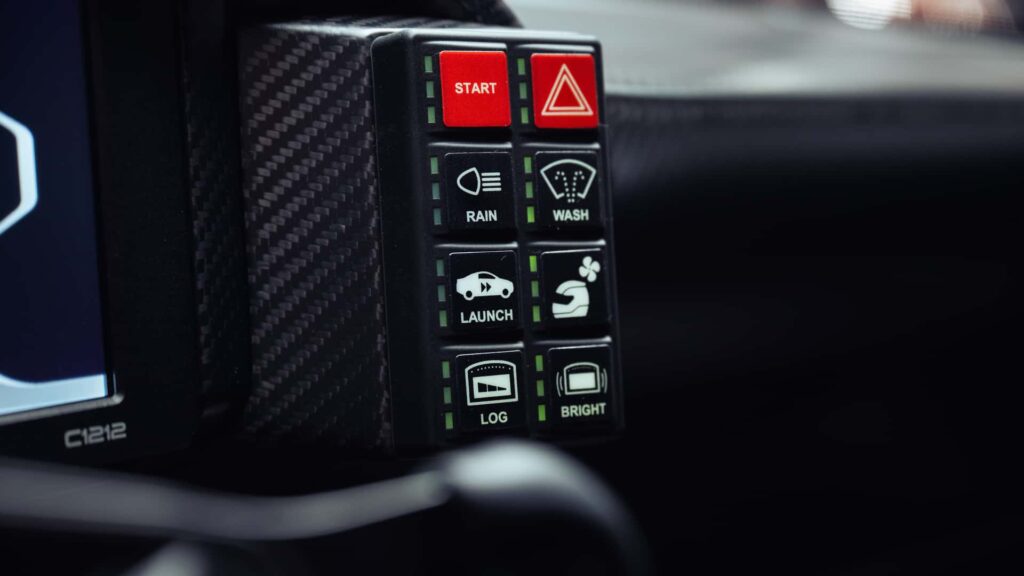
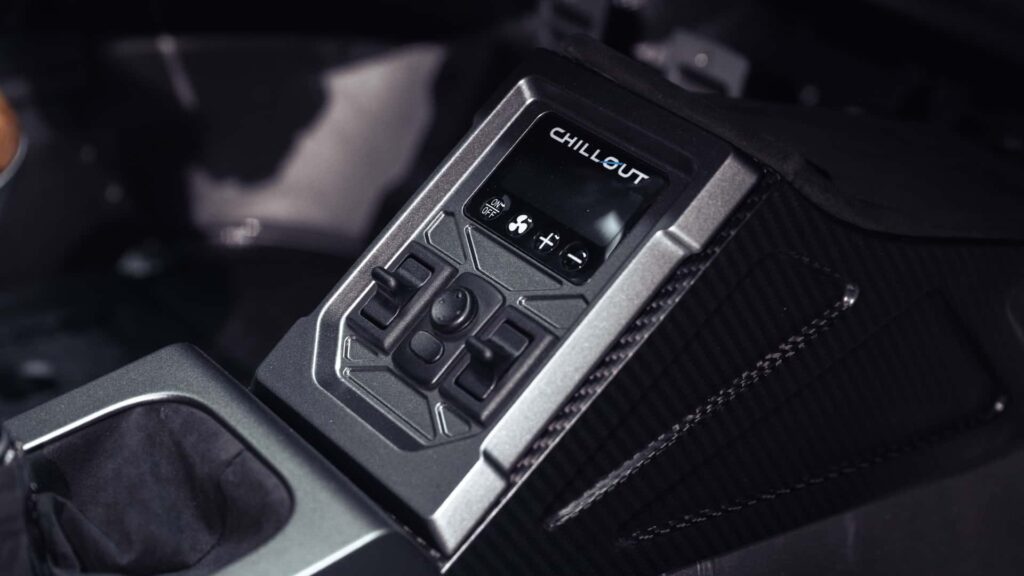
One of the most revealing details is the integrated helmet-cooling system.
That is not something installed because it looks impressive in photographs.
It exists because Gunther Werks expects owners to use the car hard enough for driver temperature to become a genuine consideration.
The feature says more about the GXR-Evo’s purpose than almost any horsepower figure could.
This is not a 993 created merely to occupy the centre of a collection.
Gunther Werks wants it on a circuit.
Gunther Werks McKenna Commission: A Porsche 911 Reimagined Through Personal Heritage
Built-In Pneumatic Air Jacks
The same applies to another distinctly competition-oriented feature: integrated pneumatic air jacks.
Connect an external compressed-air supply and the car can raise itself from the ground, simplifying wheel changes and trackside setup adjustments.
On a conventional road car, the system would be absurd.
On a GXR-Evo, it feels completely logical.
The car increasingly resembles a GT racer that happens to retain registration plates rather than a road car modified for occasional circuit work.

Road Legal, but Clearly Not Road Focused
That distinction is central to understanding the GXR-Evo.
It remains street legal.
But road legality does not define its mission.
Its engineering decisions consistently prioritise circuit performance:
extreme weight reduction,
aggressive aerodynamics,
adjustable suspension,
race brakes,
magnesium wheels,
fire suppression,
air jacks,
helmet cooling,
harnesses,
and a competition-oriented cockpit.
The road provides access to the circuit.
The circuit provides the reason the car exists.
Only 15 Examples
Gunther Werks will build just 15 GXR-Evos.
That makes it considerably rarer than most limited-production supercars and even many other Gunther Werks programmes.
The company’s original Speedster programme, for example, comprised 25 commissions, while the naturally aspirated GWR programme is limited to 40.
Fifteen moves the GXR-Evo into another category.
For collectors already familiar with the company’s work, this is effectively the most focused naturally aspirated endpoint.
$1.35 Million
The GXR-Evo starts at approximately $1.35 million.
That figure is extraordinary when viewed purely as the price of a 993-derived automobile.
But the GXR-Evo stopped being a conventional 993 long before completion.
Carbon bodywork.
Bespoke engine.
Custom suspension.
Race-derived aerodynamics.
Magnesium wheels.
Competition braking hardware.
A comprehensively reconstructed interior.
Extremely limited production.
And the enormous amount of low-volume engineering behind each component.
The relevant comparison is no longer another used Porsche 911.
It is other seven-figure collector cars.
And You Get a Racing Simulator
There is another unusual element included with every car.
Each GXR-Evo customer receives a bespoke racing simulator configured around their automobile.
The simulator incorporates carbon-fibre elements matching the real car and is intended to reproduce its driving characteristics.
It sounds extravagant.
But there is logic behind it.
Owners can learn circuits.
Practise braking points.
Understand corner sequences.
And familiarise themselves with the dynamics of an exceptionally valuable track car before committing to those decisions in reality.
For a $1.35 million machine designed to be driven hard, virtual practice suddenly makes considerable sense.
The Opposite of the F-26
The timing of the GXR-Evo is particularly interesting because Gunther Werks recently revealed the F-26.
That car represents another extreme.
Twin turbochargers.
More than 1,000 horsepower.
A dramatic interpretation of how far the air-cooled 911 can be pushed through enormous power. Gunther Werks currently quotes 1,067 hp for the F-26 programme.
The GXR-Evo asks a completely different question.
What if power is not the objective?
What if response, weight, braking, aerodynamics and mechanical involvement matter more?
One car uses overwhelming force.
The other uses precision.
Both emerge from the same philosophy.
Gunther Werks Project Endgame — Iron Man-Inspired Perfection, Taken to the Extreme
Why Naturally Aspirated Still Matters
Turbocharging is an extraordinarily effective technology.
It creates enormous torque.
Enormous horsepower.
And increasingly remarkable efficiency.
But it inevitably changes the relationship between throttle, combustion and response.
A naturally aspirated engine remains fundamentally different.
Airflow follows accelerator input more directly.
Power builds with rotational speed.
The driver has a reason to chase the upper end of the rev counter.
In the GXR-Evo, that means approaching 9,000 rpm before selecting another gear manually.
For an analogue-focused automobile, the experience is difficult to replace with a larger number on a specification sheet.
Gunther Werks and the Evolution of the 993
Gunther Werks began in 2017 with a simple but ambitious idea: explore what the final air-cooled 911 could become if its evolution had continued using contemporary materials and engineering.
The original Coupe produced 435 horsepower.
The Speedster removed the roof and intensified the analogue experience.
The GWR introduced a new generation of naturally aspirated engineering.
The Turbo programme explored forced induction.
The F-26 pushed air-cooled power beyond four figures.
And now the GXR-Evo takes the naturally aspirated side of the family towards competition.
Seen individually, each car is extreme.
Seen together, they form an interesting alternative history of the 993.
A 993 That Porsche Never Built
Porsche itself never created anything resembling the GXR-Evo during the 993 era.
It could not have.
The materials, computational tools, tyre technology, damper sophistication and manufacturing processes available today simply did not exist at the same level three decades ago.
That is what makes the project more interesting than a recreation.
Gunther Werks is not asking how accurately it can reproduce 1990s engineering.
It is asking what the 993 concept might look like if development had never stopped.
The GXR-Evo is one possible answer.
When 455 HP Becomes More Interesting Than 1,000
Perhaps the most refreshing thing about the Gunther Werks GXR-Evo is that its specification initially seems almost backward.
In 2026, 455 horsepower no longer sounds extraordinary.
Electric family cars can exceed it.
Supercars have doubled it.
Hypercars can quadruple it.
Yet none of that makes the GXR-Evo irrelevant.
Quite the opposite.
Because horsepower becomes very different when attached to only 1,082 kilograms, a naturally aspirated engine approaching 9,000 rpm, a six-speed manual gearbox and a chassis designed around circuit precision.
The GXR-Evo demonstrates that performance is not a single number.
It is a relationship.
Between power and weight.
Between aerodynamics and speed.
And ultimately, between driver and machine.
Gunther Werks could have added turbochargers.
Instead, it removed weight.
For the GXR-Evo, that may have been the more radical decision.