
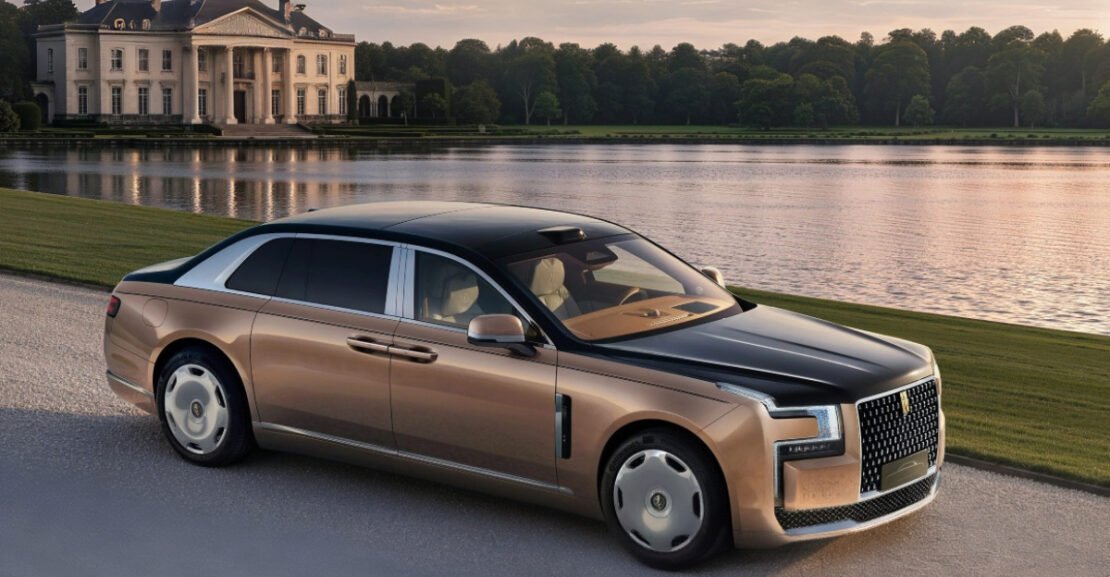
Unveiled in Abu Dhabi, the 2026 Yangwang Altior introduces an ambitious interpretation of automotive luxury. With a 5.6-metre body, coach doors, extraordinary Chinese craftsmanship and more than 1,000 kilometres of claimed electric range, BYD’s flagship marque is entering a world traditionally dominated by Europe’s most prestigious manufacturers.
For more than a century, the highest levels of automotive luxury have been defined by a relatively small group of manufacturers. Rolls-Royce, Bentley and Mercedes-Maybach have established their reputations through exceptional craftsmanship, refined engineering and the ability to transform an automobile into a deeply personal expression of status.
But the landscape of contemporary luxury is beginning to change.
On November 7, 2026, in Abu Dhabi, Chinese luxury marque Yangwang introduced a vehicle intended to challenge those established conventions.
The Yangwang Altior is not simply another large electric sedan. It represents an ambitious attempt to establish a distinctly Chinese identity in the international ultra-luxury automotive market.
Measuring 5.6 metres in length, equipped with rear-hinged coach doors and featuring a four-seat executive cabin, the Altior combines traditional craftsmanship with some of the most advanced technologies developed by parent company BYD.
From its ceremonial lighting and jewel-like exterior detailing to its sophisticated electric powertrain and extraordinary rear-passenger environment, almost every element has been conceived to communicate exclusivity.
Yet perhaps its most significant achievement is conceptual.
Rather than merely reproducing European luxury traditions, Yangwang is attempting to introduce an alternative interpretation built around Chinese cultural heritage, technological sophistication and contemporary craftsmanship.
Yangwang: BYD’s Ambition Beyond the Conventional Luxury Market
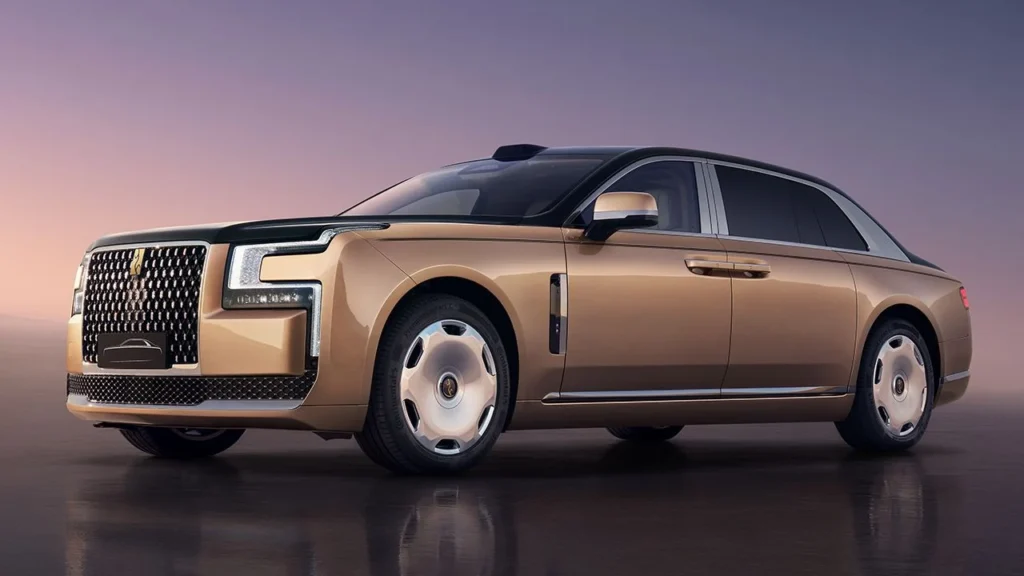
Founded in November 2022, Yangwang was established as BYD’s flagship luxury marque.
While BYD has become internationally recognized for electric vehicles and advanced battery technology, Yangwang operates in a substantially more exclusive segment.
Its portfolio already includes the U8 luxury off-road SUV, the U7 executive sedan and the U9 electric supercar.
These vehicles have demonstrated the company’s engineering capabilities through innovations ranging from individually controlled electric motors to advanced body-control systems.
However, the Altior represents a different challenge.
Producing an exceptionally powerful electric vehicle is one achievement. Establishing credibility in the world of chauffeur-driven limousines, bespoke craftsmanship and high-end collector automobiles is another.
In this environment, performance figures alone are insufficient.
Customers expect exceptional refinement, meaningful personalization, distinctive materials and an experience that extends far beyond transportation.
With the Altior, Yangwang is attempting to bring these qualities together within a uniquely Chinese luxury identity.
The decision to unveil the vehicle in Abu Dhabi is also significant.
The United Arab Emirates represents an important international market for luxury automobiles, where customers are familiar with highly personalized Rolls-Royce, Bentley and Mercedes-Maybach models.
Introducing the Altior in this environment positions Yangwang as an international luxury contender rather than merely a domestic premium brand.
A 5.6-Metre Statement of Automotive Presence
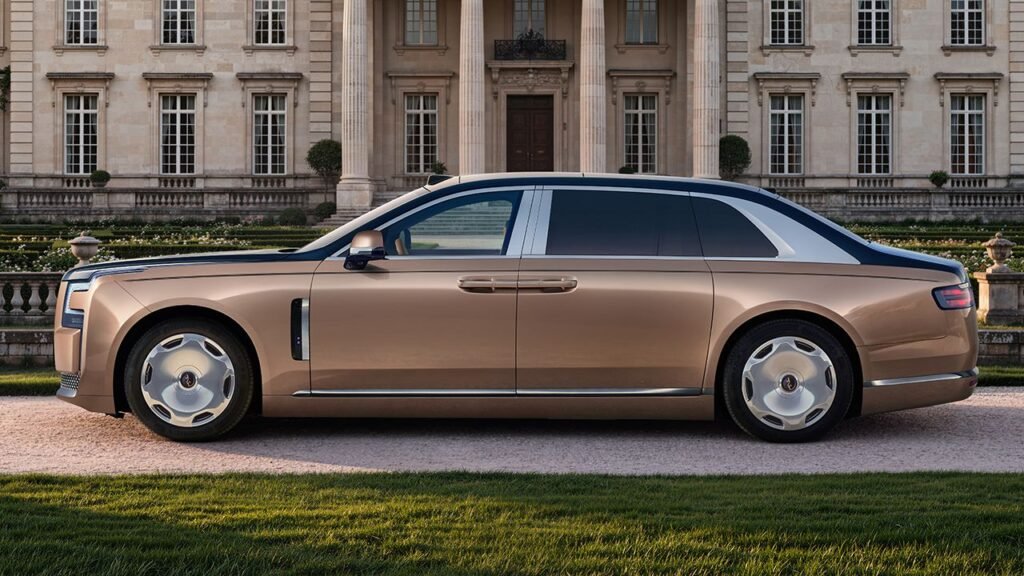
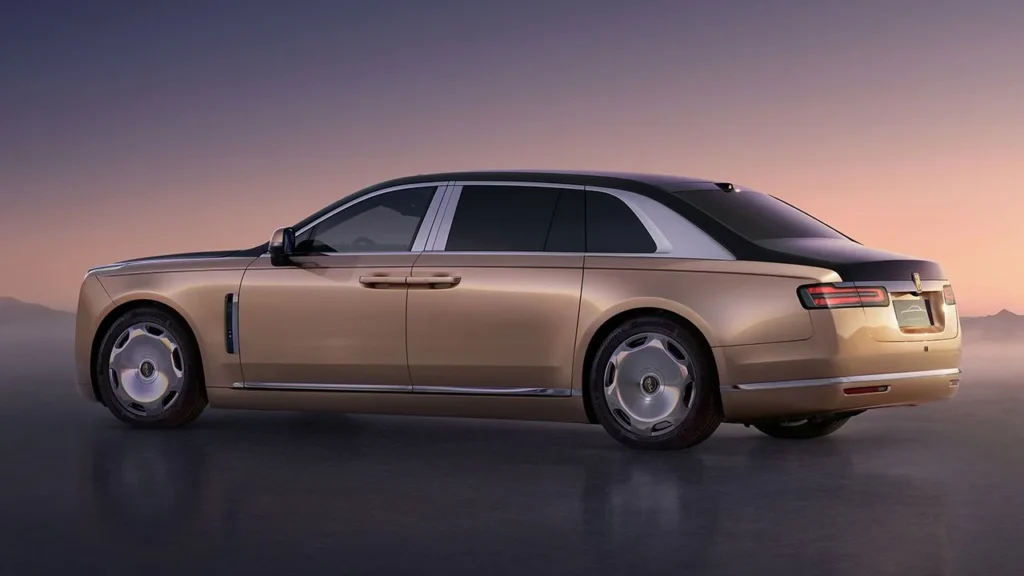
The Yangwang Altior establishes its identity through imposing proportions.
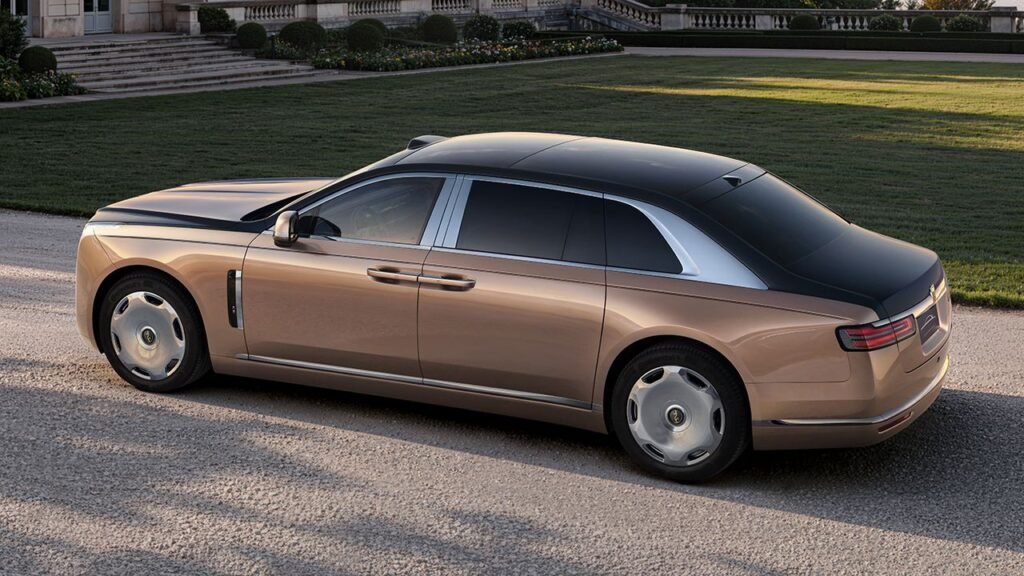
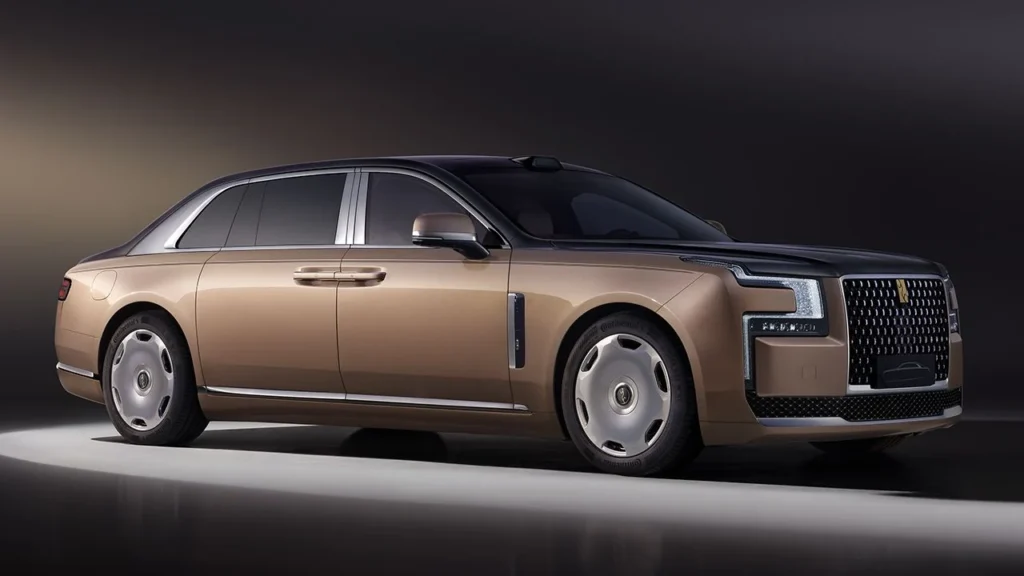
Measuring 5,600 mm long, 2,030 mm wide and 1,590 mm high, with a wheelbase of 3,500 mm, the sedan occupies the physical territory of a full-size executive limousine.
Its long wheelbase allows the passenger compartment to prioritize rear-seat space, while its substantial width contributes to a commanding road presence.
The design was developed over approximately three years and draws inspiration from the ding, an ancient Chinese ceremonial bronze vessel traditionally associated with authority, prestige and cultural significance.
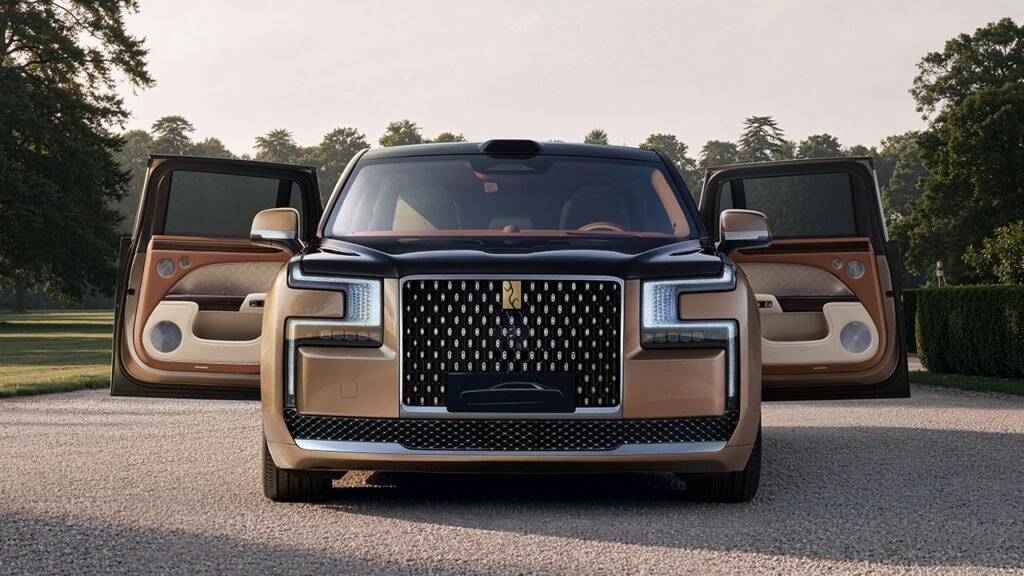
This influence is particularly visible in the nearly vertical front fascia, short front overhang and architectural appearance.
Rather than following the increasingly minimalist design language of many contemporary electric vehicles, Yangwang has chosen a more formal and expressive approach.
The front grille occupies a prominent position despite the absence of a conventional combustion engine.
It is intended not simply as an aerodynamic or functional element, but as a central expression of the vehicle’s identity.
Two carefully defined character lines extend approximately 4.8 metres along the body, emphasizing its exceptional length and providing visual continuity between the front and rear.
Three different 21-inch wheel designs are offered, including multi-spoke, polished-disc and fully enclosed interpretations.
Combined with 275/45 tyres developed with low road noise in mind, they reinforce the Altior’s positioning as an automobile designed around refinement rather than overt sporting aggression.
A Front Grille Inspired by Fine Jewellery
One of the Altior’s most distinctive design features is its elaborate front grille.
Yangwang has approached its construction with principles more commonly associated with fine jewellery than conventional automotive manufacturing.
The grille incorporates an intricate arrangement of individually finished decorative elements, creating changing reflections as light moves across the vehicle.
Reports from the launch describe a composition of 137 gemstone-cut elements, emphasizing the precision and visual complexity involved.
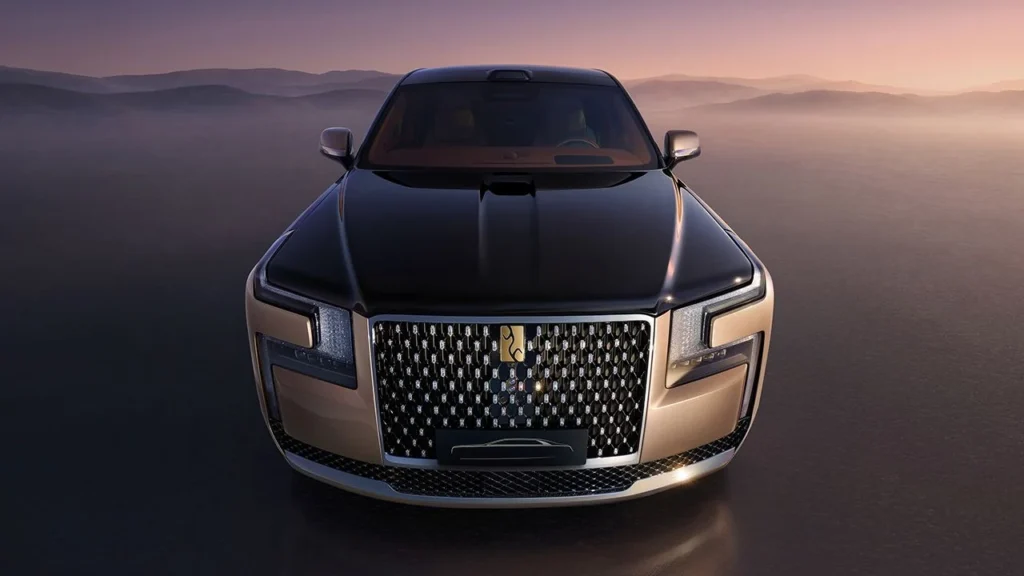
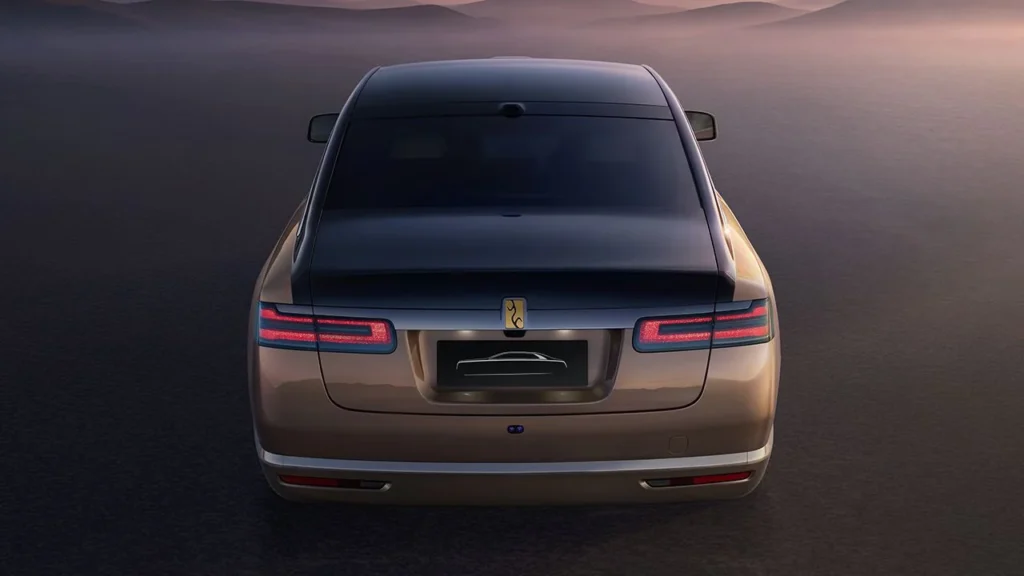
Above it sits the Yangwang emblem, whose graphic identity draws inspiration from ancient Chinese oracle-bone script.
The lighting system introduces another carefully choreographed detail.
Twelve elements rotate and illuminate sequentially as the owner approaches, creating a ceremonial welcome that transforms the act of entering the vehicle into an experience.
This emphasis on arrival is particularly relevant in the ultra-luxury segment.
For an automobile designed to be driven by a chauffeur, the exterior presentation is not simply intended to impress other road users.
It also forms part of the owner’s personal experience.
The Altior therefore treats lighting, doors and exterior detailing as components of a coordinated ritual.
Coach Doors: A Familiar Luxury Tradition With a Chinese Identity
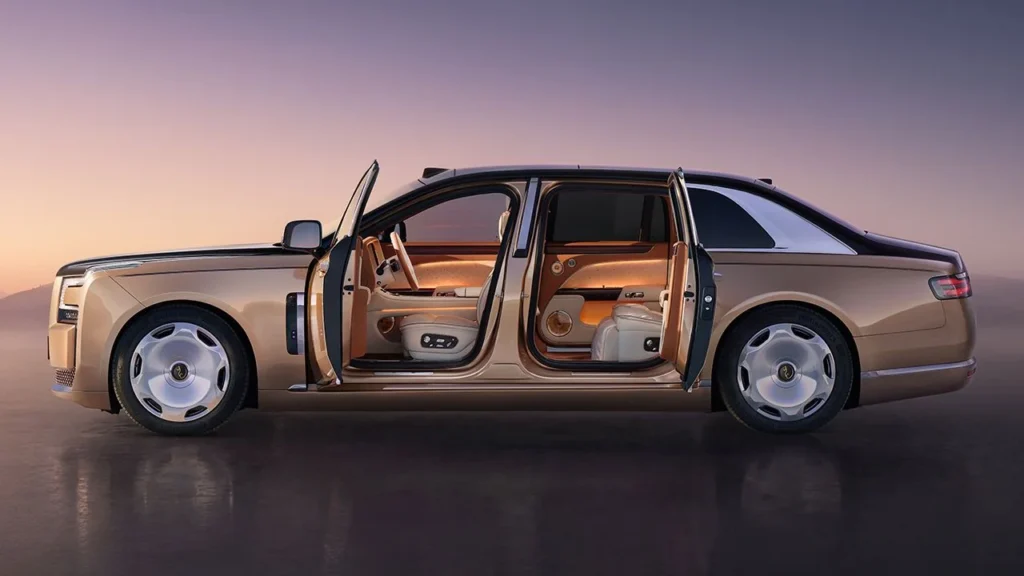
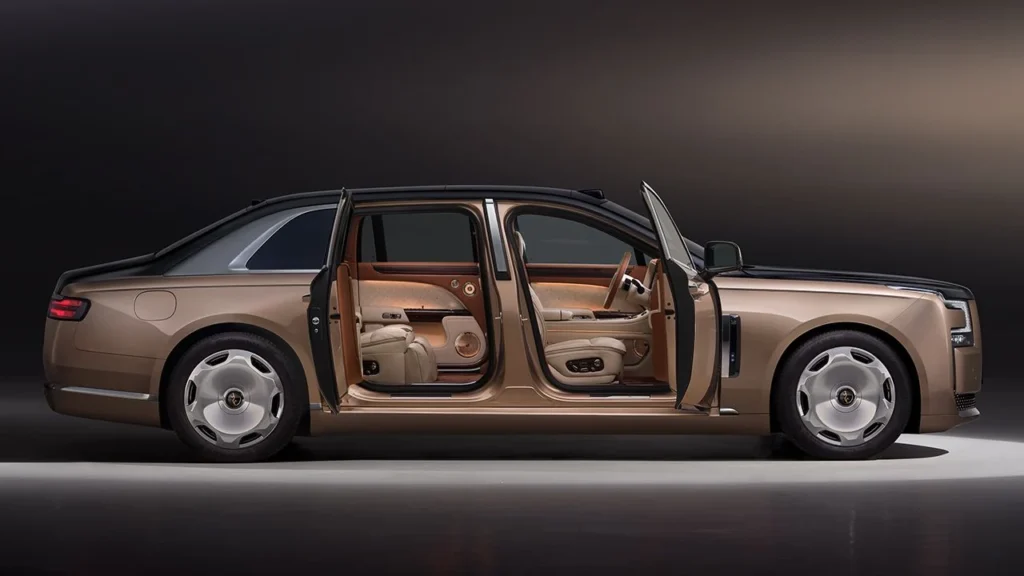
The Altior features one of the most recognizable architectural details associated with ultra-luxury automobiles: rear-hinged coach doors.
The front doors open to an angle of up to 80 degrees, while the rear doors can open to approximately 90 degrees.
This arrangement provides exceptionally generous access to the passenger compartment.
It also gives the sedan a sense of ceremony closely associated with automobiles such as the Rolls-Royce Ghost and Phantom.
However, Yangwang has added distinctive cultural references.
Custom umbrellas are integrated into the doors, drawing design inspiration from the Hall of Prayer for Good Harvests at Beijing’s Temple of Heaven.
The feature combines practical convenience with a reference to traditional Chinese architecture.
It is a relatively small detail, but one that demonstrates the broader philosophy behind the Altior.
Rather than relying exclusively on expensive materials to communicate luxury, Yangwang is attempting to incorporate cultural meaning into the vehicle’s everyday interactions.
An Interior Conceived as a Private Luxury Residence
The true character of the Yangwang Altior becomes apparent inside.
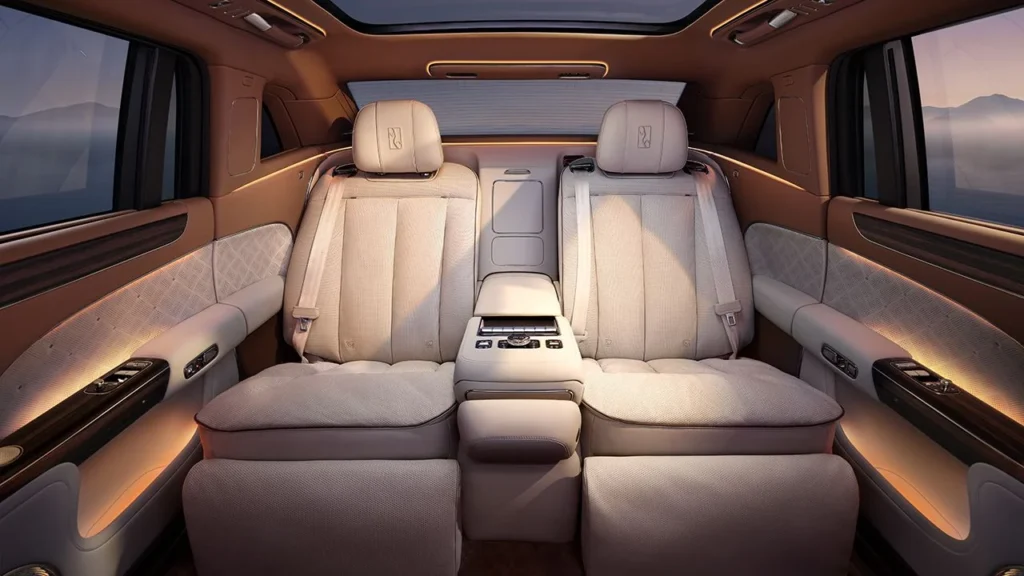
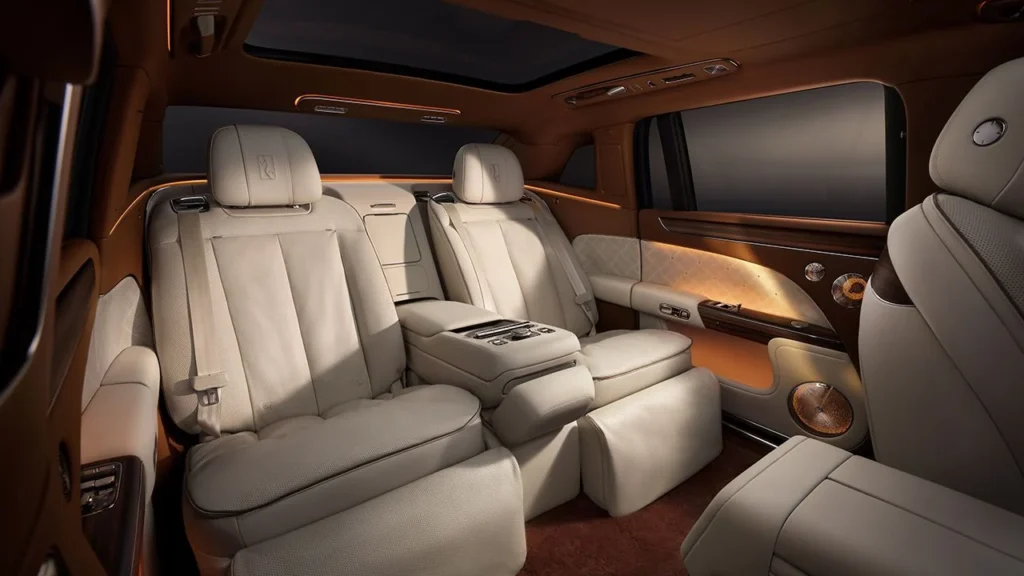
The four-seat configuration transforms the passenger compartment into a private executive environment, with two individual rear seats separated by an elaborate central console.
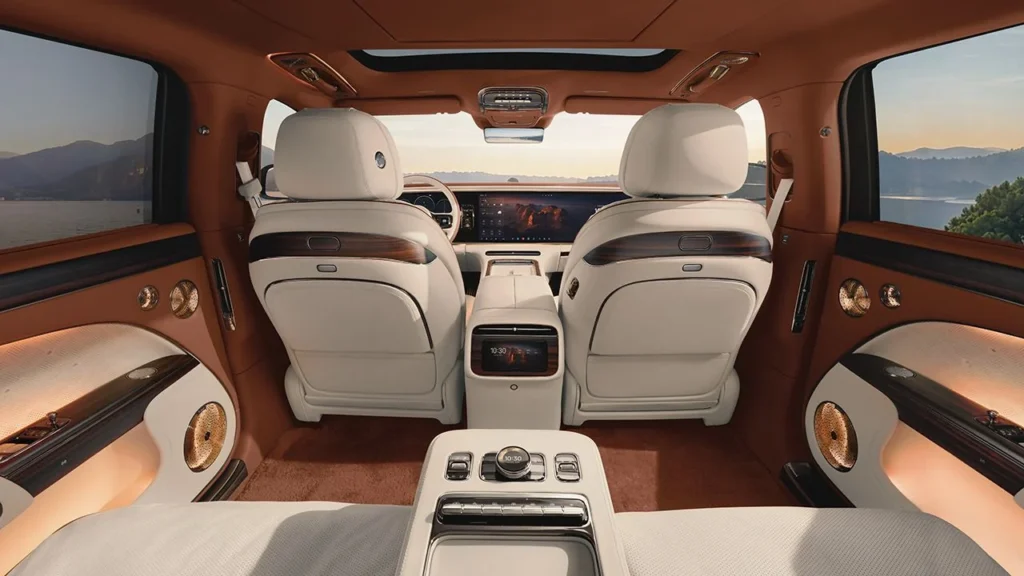
The interior architecture emphasizes symmetry, drawing inspiration from traditional Chinese spatial design.
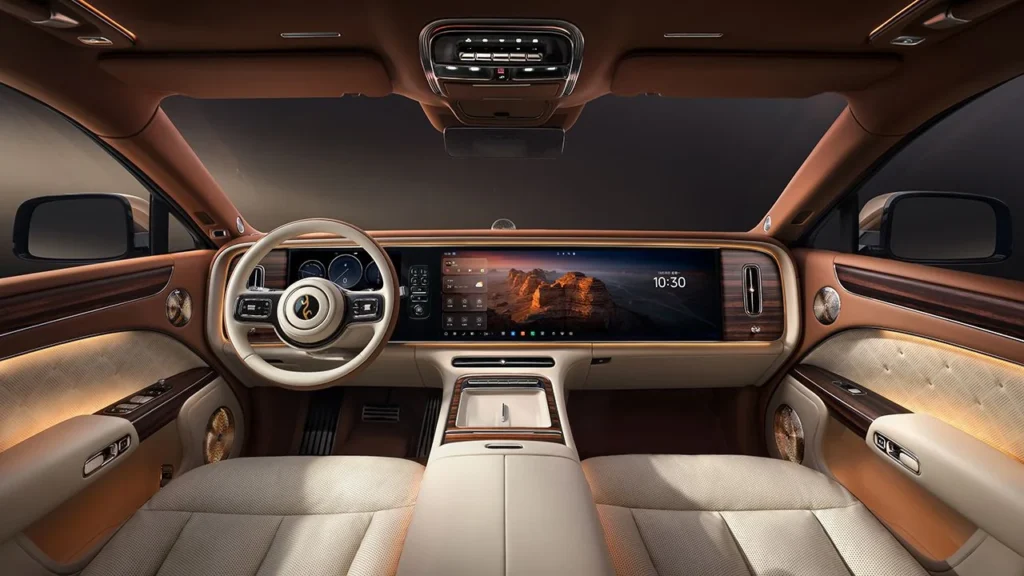
A central visual axis extends from the front display toward the rear executive console, creating a carefully balanced composition.
The rear seats are particularly sophisticated.
Both feature a zero-gravity-inspired reclining configuration, integrated leg rests and mechanical massage systems using four spherical massage heads.
Yangwang reports 1,209 mm of rear legroom and 354 mm of knee clearance.
The front passenger seat can also fold forward at the touch of a button, opening the view ahead for the rear executive passenger.
These features are intended to create a space suitable for professional travel, relaxation and long-distance journeys.
A relaxation mode coordinates several cabin functions simultaneously.
The seats recline, leg rests extend, privacy shades close and ambient lighting becomes softer, while the climate and massage functions contribute to a more restful environment.
This is luxury defined not simply by the presence of equipment, but by the way multiple systems work together to create a particular experience.
Rolls-Royce Ghost Savile Row: Where Bespoke Tailoring Meets Automotive Craftsmanship
Jade, Silk Embroidery and the Return of Cultural Craftsmanship
The Altior’s approach to materials is among its most interesting characteristics.
Traditional Chinese craftsmanship plays a central role in the cabin.
Yellow Hetian jade appears within the air-vent detailing, where each element is polished to emphasize the material’s distinctive texture and appearance.
The upholstery incorporates Suzhou embroidery, a traditional Chinese textile art known for its intricate workmanship.
Delicate cloud-inspired patterns are combined with precisely executed perforations, introducing visual references to traditional decorative motifs.
Semi-aniline full-grain leather, natural wood and pure wool carpeting complete the material palette.
The use of these materials represents an important departure from the conventional language of many modern luxury vehicles.
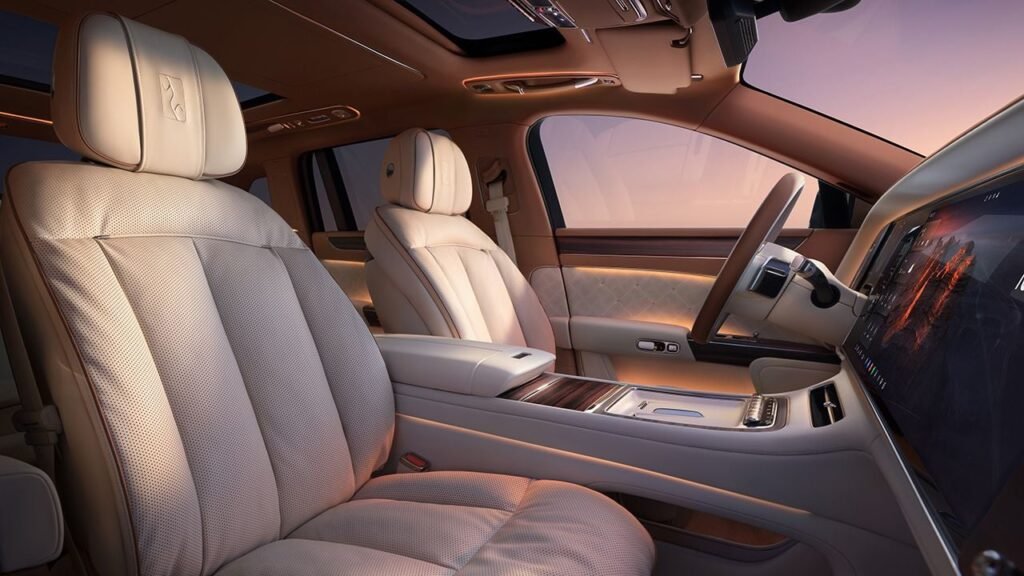
While European manufacturers frequently emphasize leather, polished metal and rare wood veneers, Yangwang introduces materials and decorative traditions with a specifically Chinese cultural identity.
Even the controls receive unusually detailed attention.
The interior includes 48 decorative components distributed across 11 locations, incorporating jewel-inspired forms and carefully engineered optical finishes.
The intention is to make the cabin feel like a collection of individually considered objects rather than an assembly of conventional automotive components.
Whether this approach ultimately achieves the same perceived refinement as long-established luxury marques will depend on the quality of the finished production vehicles.
Nevertheless, the ambition is unmistakable.
A 39-Speaker Dynaudio System and a 21.4-Inch Private Cinema
Technology forms another central element of the Altior’s appeal.
The sedan incorporates a 39-speaker Dynaudio Platinum Evidence audio system, developed to provide an exceptionally immersive listening environment.
The tweeters perform a distinctive movement sequence when the vehicle is activated, rising and rotating as part of the welcome experience.
Rear passengers also benefit from a motorized 21.4-inch ceiling-mounted display.
Designed for entertainment, screen sharing and videoconferencing, the system reflects the increasingly multifunctional nature of contemporary executive vehicles.
An elaborate rear centre console incorporates controls and storage areas intended to support both business and leisure.
Two integrated refrigerators add another level of convenience.
The rear unit provides 5.5 litres of capacity and includes independent cooling and heating functions.
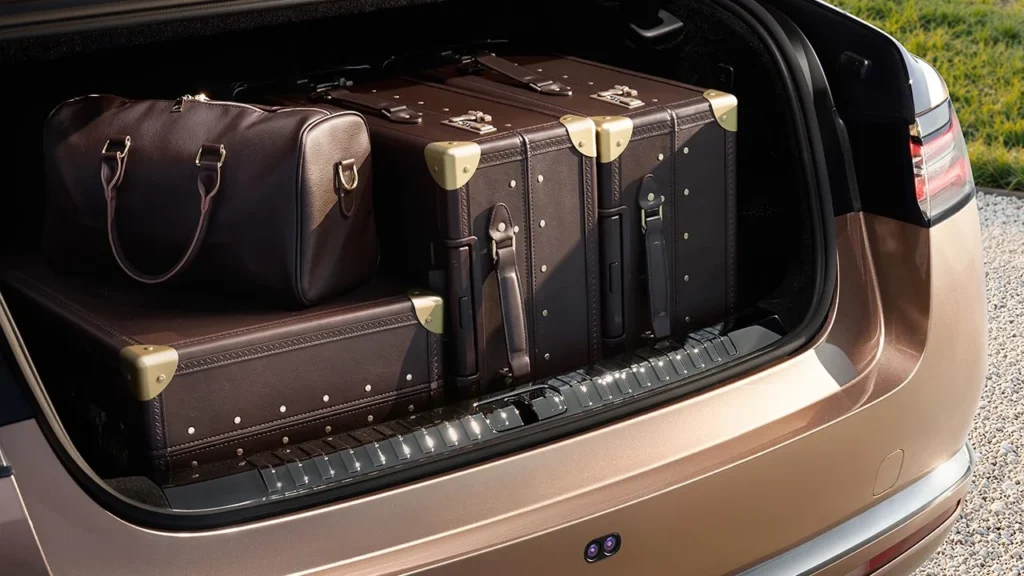
A 532-litre luggage compartment ensures that the vehicle retains practical capacity for longer journeys.
Taken together, these features reinforce the idea that the Altior is conceived primarily around the passenger experience.
Its most important competition may therefore be determined less by acceleration figures than by the quality of time spent inside.
Four Electric Motors and the e⁴ Intelligent Platform
Beneath the Altior’s traditional luxury appearance lies some of BYD’s most sophisticated engineering.
The vehicle uses Yangwang’s e⁴ platform, incorporating four independently controlled electric motors.
This architecture allows the system to adjust the torque delivered to each wheel individually.
According to Yangwang, torque distribution can be modified more than 100 times per second, helping the vehicle respond to changing road conditions.
The technology provides advantages extending beyond conventional traction management.
It supports specialized manoeuvring capabilities, including turning substantially on the spot through differential wheel rotation.
For an automobile measuring 5.6 metres in length, such functionality could prove especially useful in confined spaces.
The system is also designed to assist vehicle stability in demanding situations, including certain high-speed tyre-failure scenarios.
Another unusual capability is an emergency flotation function, intended to provide additional assistance if the automobile accidentally enters deep water.
These technologies demonstrate an interesting difference between Yangwang and many traditional luxury manufacturers.
Rather than relying primarily on established mechanical engineering traditions, the company is attempting to use sophisticated electronic control systems as an integral part of the luxury experience.
DiSus Suspension: Technology in the Service of Comfort
The Altior also introduces a new generation of Yangwang’s fully active DiSus body-control technology.
Working alongside the e⁴ platform, the system manages vehicle movement across six degrees of freedom.
It can anticipate changes in the road surface and adjust suspension behaviour in real time.
The objective is to reduce unwanted body movements, improve stability during cornering and minimize disturbances reaching passengers.
For an executive limousine, these characteristics may prove more relevant than outright performance.
A genuinely exceptional luxury automobile must preserve its composure over imperfect roads, during urban journeys and at motorway speeds.
Yangwang is therefore using technology not simply to deliver more power, but to refine the physical experience of travelling.
The ultimate effectiveness of these systems will require independent road testing.
However, the engineering philosophy is clear: the vehicle’s considerable technological complexity is intended to remain largely invisible to its occupants.
The New Bentley Flying Spur: When a Luxury Sedan Thinks It’s a Supercar
More Than 1,000 Kilometres of Claimed Electric Range
The Yangwang Altior incorporates BYD’s second-generation Blade Battery technology.
According to the manufacturer, the vehicle offers more than 1,000 kilometres of electric range under China’s CLTC testing cycle.
This is an ambitious figure for an automobile of its dimensions and luxury equipment level.
However, it is important to distinguish the Chinese CLTC test cycle from the European WLTP standard.
Actual driving range will depend on factors including vehicle speed, ambient temperature, road conditions and the use of onboard systems.
The manufacturer has not yet provided an equivalent WLTP figure.
The Altior also incorporates BYD’s FLASH Charging technology, although detailed charging specifications and charging-time figures have not yet been announced.
Likewise, official battery capacity, combined motor output, acceleration and maximum-speed figures have not been fully disclosed.
For prospective buyers, these details will be important in establishing how the Altior compares with existing ultra-luxury electric vehicles.
Nevertheless, its claimed range suggests that Yangwang intends the vehicle to offer genuine long-distance touring capability rather than functioning exclusively as an urban executive limousine.
Xuanji A3 and the Next Generation of Intelligent Luxury
The Altior is also the first Yangwang model equipped with BYD’s proprietary Xuanji A3 4-nanometre driving-assistance chip.
This advanced processor works with the company’s God’s Eye A driver-assistance system.
The technology is designed to support navigation assistance in urban environments, on motorways and during parking manoeuvres.
Its capabilities include assisted journeys between parking locations, although these functions remain dependent on operating conditions, software availability and applicable regulations.
This distinction is important.
Advanced driver assistance should not be confused with unrestricted autonomous driving.
Nevertheless, the integration of increasingly sophisticated computational systems demonstrates how Yangwang intends to differentiate itself from more traditional automotive luxury manufacturers.
For the Altior, digital intelligence is presented as another contributor to passenger comfort, convenience and confidence.
Executive, Bespoke and the Exclusive Shanhe Dingyun Edition
Yangwang plans to offer the Altior in two principal expressions: Executive and Bespoke.
The Executive version emphasizes the vehicle’s role as a premium chauffeur-driven limousine.
The Bespoke programme introduces greater opportunities for personalization, allowing customers to express their preferences through distinctive materials, finishes and design themes.
The first themed Bespoke creation is known as Shanhe Dingyun.
Inspired by Chinese landscapes and traditional artistic references, this edition combines brown and gold exterior tones with interior detailing associated with white jade and classical decorative motifs.
Its presentation reflects the broader philosophy behind the Altior: luxury should carry cultural significance as well as material value.
Unlike a conventional production specification, the Shanhe Dingyun edition will be produced in a strictly limited series.
Only 399 examples are planned worldwide, making it the first explicitly limited collector-focused interpretation of the Altior.
The edition is intended to appeal to buyers who value rarity, distinctive design and the ability to own an automobile connected to the launch of a new ultra-luxury flagship.
Yangwang Altior Price: How Much Will It Cost?
Pricing is one of the most interesting aspects of the Altior’s market positioning.
Following the Abu Dhabi debut, Yangwang opened Chinese pre-orders for the limited-edition Shanhe Dingyun specification.
Its anticipated price is approximately 2,080,000 yuan, equivalent to around $310,000 at the exchange rates reported at launch.
The amount remains indicative rather than a finalized retail price.
Chinese reservations require a deposit of 300,000 yuan.
Importantly, the expected price applies to the initial limited-edition model and should not be interpreted as the confirmed starting price of the complete Altior range.
Final pricing for other versions, international specifications and individual markets has not yet been announced.
Nor has Yangwang confirmed a comprehensive international delivery timetable.
The company has ambitions to expand its premium presence outside China, but the Altior’s eventual availability in European markets remains to be established.
For buyers accustomed to the traditional European ultra-luxury segment, the Altior’s pricing places it in an increasingly serious competitive position.
However, pricing alone will not determine its success.
At this level, brand reputation, customer service, long-term ownership experience, personalization and perceived craftsmanship are fundamental considerations.
Yangwang Altior vs Rolls-Royce Ghost and Mercedes-Maybach
Comparisons with Rolls-Royce and Mercedes-Maybach are inevitable.
The Altior shares several visual and conceptual characteristics with established executive flagships, including imposing proportions, coach doors, an elaborate rear-passenger environment and extensive attention to material detailing.
Yet the differences may be more interesting than the similarities.
Rolls-Royce derives much of its prestige from more than a century of heritage, individualized coachbuilding and an internationally recognized approach to craftsmanship.
Mercedes-Maybach combines traditional executive-limousine refinement with the engineering expertise and global support infrastructure of Mercedes-Benz.
Yangwang approaches the same market from a different direction.
Its appeal is founded on advanced electric propulsion, sophisticated body-control technology, digital intelligence and the reinterpretation of Chinese artistic traditions.
In that sense, the Altior should not be judged solely by whether it can reproduce the experience of a European luxury limousine.
The more important question is whether it can establish a distinctive experience that affluent buyers perceive as equally desirable.
That challenge will take time.
Prestige cannot be created through specifications alone.
But the Altior demonstrates that Yangwang is prepared to compete on far more than the conventional advantages of modern electric vehicles.
BMW 7 Series 2026 — Digital Luxury Redefined at the Summit of the Segment
A New Expression of Global Automotive Luxury
The arrival of the Yangwang Altior reflects a wider transformation of the international luxury automotive industry.
For decades, the highest end of the market has been dominated by European names whose reputations are rooted in heritage, craftsmanship and exclusivity.
China’s automotive industry has already demonstrated its ability to compete in electrification, battery technology and advanced vehicle electronics.
The Altior represents an attempt to translate those technical strengths into a different form of desirability.
Its success will depend on whether customers perceive the combination of cultural identity, craftsmanship and technology as a credible alternative to established luxury traditions.
The first production examples, international customer experiences and long-term ownership standards will ultimately provide that answer.
For now, however, the Altior deserves attention.
It is not an inexpensive imitation of an established European flagship, nor simply an oversized electric sedan distinguished by an extensive equipment list.
It is a carefully positioned attempt to redefine what a Chinese ultra-luxury automobile can represent.
The Yangwang Altior may not yet possess the heritage of Rolls-Royce or the established prestige of Mercedes-Maybach. But it introduces something equally important to the evolution of luxury: a new cultural perspective, supported by serious technological ambition.
And in an industry where true differentiation is increasingly difficult to achieve, that ambition alone makes the Altior one of the most intriguing luxury-car introductions of 2026.