
There are many ways to personalise a Ferrari.
And then there is Special Projects.
At the highest level of Maranello’s bespoke universe, selecting a unique colour, unusual leather or exclusive trim is no longer enough. Here, Ferrari works directly with a select client to create something that exists nowhere else.
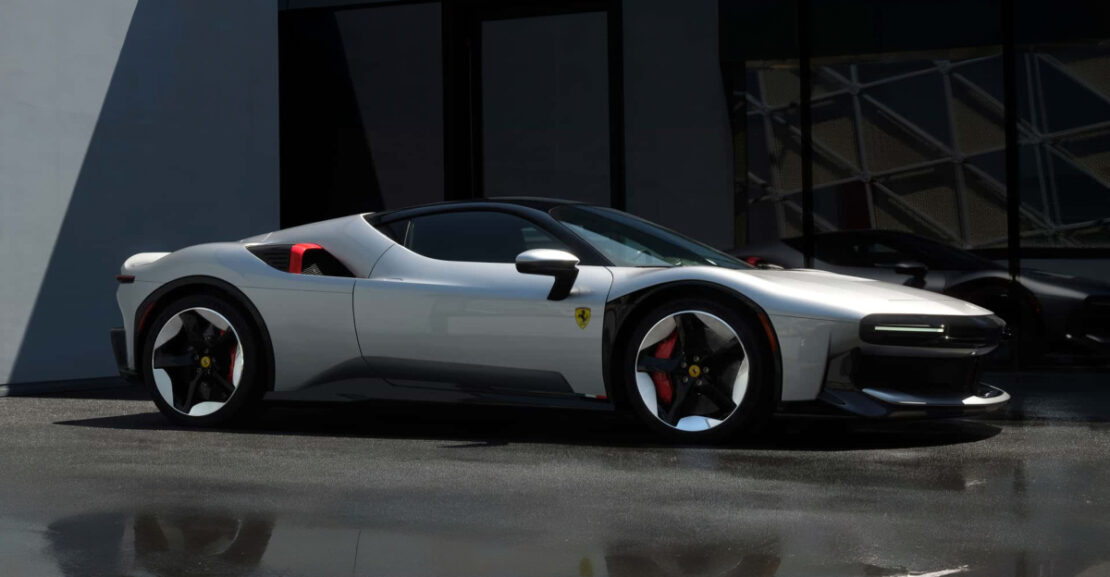
The Ferrari CZ26 is the latest expression of that philosophy.
Created for a client in the United States and developed over approximately two years, the CZ26 begins with the extraordinary architecture of the SF90 Stradale but transforms its visual identity almost completely.
The familiar 1,000 cv plug-in hybrid powertrain remains beneath the surface.
Almost everything surrounding it has changed.
Unveiled during 2026 Monterey Car Week and making its public debut at Pebble Beach, the CZ26 becomes a fascinating demonstration of what happens when Ferrari treats an existing supercar not as a finished product, but as the mechanical foundation for an entirely new design.
One client.
One car.
One Ferrari that will never be repeated.
Ferrari Special Projects
The CZ26 has been created through Ferrari’s Special Projects programme, one of the most exclusive services available to the company’s clients.
The philosophy goes considerably beyond conventional personalisation.
Ferrari’s Tailor Made programme allows customers to explore extraordinary combinations of colours, materials and finishes while retaining the fundamental design of an existing model.
Special Projects operates at another level.
Here, the objective is to create an entirely individual automobile.
The client works closely with Ferrari’s designers and engineers over an extended development process, creating a car around an existing Ferrari architecture but with a unique visual identity.
The CZ26 required approximately two years of development.
The result is not an SF90 with different panels.
It is a new interpretation of what an extreme mid-engined Ferrari berlinetta can look like.
The SF90 Stradale Beneath the Surface
Underneath its bespoke bodywork lies one of the most technically important Ferraris of the modern era.
The SF90 Stradale represented a fundamental moment for Maranello when it appeared in 2019.
It was Ferrari’s first series-production plug-in hybrid and combined a twin-turbocharged V8 with three electric motors to create an extraordinary four-wheel-drive powertrain.
Total output reached 1,000 cv.
Two electric motors power the front axle independently, while a third electric motor sits between the V8 and eight-speed dual-clutch transmission.
The result transformed what could be expected from a production Ferrari.
Electrification was no longer simply an efficiency technology.
It became another instrument for performance.
For the CZ26, Ferrari saw no reason to fundamentally change that extraordinary mechanical foundation.
Instead, the transformation occurs around it.
A Completely Different Ferrari
Place an SF90 Stradale beside the CZ26 and the relationship is far from obvious.
That is intentional.
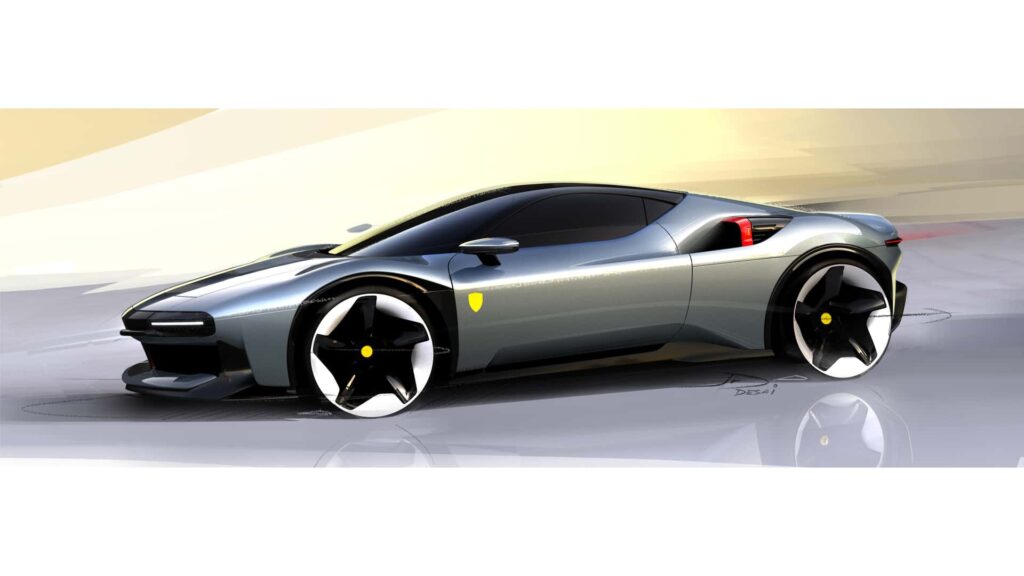
Ferrari describes the project as a complete reinterpretation of the SF90 Stradale, giving its high-performance berlinetta architecture an entirely new visual identity.
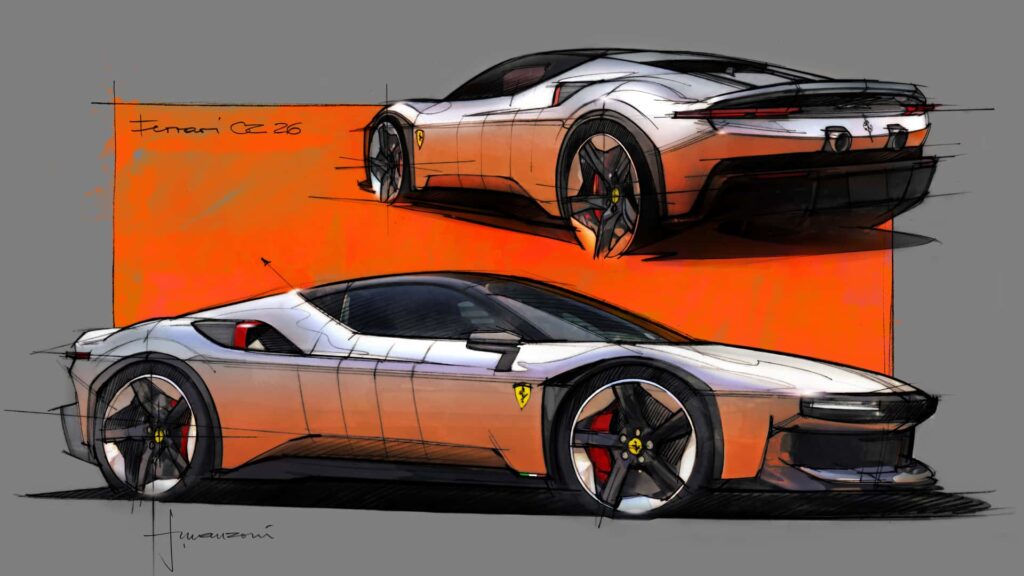
The fundamental philosophy is built around horizontal design.
Rather than using a collection of individual sculptural elements competing for attention, the CZ26 emphasises lines extending across the width of the automobile.
This gives the car an unusual visual character.
Wide.
Low.
Technical.
And remarkably clean.
The proportions still communicate mid-engined performance, but the way those proportions are expressed feels substantially different from the SF90.
A New Two-Box Silhouette
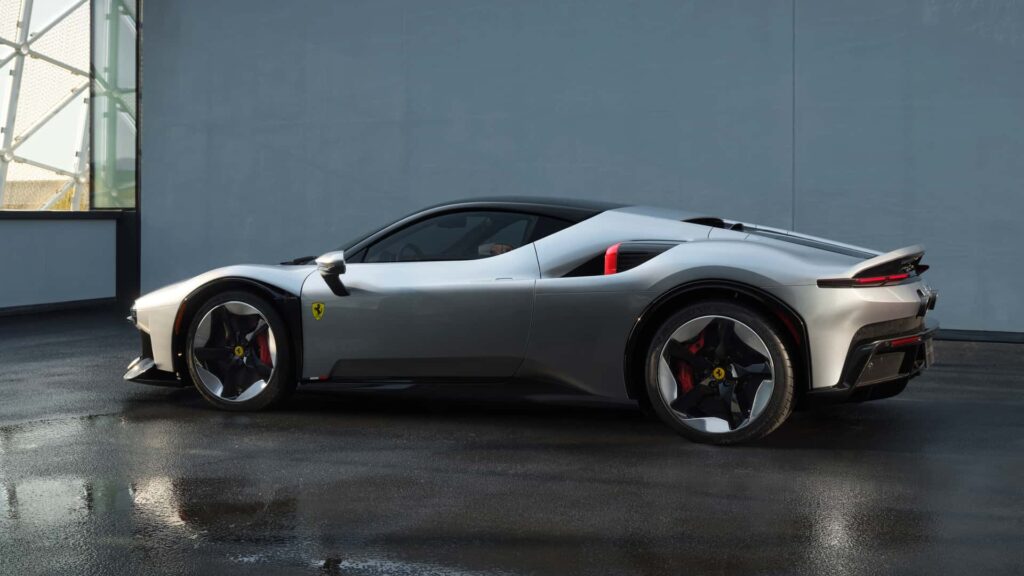
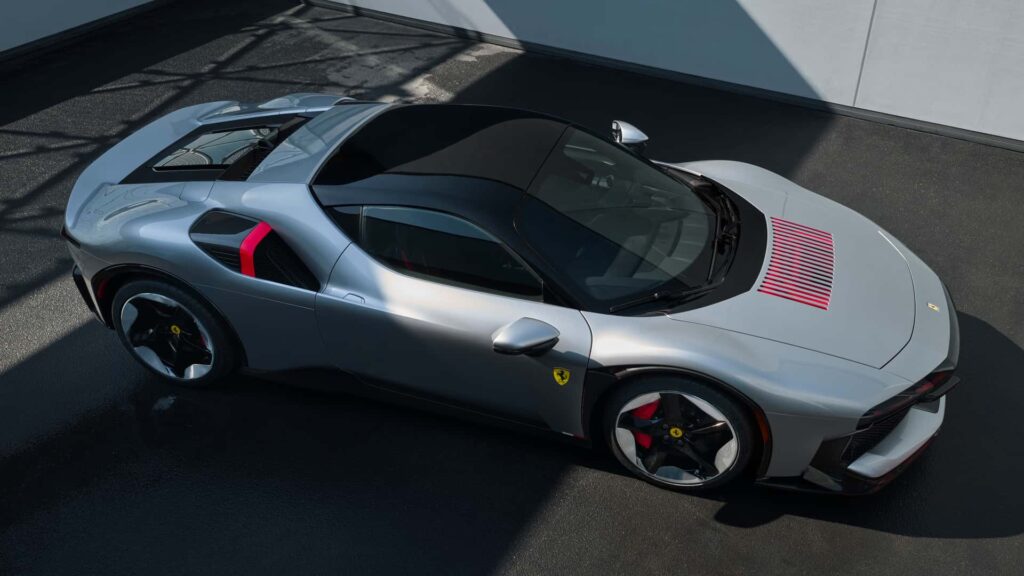
One of the most important changes is the CZ26’s distinctive two-box architecture.
The cabin and body volumes have been visually reorganised to create a stronger separation between the two, producing proportions that feel simultaneously futuristic and connected to traditional berlinetta design.
The rear section appears particularly long and horizontal.
Rather than concentrating visual mass around the engine compartment, the body seems to stretch backwards towards a sharply defined tail.
This gives the CZ26 an unusual sense of speed even when stationary.
It also demonstrates how significantly Ferrari can alter the perceived proportions of an automobile without fundamentally changing its underlying architecture.
A Front End Defined by Width
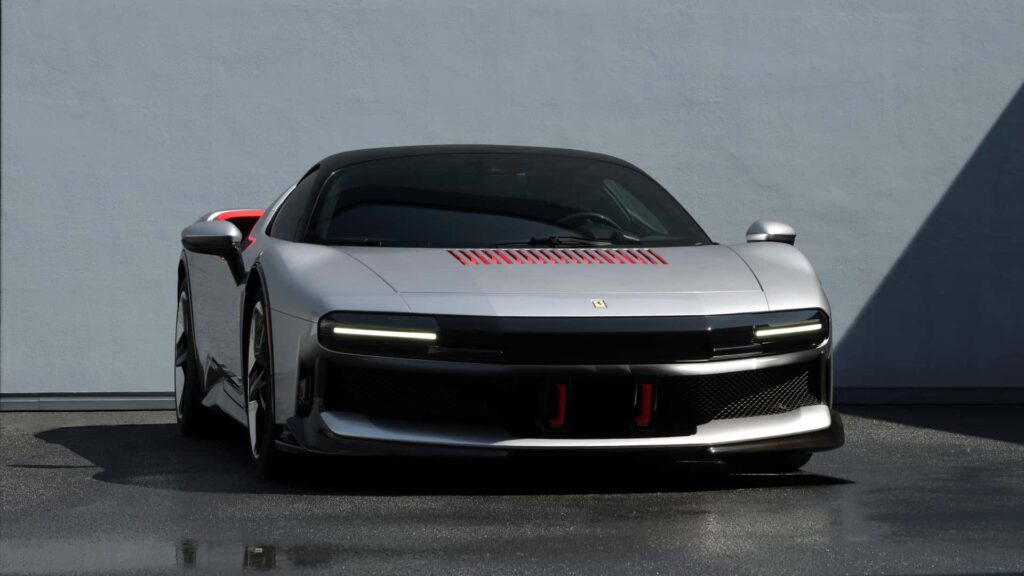
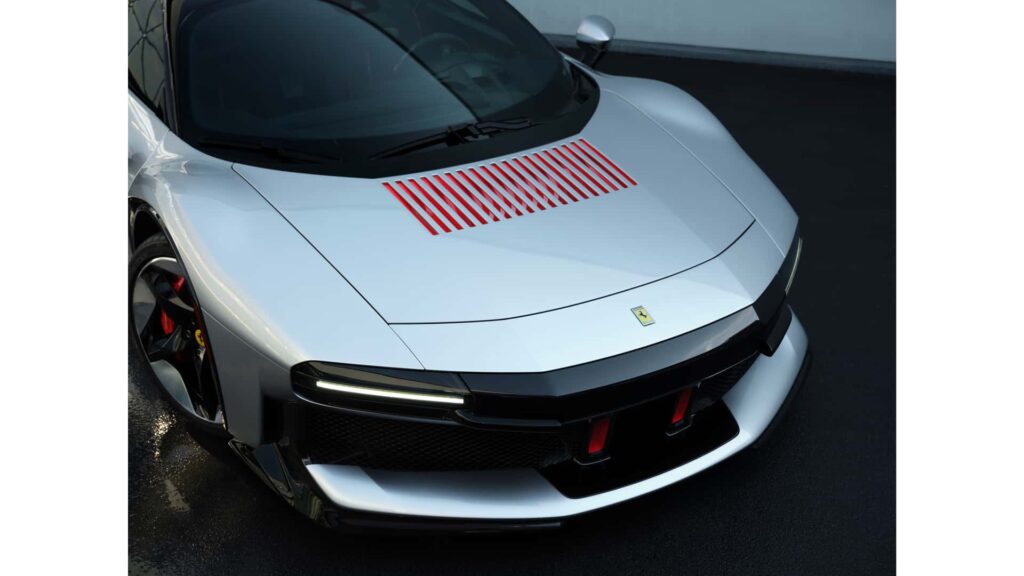
The nose introduces one of the CZ26’s strongest visual signatures.
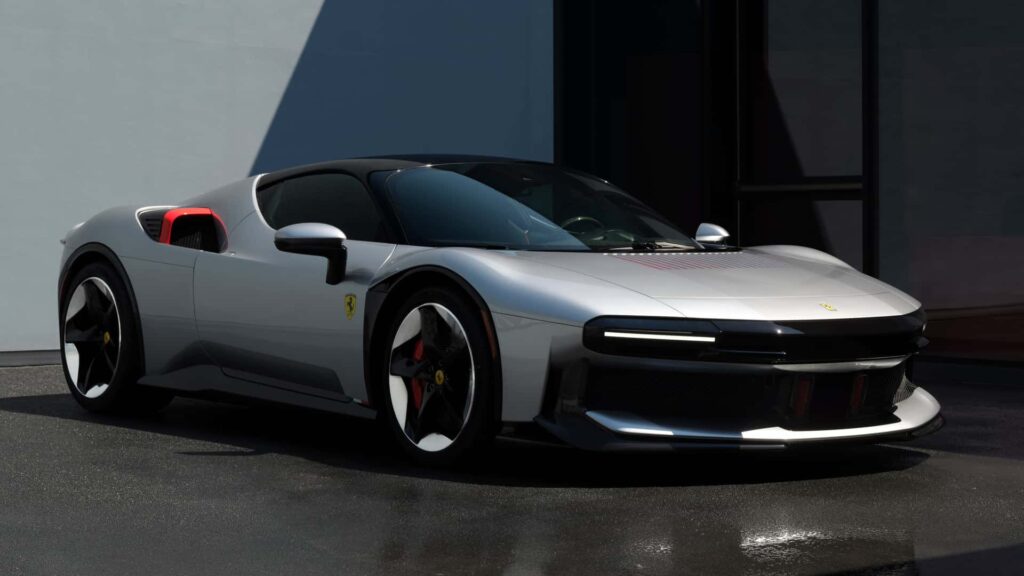
A wide horizontal graphic extends across almost the entire front of the car, incorporating exceptionally slim lighting elements into the composition.
The effect is dramatically different from the SF90.
Rather than visually separating the headlights from the aerodynamic openings, Ferrari integrates lighting, cooling and body graphics into a continuous horizontal structure.
Large aerodynamic channels below manage airflow around the nose and towards the sides.
The CZ26 therefore appears wider than its mechanical foundation suggests.
That visual width becomes one of the defining themes of the entire automobile.
Lighting Becomes Architecture
Modern Ferrari design increasingly treats lighting as part of the architecture rather than as an isolated component.
The CZ26 takes that philosophy particularly far.
At the front, the exceptionally thin lighting signatures almost disappear into the horizontal graphic when viewed from certain angles.
At the rear, the approach becomes even more distinctive.
Rather than traditional circular Ferrari taillights, the CZ26 uses slim, cantilevered lighting elements integrated into the rear architecture.
The result feels technical without becoming unnecessarily complicated.
Light becomes another surface.
Another line.
Another way of defining width.
Ferrari One-Off Masterpieces: The Art of Absolute Exclusivity
The Rear May Be Its Most Dramatic Angle
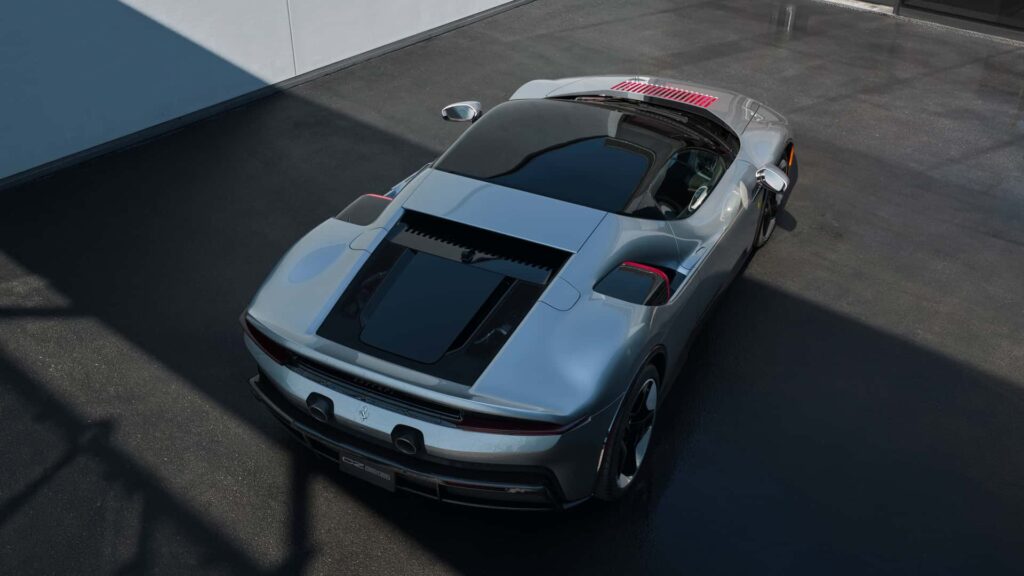
If the front establishes the CZ26’s identity, the rear completes it.
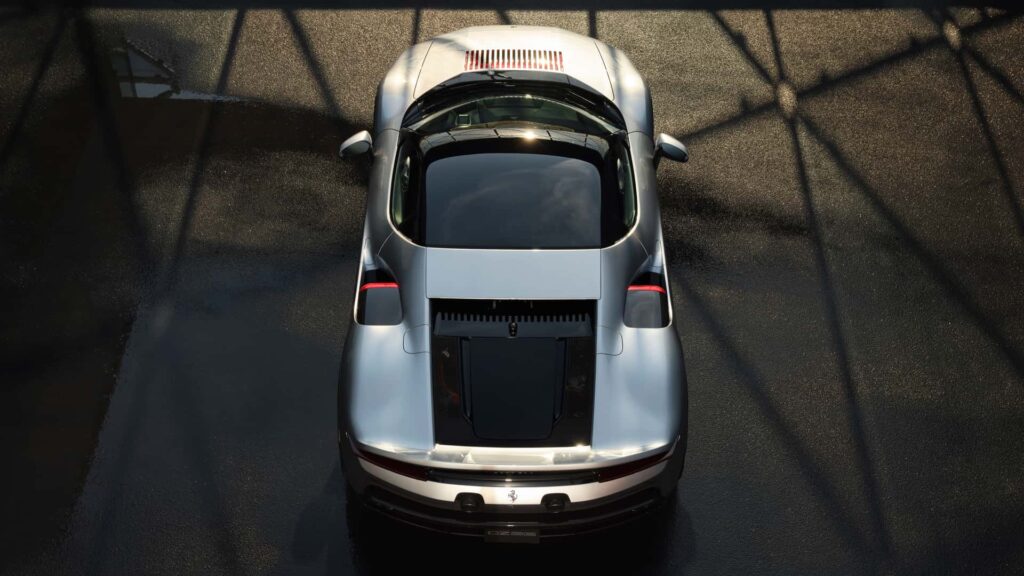
The body terminates abruptly in a truncated tail, giving the car a distinctive aerodynamic profile while visually extending the horizontal surfaces leading towards it.
An integrated spoiler forms part of the architecture rather than appearing as an additional element attached afterwards.
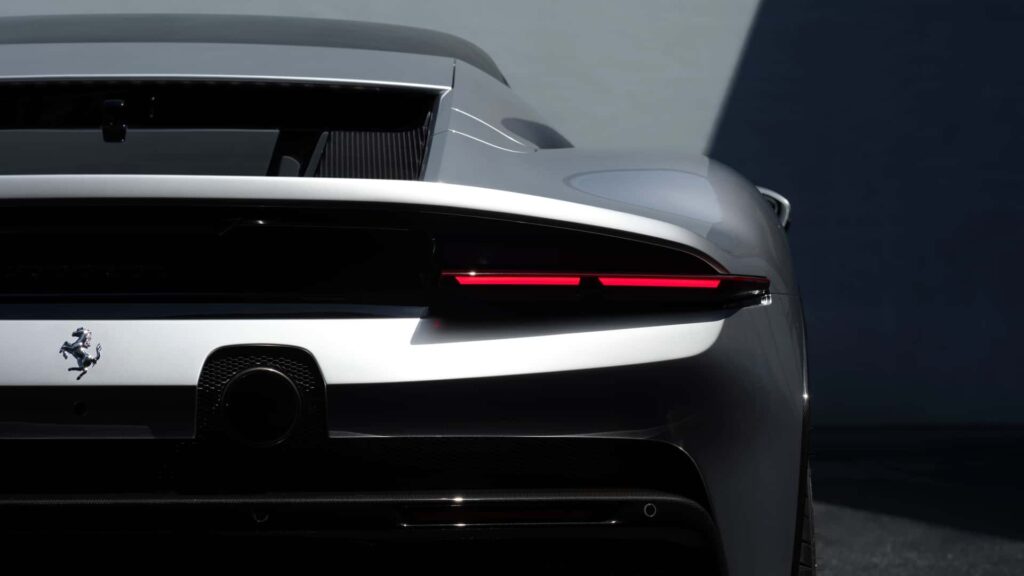
Below it sits an enormous diffuser.
Its dimensions immediately reveal that the CZ26’s redesign is not purely aesthetic.
Ferrari’s engineers had to reconsider airflow across and underneath the car to ensure that the completely new body retained the aerodynamic performance expected from its SF90 foundation.
The result is one of the most technically expressive rear treatments seen on a recent Ferrari one-off.
Aerodynamics Reconsidered
Changing almost every visible surface of a car capable of SF90 levels of performance creates a significant engineering challenge.
The original aerodynamic balance cannot simply be assumed to survive beneath different bodywork.
Ferrari therefore extensively reworked the CZ26’s aerodynamic package.
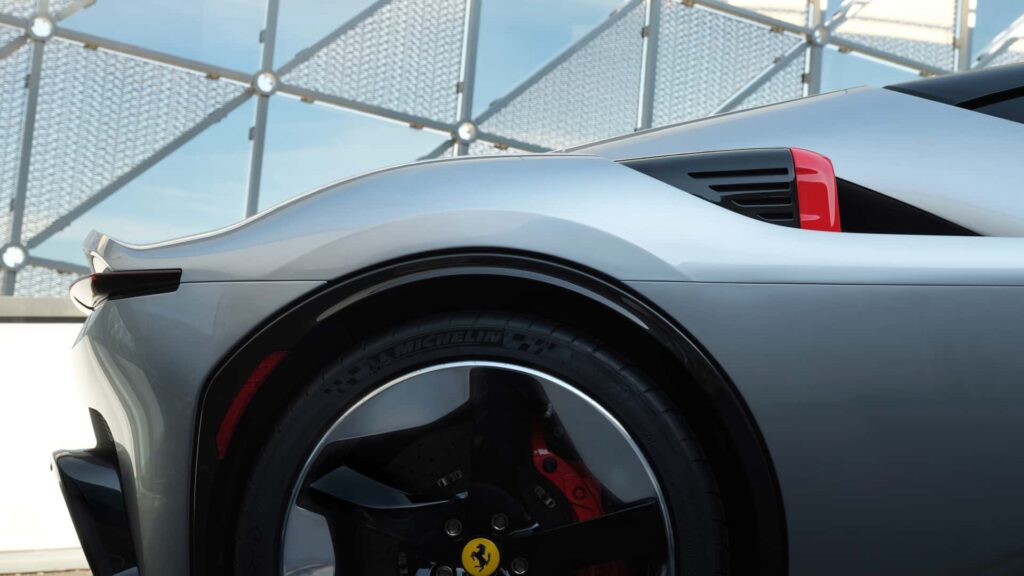
The underbody has been redesigned.
New vortex generators manipulate airflow beneath the car.
Air curtains manage turbulence around the wheels.
The rear diffuser has been extensively developed.
Cooling airflow has also been reconsidered to accommodate the requirements of both the combustion engine and hybrid system.
The objective was not merely to reproduce the SF90’s aerodynamic behaviour beneath a different shape.
The new surfaces became an opportunity to develop their own aerodynamic solution.
Argento Veloce
The launch specification plays an important role in revealing those surfaces.
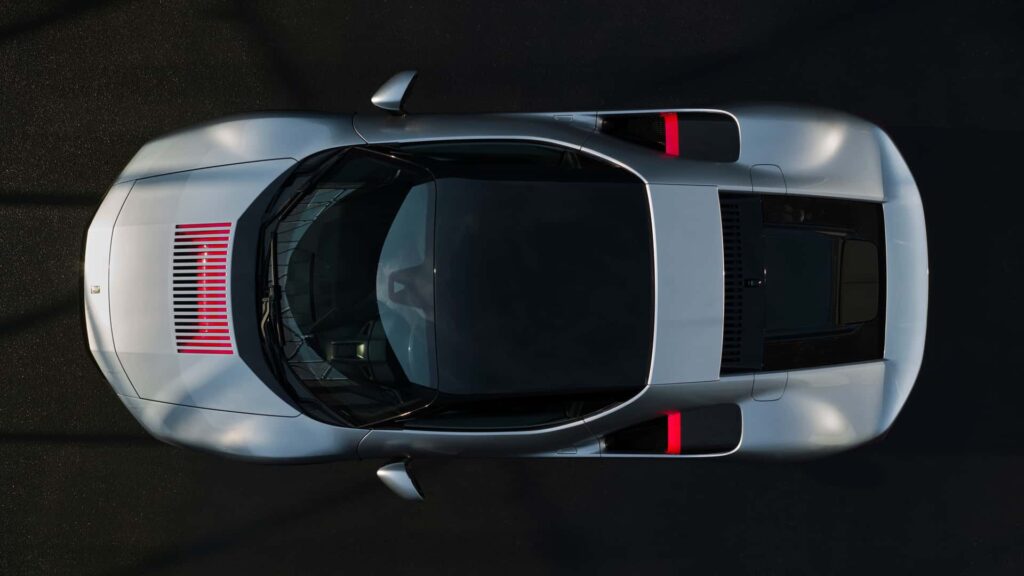
The CZ26 is finished in Argento Veloce, an elegant silver developed to emphasise the complex relationship between its volumes.
Silver is particularly unforgiving.
It exposes every transition.
Every highlight.
Every change in curvature.
Here, that characteristic becomes an advantage.
Light moves cleanly across the CZ26’s body, revealing the horizontal architecture and making even subtle changes in surface tension visible.
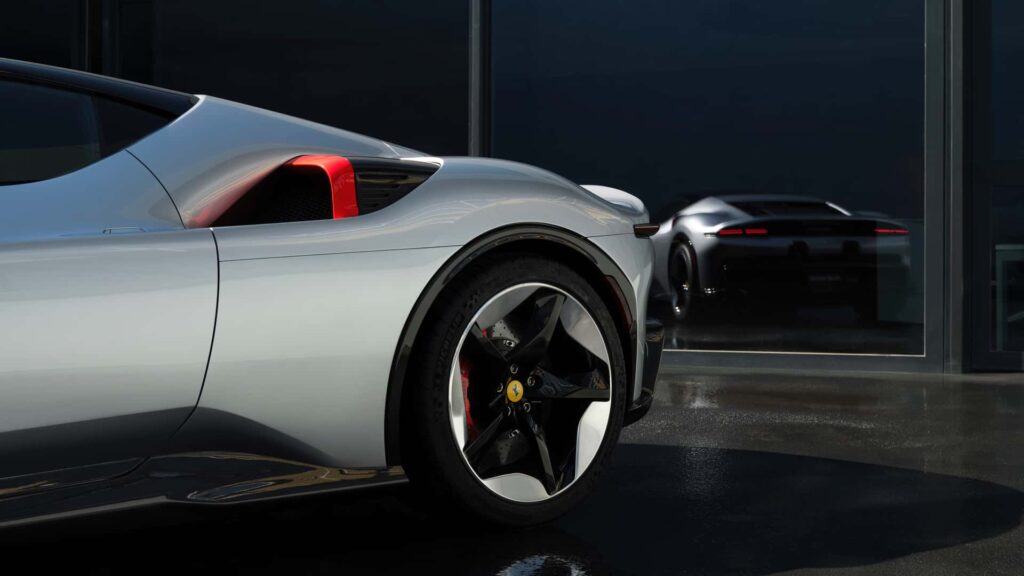
The restrained main colour is then interrupted by carefully positioned red accents.
The contrast feels unmistakably Ferrari without overwhelming the design.
Red Carbon Fibre
Some of the most interesting details appear only on closer inspection.
Ferrari has incorporated red-tinted carbon fibre into selected exterior components.
Rather than simply painting carbon components red, the material itself becomes part of the colour story.
The effect changes according to lighting conditions.
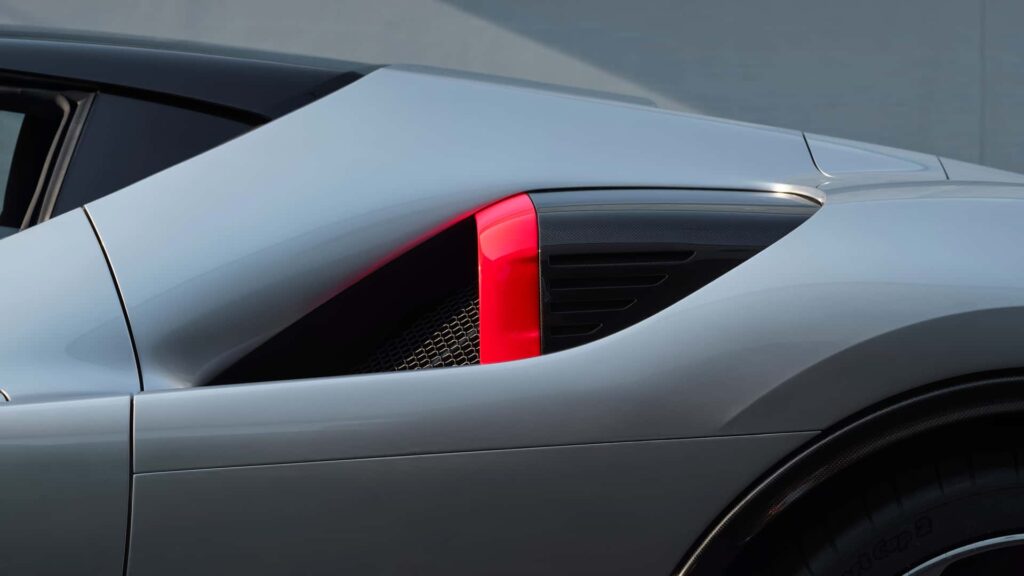
From a distance, the elements appear as deep red accents.
Closer inspection reveals the familiar technical weave beneath the colour.
It is precisely the kind of detail that makes sense on a one-off Ferrari.
Not something designed for mass production.
Something designed for one person.
The Cabin Continues the Experiment
The interior follows the same philosophy.
Rather than filling the cabin with traditional luxury materials, Ferrari has pursued a distinctly technical atmosphere.
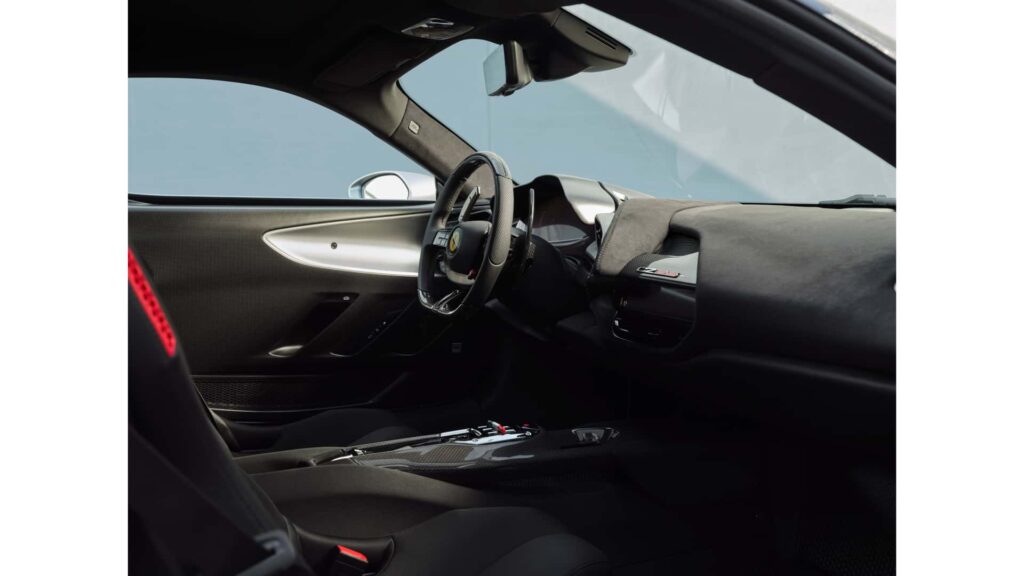
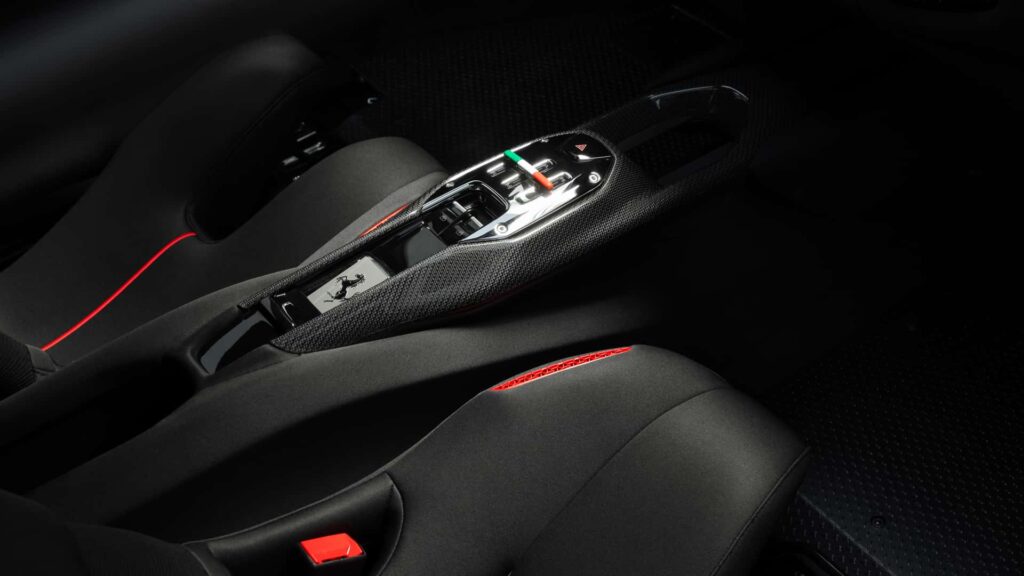
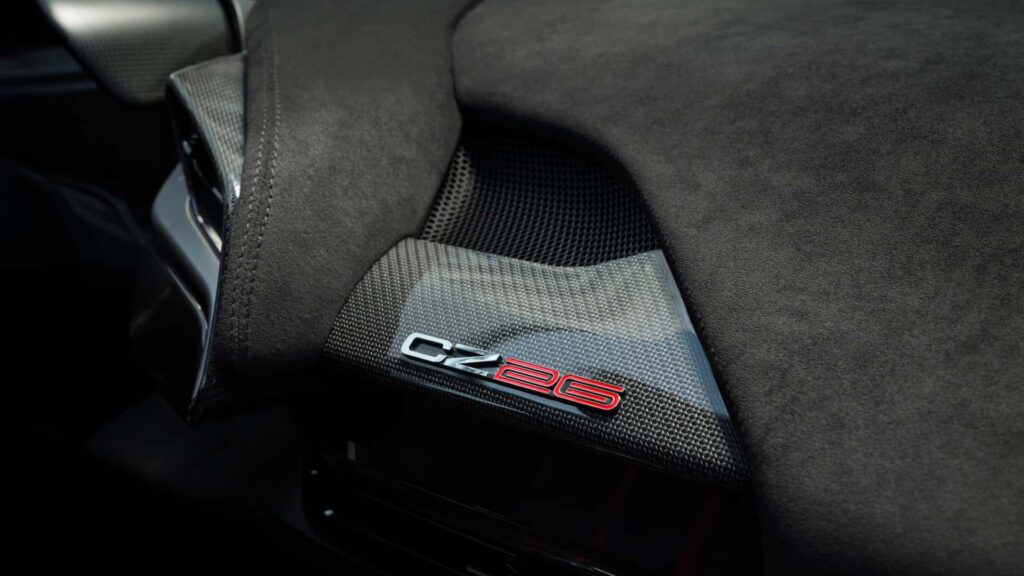
A specially developed black technical fabric covers important areas of the interior.
Carbon fibre remains exposed.
Red details establish continuity with the exterior.
Body-coloured elements bring Argento Veloce inside the cockpit.
The CZ26 logo appears discreetly throughout the cabin, reinforcing the fact that this is not simply another specification of an existing model.
It has its own identity.
Its own name.
Its own materials.
3D-Printed Seat Inserts
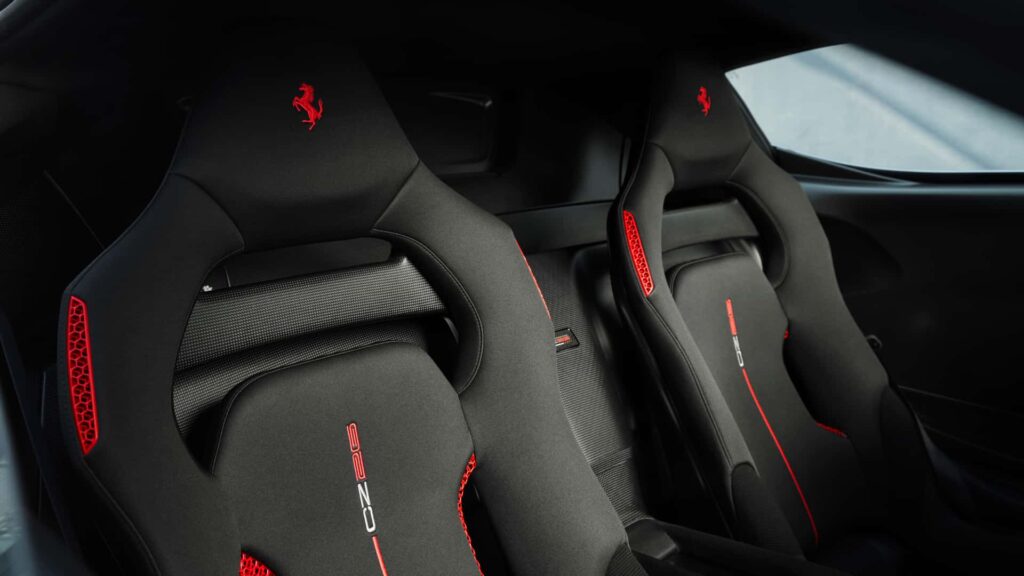
One of the cabin’s most unusual features can be found within the seats.
Ferrari has created bespoke inserts using additive manufacturing, effectively employing advanced 3D-printing technology to produce structures that would be difficult or impossible to manufacture through conventional techniques.
This is particularly interesting because Special Projects increasingly provides Ferrari with an opportunity to experiment.
A one-off can explore materials, manufacturing methods and design solutions without the same industrial constraints associated with producing thousands of vehicles.
The CZ26 therefore becomes more than an exercise in exclusivity.
It becomes a laboratory.
Daytona Shooting Brake Hommage: Reimagining One of Ferrari’s Greatest Coachbuilt Icons
1,000 CV Remain at the Driver’s Disposal
Despite the visual transformation, the CZ26 retains the fundamental performance architecture of the SF90 Stradale.
At its centre sits Ferrari’s twin-turbocharged V8, working alongside three electric motors.
Combined output remains 1,000 cv.
Two electric motors operate at the front axle, giving the car electrically assisted all-wheel drive, while another works with the combustion engine and transmission at the rear.
An eight-speed dual-clutch gearbox manages the enormous combined output.
The SF90 architecture also allows pure-electric operation over short distances through its high-voltage battery system.
For the CZ26’s owner, therefore, the driving experience begins with one of Ferrari’s most formidable modern powertrains.
The difference is that nobody else will experience it from inside this particular Ferrari.
Why Ferrari Didn’t Need More Power
In an era increasingly obsessed with headline horsepower figures, Ferrari’s decision not to make power the central story of the CZ26 is significant.
One thousand metric horsepower is already extraordinary.
Adding another fifty or one hundred would change a statistic.
It would not necessarily make the car more special.
The CZ26 demonstrates a different interpretation of exclusivity.
Its value comes from design.
From the hundreds of decisions required to transform an existing architecture into something completely individual.
Anyone with sufficient resources can buy an extremely powerful automobile.
Only one person can own the CZ26.
Modern Coachbuilding, the Ferrari Way
The project also reconnects Ferrari with one of the great traditions of Italian automotive history.
During the middle decades of the twentieth century, extraordinary Ferrari chassis frequently received bodies created by celebrated Italian carrozzerie.
Pininfarina.
Vignale.
Touring.
Ghia.
Scaglietti.
The same mechanical foundations could result in dramatically different automobiles depending on the desires of the client and the imagination of the coachbuilder.
Modern automotive manufacturing makes that approach increasingly difficult.
Homologation.
Crash requirements.
Aerodynamics.
Thermal management.
Electronic systems.
Production complexity.
All make creating an individual body far more challenging than it was seventy years ago.
Ferrari Special Projects brings the spirit of coachbuilding into that modern engineering environment.
The coachbuilder now exists inside Maranello.
Designed Under Flavio Manzoni
The CZ26 was developed by the Ferrari Styling Centre, led by Flavio Manzoni.
That distinction is important.
The project is not an external reinterpretation of a Ferrari.
It is a Ferrari designed by Ferrari.
The same design organisation responsible for the company’s production cars has been given considerably greater freedom to explore an individual client’s vision.
That explains why the CZ26 can feel experimental while remaining unmistakably connected to contemporary Maranello design.
Its horizontal graphics, lighting architecture, clean surfaces and integration of aerodynamics.
All belong to Ferrari’s evolving visual vocabulary.
They have simply been pushed somewhere production constraints would rarely allow.
A Glimpse at Ferrari’s Changing Design Language
This may ultimately make the CZ26 interesting beyond its one fortunate owner.
Ferrari’s one-offs have occasionally provided clues about ideas later explored elsewhere.
Not because Special Projects cars are direct previews of future production models, but because they allow Ferrari’s designers to experiment with proportions, graphics and technical solutions.
The CZ26’s strong horizontal emphasis feels particularly relevant.
Recent Ferraris have increasingly moved away from isolated traditional design elements towards broader graphic structures integrated into the body.
The CZ26 takes that tendency to an extreme.
Whether any individual detail appears on another Ferrari is almost irrelevant.
The broader direction is clear.
Ferrari design is changing.
Novitec Ferrari 12Cilindri Spider: Refining Ferrari’s Open-Air V12 Masterpiece
Two Years for One Car
The CZ26 required approximately two years from the beginning of the project to completion.
For a single automobile.
That fact perhaps explains Special Projects better than any description of materials or horsepower.
Developing a completely new exterior around an existing high-performance architecture requires design studies, aerodynamic development, engineering validation, material selection, manufacturing solutions and countless conversations with the client.
And after all that work, Ferrari builds one.
There will be no CZ26 production run.
No limited series.
No second example in another colour.
The entire development process exists for a single automobile.
That is exclusivity in its purest automotive form.
Pebble Beach Is Exactly Where It Belongs
Ferrari chose Pebble Beach for the CZ26’s public debut.
It is difficult to imagine a more appropriate setting.
Every August, Monterey becomes one of the most extraordinary concentrations of automotive history and collecting culture anywhere in the world.
Unique coachbuilt Ferraris from previous generations share the Californian peninsula with contemporary hypercars and multimillion-dollar commissions.
The CZ26 sits naturally between those worlds.
Technologically, it is unmistakably modern.
Conceptually, it belongs to a tradition stretching back decades.
A wealthy client commissions a unique Ferrari.
Maranello creates a body that exists nowhere else.
And eventually that automobile becomes part of Ferrari history.
The tools have changed.
The idea has not.
Beyond the SF90 Stradale
The Ferrari CZ26 demonstrates why the most interesting bespoke automobiles are rarely those with the longest option lists.
True personalisation begins when the catalogue ends.
Its owner did not simply ask Ferrari to make an SF90 different.
The project reconsiders the automobile’s visual identity almost completely while preserving one of the most extraordinary mechanical foundations Maranello has created.
A new silhouette.
A new aerodynamic package.
A unique interior.
New materials.
Additive manufacturing.
Two years of development.
And only one finished car.
Beneath everything remains the 1,000 cv technological revolution that was the SF90 Stradale.
But the CZ26 is no longer defined by the car beneath it.
That is precisely what makes it a genuine Special Project.
There are many SF90 Stradales.
There will only ever be one Ferrari CZ26